05
Jan

Thanks to Stewart Tudor-Jackman for the interview!

++ Who were The Kensingtons? How did it start? Why did you choose that name?

It started with me at university in the late 80s, just sat in the bedroom writing and recording stuff onto a 4 track in the corner of the room. I was in another band at the time, which I loved, but which wasn’t really suited to some of the songs I was writing. The name came from a great pop song called ‘the kid from Kensington’ by Dogs D’Amour. When I left university and went back home to Somerset I got together with Andy Howlett, who I’d recently met, and then we were off. For a while we also had Adam Discombe (who I went to school with) on guitar. All 3 of us are on the hope Corner lane ep, and pretty much everything else was recorded with just me at home.

++ What inspired The Kensingtons to make music? Were you a Sarah fan? What about trains? Did you travel a lot on them?

The main inspiration for me was simply the fact that I enjoyed my life so much – that’s what made me write songs. Despite the fact that I had no money whatsoever, I was having an absolute ball with my chums. My memory is that the sun was out all the time, I had time to play music, I sold music for a living, and I had a fabulous haircut. Perfect.

I was a Sarah fan until number 60 something, when I thought they got a bit bland to be honest. My favourites were the Sea Urchins, the Hit Parade, and Action Painting.

Trains were just a functional part of my life, getting me from home to either Bristol (for gigs) or back to Leicester (for uni) or to London (to see my now wife). Londoners tend to get more emotional about trains than the rest of us in England. Must be an Underground thing.

++ Were you in any bands before or after The Kensingtons?

Prior to the Kensingtons I was in a few bands that did nothing much. During and after the Kensingtons I was also in Satchel and Cellophane. Satchel (which was me and Andrew Anorak) appeared on a fair few compilation tapes in the early 90s, despite the fact that we only ever recorded 4 songs in one afternoon. And Cellophane appeared on a pillar Box Red single along with southville and a few others. It was called ‘Tales from the pillarbox’.

++ How did the PillarBox Red flexi ‘Searching for the blake hall’ happen?

I’d already been on the Cellophane joint single, and Andrew at Pillar Box had also heard some of my own Kensingtons material. I remember that he phoned me and said ‘’We need a song about trains, and we need it in a couple of weeks…’’. So that original version of ‘intercity Baby’  then got written and recorded in my bedroom within 2 hours. Amazing what you can do under pressure, and with a bottle of cider.

++ Why did it take 3 years for the next record? What were you doing during this time?

The songs for ‘hope corner lane’ were actually recorded in 1993, but the record didn’t come out till early 1995. So the delay was more to do with the record company rather than us. By the time it came out, Andy and I had already parted ways. Basically between 1991 and early 1994 we were writing and playing pretty much most of the time.

++ Hope Corner Lane was released on a German label in 1995. How did Jorg from Meller Welle come to you? How come you ended up on a non British label?

I think Jorg heard us on a compilation tape, and then he ended up putting some of our songs on one of his compilations. I think they went down fairly well, which resulted in the record. I’d have loved to have released more stuff on British labels, but most of our fans seemed to be overseas for some reason.

++ What do you remember of these recording sessions? How did you decide which 4 to put on the vinyl?

We actually recorded them in 1993 at a friend’s studio in Somerset. Because we pre-programmed most of it on a sequencer, we were able to record 7 songs in one day, which is unheard of. To be honest, the 4 that got chosen were the only 4 that came out ok as we did it so quickly. We had a manager by that time too, who was already trying to rip us off, and we weren’t in a great mood on the day because of him being an arse. So at the end of the recording session we fired him.

++ The songs are upbeat, but the lyrics are quite sad, mostly about missing a girl. Were Surbiton girl and Intercity Baby real?

Surbiton girl was real. She used to write to me twice a week once she’d bought one of our tapes, which was of course extremely flattering, but a bit weird. And me being an idiot, I wrote ‘Surbiton Girl’ and sent it to her. That just made her even more of a nutter, rather predictably, so I stopped keeping in touch. I love the song, but I really didn’t handle the attention very well.

Intercity Baby is about the trip from Taunton, where I grew up, to Leicester, where I went to uni. It’s the train journey I knew best.  Although a lot of the songs are quite sad, I really don’t think of myself a sad person. Quite the opposite in fact. I just think sad lyrics are a bit easier to write than happy ones.

++ Why didn’t the Pillar Box split LP with Southville happen?

I don’t know. I remember getting really excited when it was talked about, but I think money was the issue with the label.

++ Why didn’t you release more records? What about demo tapes? Did you record some?

We were happy just doing our thing locally, and really got quite surprised by the attention we had for a while. We never chased anything, the opportunities just ended up at our feet every now and again. We had a number of labels tell us ‘’you’ll be on the next record’’ but they all seemed to run out of money at the wrong time…

I ended recording around 50 songs (mostly at home), and still do so now.

++ Did the Kensingtons gig a lot? Any particular ones you remember? What was your favourite venue?

We probably played once a month or so in the early 90s. My favourite place was a pub in Taunton where we played regularly – we were well known in the pub, it got packed, and we got looked after from the fancy restaurant upstairs. Like all gigs we did, it was very small, but I always used to really enjoy it there. Once I’d decided to move away from Somerset, we held our ‘farewell’ gig there, and that was the one I have the fondest memories of.  A great night.

I also remember our first home-town gig, which was in a very dodgy boozer with a couple of other bands. By that stage Andy and I only had 5 songs, and we hadn’t had time to pre-program any of the drums. So we got a friend of ours who knew nothing about music, and who knew none of our songs, to stand at the back of the stage  next to the drum machine. It only had one drum pattern on it, which therefore became the backing to all 5 songs…and it was started and stopped by me nodding to our mate at the back, who then pressed ‘start’ and ‘stop’. I bet Coldplay don’t do that.

++ How was the relationship between the Kensingtons and fanzine culture? Do you remember being written about in any of them at the time?

We were in them a fair bit. I’ve still got the Waaah! one we were in, plus another few like Cherry Fizz Pop and Scholarship is the enemy of Romance. I loved them, because they are the perfect DIY music tool. I love the fact that noone cared if you sounded shit – as long as you had some great songs.

I used to love the excitement of sending off for a fanzine, and then it arriving with 20 flyers in the envelope for other fanzines and tapes. A great way of getting to hear new stuff and meet lots of fabulous people.

++ Indiepop being underground at the time – did that affect the band?

I liked the fact that indiiepop was a counter culture, and had that perfect bedroom pop ethic. I don’t think if affected us directly though, as we were into a lot of other stuff at the time too like the Wedding Present, Weather Prophets, Mary Chain, MBV and so on.

++ Do you still listen to indiepop?

I still listen to the stuff from the 80s and 90s a lot, but not so much the newer stuff. I found that a lot of the spark had gone from a lot of it, and it became style over substance. Sarah went horribly downhill, the Fat Tulips split up – it was the end of an era.

++ When and why did you call it a day?

I never have called it a day really. I’ve just been a little slow for 13 years. I moved away from Taunton in 1994, thinking that I should probably go and earn a proper living, which I’m still trying to do.  These days I’m in Australia, and still looking for someone else to make music with. The reason it worked with Andy was that we were chums first, and then started playing music together. Over the last few years I’ve started getting stuff together with people, but I’ve just not really clicked with anyone else. I’ve still being recording stuff over the years, but when I do it on my own I’m really slow, and probably need someone like Andy to kick me up the arse.

One thing I have been doing over the last couple of years is trying to record some decent versions of the old Kensington’s material that was only ever recorded onto 4-track tape. Eventually I’ll end up with all the old songs recorded, plus a number of newer ones from the last 10 years.

::::::::::::::::::::::::::::::::::::::::::::::::::::::::::::::::::::::::::::::::::::::::::::::

Listen

The Kensingtons – Intercity Baby ‘94

28
Dec

Thanks to Andrew Everett for the interview!

++ ” Described by those in the know as a ‘vanity project that got out of control” what do you mean by that?

Basically I had the money to make some records but not the fan base to justify making them.

++ How did the band start? How did you all meet? What was the music direction you wanted to follow with The Blue Smarties? Why did you decided to make pop music?

The band started in early 1990 in Leicester when Gary and I started jamming on our guitars, I knew Andy who was on the same course as me and played bass and we did our first 3 song gig in Feb, Karen joined some months later after we had done about 10 gigs, she knew Gary, initially she was on flute until it turned out she could sing when she started singing along to ‘Nothing Compares 2U’ at her first practice. We never had a drummer, cause we didn’t know any, so we used a drum machine that was available on the course Andy and I were doing and we used to mix the drums onto a cassette tape with some samples between the drum tracks and plug that into the PA using Gary’s cassette deck and play along to it. We didn’t worry about the type of music etc, just played whatever people wrote.

++ What were the influences of the band?

I guess Carter the Unstoppable Sex Machine were an influence as they used a taped backing and I saw them live and saw how it could work but otherwise we all liked different things.

++ Why having always people helping with keyboards, kazoos and other instruments, you always had a drum machine and not a drummer? Was that on purpose?

As things developed and we all ended up living in different places, it was easier not to have a drummer as it was one less thing to worry about. If you wrote the song, you sorted out the drums!

++ Your relationship with Cordelia Records main man Alan Jenkins comes a long way. He had produced and recorded both albums. How did this relationship start and how big was his influence? Why didn’t you end up releasing on his label?

We met Alan and Ruth when Ruth’s Refrigerator came to watch one of our gigs. Gary already knew Alan and so we all got chatting. Alan was a big influence in terms of the fact he released his own records and was willing to help us with recording stuff and also that he was positive about our music. We didn’t release anything on his label because we had no fans so no one was going to buy our CD so I paid for it to happen, hence the ‘vanity project’ tag.

++ The other important label and person in Leicester was Rutland Records and it’s Ruth Miller. What did having this people around you mean? This is a scene that has been overlooked by many popkids, but bands like Po!, Ruth’s Refrigerator, The Originals and The Ammonites are all GREAT! Did you feel part of a scene?

Not at all.

++ I don’t have any clue about the “File Under Spoon” tape. Can you tell me a bit about it? Was it the first release?

It was our first release and was on Rutland on cassette. It was a collection of demos we recorded in 1990 and 91, basically it’s the ‘Teeth Like Sheep’ tracks.

++ Were you involved in other bands prior or after The Blue Smarties?

Sort of before but nothing much was ever recorded and after the BS I started The Shandy Express. Gary has played in PO! The Freed Unit and Thurston Lava Tube.

++ The Blue Smarties came to life in 1990 but it wasn’t till 1994 that you had your first proper release, the album Teeth Like Sheep. Why did it take you too long? What were you doing during those years?

From August 1990 I was working in London in retail, Gary was working in Leicester, Karen was working in Scotland and later Andy was working in Bristol. We weren’t really functioning as a band by the time we recorded the album but I had the money to do the album and was keen and the others were up for it too. We had the demos as templates so it wasn’t too tricky to do.

++ This first album was released on Grape Star Records. This is the only release I know on this label. Did they do anything else? Who were they?

It was a label I created named after a type of lipstick. ‘Teeth Like Sheep’ never had any distribution although I did sell a few copies by putting an ad in Select magazine and selling it for £2.00

++ Teeth Like Sheep is such a fun record, I bet that same enthusiasm happened at gigs! What was the usual Blue Smarties fare for a gig? How long would your sets last? Any particular gigs you remember?

We were pretty good live and played over 20 gigs altogether including Leicester, Hereford and three times in Edinburgh once supporting Swervedriver. We used to throw smarties at the crowd till they started throwing them back! My personal favourite gig was when we played a pub called the Royal Mail in Leicester not long before I went to work in London, a good crowd showed up and I met Alan Jenkins that night as well.

++ The band started being a four piece, with Andy, Gary, Karen and you. For the second album Fruit Tree Feeling it was only Karen and you. There was a seven year gap between both albums as well. What happened in between?

Basically the band split up in about 1994, though I continued to do some recording with Alan and then in 1999 I decided it would be fun to record a vinyl single and the others were up for it. Karen was keen to do her Ian Beale song which we had demoed in 1994, see Myspace page to hear it, so that was included, Steve Lamacq like it, so we did another vinyl ep but by this time Andy went off to work in Australia for a while, so missed that. With the actual album it was basically down to Karen and I and some people who helped us out and many thanks to them.

++ Fruit Tree Feeling is a true gem! The song “I Feel Like Ian Beale” was praised by Steve Lamacq. Was that the biggest highlight of The Blue Smarties?

Not for me as I didn’t write it or even play on it and was jealous at its success although it was very exciting hearing it on the radio. The highlight for me was completing the end section of a song called ‘Rewire’ and hearing it for the first time and also some very nice fan letters I got from someone called Clare – thanks again.

++ There were two singles, plus the Fruit Tree Feeling album, on Sorted Records. Also there was a compilation appearance. Is that the full discography? Why did you change labels? Who were Sorted Records?

Sorted records still exist and are a Leicester label. They had a distribution deal and I was keen our music had distribution so we ended up funding the releases but they came out on Sorted so they got distributed. I was very grateful to them and liked this arrangement as I still own the copyright to my songs and recordings.

As far as I remember the BS are on:

  • Rutland Records – A compilation tape (a couple of tunes from ‘File Under spoon’
  • Rutland Records – ‘File Under Spoon’ A collection of demo
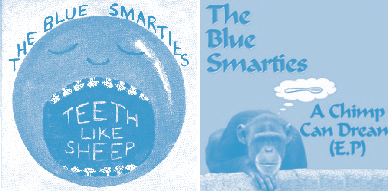
  • Grape Star Records ‘Teeth Like Sheep’ 16 track CD album released in 199
  • Sorted Record ‘A chimp can dream’ 4 track EP 199
  • Sorted Records ‘Nodding Dogs’ 4 track EP 200
  • Sorted records ‘’Left hand side of Egypt’ 3 track vinyl compliation EP (BS has one track on it
  • Sorted records ‘Fruit Tree Feeling’ 13 track CD album 200
  • Sorted Records ‘Havock Junction’ Compilation CD (BS has one track on it) 2001

++ Why did you stop making music as The Blue Smarties? Btw, why did you call the band like that? I just read that the blue smarties have just being reintroduced again last February. Did you miss them?

Communication between Karen and I was never great and eventually dwindled away. I haven’t spoken to her for at least four years and I have no idea what she is up to but with the BS you can never say its over……………….!! We were originally called The Blue Smartie Syndrome in reference to the strange additives they used to put in the blue ones.

++ “Only Smarties have the answer”, so, what’s the answer Andrew?

Spoon-Spurt-Dump.

::::::::::::::::::::::::::::::::::::::::::::::::::::::::::::::::::::::::::::::::::::::::::::::

Listen
The Blue Smarties – I Feel Like Ian Beale

19
Dec

Thanks to Perry Groove for the interview!

++ I’ve googled The Grooveyard and there are almost no results! So I think I should ask the basics, where and when did the band formed? who were The Grooveyard and how did you meet? And why start a band?

First of all i should say that i wasn’t in the band at the beginning or at the end but was in it during the middle section of 2 years and play on all the recordings.

The Grooveyard supported a band i was in at the Clarendon in Hammersmith. in 1986. We had some mutual friends. A few weeks later they asked me to join as drummer which i did as i liked them personally and their music. The gigs could be chaotic but there was loads of energy and improvising. Steve Bennett was on vocals; Justin Spear on bass, guitar and vocals; Mark on guitar and bass; Simon on flute and guitar, Perry Groove on drums. Justin, Mark and Simon would all swap instruments all the time. They were very good musically and all had great characters. We were based in Kinston, we would rehearse in Justin’s attic (Justin’s dad was in the Bonzo Dog Doo-Dah band) There was also a big Brighton connection as Steve and Justin went to college there.

++ Where does the name The Grooveyard comes from?

Grooveyard was just a pun on graveyard.

++ You released a collector item, At Home with the Grooveyard. I guess at the time it wasn’t. How do you feel that the record is sought after and people paying lots of money for it on ebay? How many copies of that 12″ were made?

I had no idea that there was any interest in the band and any people wanted the record ‘At Home’. I have no idea how many copies of “At Home” were pressed. I guess about 1000

++ You released a flexi on the same label where you included the song Summer which is the only one I have ever heard. And I think it’s great! Which bands influenced you at the time? Any favourite ones that you played with at gigs at the time?

All the band were big music fans with a massive range of interests and styles between us all the band though loved Love, The Byrds, West Coast Pop Experimental Band, REM and The Smiths. Other faves at the time were The Chills and McCarthy.

I loved playing live with the band, very entertaining and musical. I was a few years older than them so a sort of father. Gigs that stand out in 1987 are supporting The Wedding Present at Brighton Pavilion (recorded for BBC Sussex). Playing at a sort of happening at the Kew Steam Museum (we just hired it and organised it), hundreds of people, loads of bands and light shows, etc. And supporting The Chills in Brighton.

Oddest gig was supporting Mud in Farnham.

++ Why didn’t you release more records? Do you have any unreleased songs?

We only went into the studio twice in Brixton. We did 3 songs: Summer (ended up on flexi), Peter and Whiskey Whirlpool. Then in Brighton we did the “At Home”. Very odd atmosphere as on way down to record it, Steve and Justin had a horriffic car crash, I think someone was killed, they were really shaken up. We recorded it basically live except for vocals) and everybody kept making mistakes on the first one we did (he said) we all got fed up and it got quicker and quicker! By the time we came to Whiskey whirlpool, we just played it once and that was it.

I have tapes of rehearsals and live gigs but buried away.

++ What happened to the band members after The Grooveyard was over? Were you at all involved in other guitar pop bands before or after?

I have no idea of what the others are doing now. Mark mainly wanted to split the band and it happened in 1988. They reformed with a friend Greavsie on drums a few months later. Then shortly later Mark left and they stayed as fourpiece after that. Rat Scabies managed them for a while and they did record a few demoes including “Speedball”. While they were in Grooveyard, Justin and Greavies were also in a Brighton band ‘Blow up’, they recorded an LP for Creation. I have only been in touch with Justin in the last few years. He does some djing and recently was on Radio London filling in for Danny Baker with Martin Freeman.

I played in loads of bands before and after Grooveyard, most lost in time. Before The Grooveyard I was on The Oddhits and Nantuck Five. And after on Perry Combo, Maybellenes (singer was Wendy may from Boothill Foot-Tappers).

++ What does indiepop mean to you? Do you follow the scene today?

I still love indie-pop but the problem with being my age,most of it sounds generic. It’s hard to have an original sound. That’s why I like Hard-Fi and The Killers.

++ Thanks so much! would you like to add anything else?

You should get in touch with Justin Spear (I most surely will!), he was Mr Grooveyard. Really, he was the bus driver, I was just a passenger and back seat driver for some of the journey.

::::::::::::::::::::::::::::::::::::::::::::::::::::::::::::::::::::::::::::::::::::::::::::::

Listen
The Grooveyard -Summer

17
Dec

Thanks to Steve King for the interview!

++ You only released the “That’s Where Caroline Lives” single. With such a strong debut, why didn’t The Candy Darlings release any more songs?

– Well basically, Little Stu, who ran Teatime Records (and was the singer in Mousefolk) offered to release a single, which he did and then didn’t offer to do another one – and we weren’t exactly inundated with other offers. Essentially, being in a band was fun for us and I don’t think we ever viewed it as having any particluar longevity but we really wanted to make a record – mainly just to have something tangible to prove we had actually existed. I remember just staring at the sleeve (we were adamant with Stu that we wanted a proper sleeve rather than a plastic bag) – amazed that we’d actually made this thing. And when it got reviewed in the NME (they thought it was rubbish – particlulary my singing) that was all we were really after. After that, we didn’t really have the impetus to chase after a follow-up, though if anyone had offered, I’m sure we’d have taken them up on it.

++ It also strikes me that the band formed in 1985 and the debut didn’t come out till 1990. Why was that? What happened in between those years?

To be honest, it took us five years to achieve the required basic level of competence on our chosen instruments. In between, we played the odd gig, recorded 4 track demo tapes (largely for our own amusement) and made each other laugh.

++ How did the band start? I read that there were 4 Candy Darlings in the beginning.

We were friends at the same school (a posh one in Bristol) who all liked the same sort of music. If I may be permitted a digression here, I still remember my first interaction with Dom. In my first year at school, I loved Adam and the Ants and, in the custom of the day, had drawn a Warrior Ant logo on my school folder. This attracted Dom’s attention and (much to his evident delight) afforded him the opportunity to belittle the fact that I was unaware that the Ants had actually released another album before Kings of the Wild Frontier. This competitive musical one-upmanship did, however, set the tone for our entire 25 (and counting) year realtionship.

Anyway, the 4 of us (including another friend, Jerry) just decided we’d form a band and sort of fell into roles by default. Dom actually had a guitar on which he has mastered at least 4 chords – so he was the guitarist. Chris also had a guitar, on which he hadn’t mastered any chords – so he played the fattest string as a bass. I’m not sure how Jerry ended up being the drummer as I think we clubbed together for a second-hand snare but he could make a reasonable fist of keeping time. I had nothing and I couldn’t really sing but I was their mate so I was in. In the beginning, Dom and I both “sang” but I was a bit of a spare part really. In fact, in the middle of the first recording we made of ourselves, we captured Dom’s mum asking the tricky question, “so what do you do Steve?”. Anyway, we were a ‘band’ and that’s all we cared about. We lost Jerry when we all left school. Dom, Chris and I all kept in contact but, for some reason, Jerry didn’t. So we pooled our grant cheques and bought a drum machine.

++ Where does the name Candy Darlings come from?

We loved the Velvet Underground and extensive background reading lead us to Candy Darling. It also had the word ‘Candy’ in it, which fitted nicely with the JAMC orthodoxy of the mid-eighties.

++ During those years Bristol had become home of Sarah. How important was the influence of the label on the city scene? Was it inspiring at all for you?

We all bought the early records on Sarah but a greater influence on what actually went on in Bristol was probably Subway. Martin Whitehead and Rocker were much more active in terms of organising things and putting bands on. In the end, records are great but actually having somewhere to go, drink and watch bands play was much more fun than sitting at home and playing 7″s. The first Brighter single was the end of religiously buying Sarah records for me. I remember playing it and just thinking that they were a parody of a generic Sarah band – so that was it, apart from Orchids records (because the Orchids were great).

++ Did you have any favourite venue in town?

The Tropic Club. It was a fantastic place, legendary on the Bristol indie scene. we had many great nights drinking, dancing and (in Dom’s case at least) puking in there. Also the place where we played our first real gig – supporting the Fizzbombs.

++ Did you play many gigs? Which bands were your favourites that you played with?

Given that we weren’t exactly proficient musicians (and that we had to re-load the drum machine by cassette after every 4 songs) playing live was something of a fraught affair and we rarely ventured beyond the Bristol borders (and our sets never lasted more than 8 songs). Our one ‘tour’ consisted of two consecutive nights supporting Mousefolk in Nottingham and Goole. Nottingham was kinda OK, but Chris wanted to get back to Reading University the next day to study for an exam so wasn’t drinking, whilst Dom and I were, which made our performance somewhat disjointed (and probably explains why Chris got a good degree and is now Head of Money at a major high street bank and Dom and I didn’t and aren’t). Whilst Chris headed back down the motorway to further his academic career, Dom, myself and all of Mousefolk stayed at the drummer (I think) out of the Fat Tulips’ parents’ house – where I rather let myself down by making some lewd remarks about sex involving the wearing of a Mousefolk t-shirt to the drummer’s girlfriend who may, or may not, also have been in the Fat Tulips but, in any event, was wearing a Mousefolk t-shirt. The next day we headed up to Goole, Dom and I showing Mousefolk’s bass player Phil the basslines to a handful of our songs in the back of the Transit van we were all travelling in. I believe that our performances that night constituted the first (and probably the last) indie-pop gig staged at the Violent Bikers Arms in Goole. Sparsely furnished and brightly lit, it didn’t give off the warmest of vibes nor did our first interaction with the propriator – “how long do you play for?” he demanded. “What’s normal?” we queried. “Most bands hold down about 2 hours” he informed us. “Oh dear”, we thought. In front of the small, yet menacing collection of bikers and psychotic locals that constitued our audience that night, calling ourselves the Candy Darlings suddenly felt ineffably twee, and asking for a punch in the face, so we announced ourselves as “Axe of Fury”, played the 4 songs we’d taught Phil and an endurance testing 10 minute version of Pablo Picasso and ran for the door.

++ You were rejected by Sarah for being too challenging and avant-garde. That’s unbelievable!! I think your music would have perfectly fitted in their catalog. How did this happen? Maybe you didn’t send Caroline to them?

Unfortunately, we did send Caroline to them. In fact we sent them pretty much everything we recorded and our rejection by Sarah was the most painful chapter in the Candy Darlings story. Matt and Clare had always been gently encouraging, always writing back in response to our tapes (thinking about it now, this must have been such a pain for them as every pointless little indie band in the country – and I include ourselves in this – must’ve been raining tapes in on them) saying mildly positive things but without actually saying “and we’d like you to release a record on our prestigious label, please”. We held a band meeting wherein it was decided that we would (I will swear to this day that I was against it but was out-voted) write and ask them straight if they would, please, put out a Candy Darlings single. No, it turned out, they wouldn’t. In the end, they didn’t actually think we were that good.

++ Your only single came out on a Bristol label, Teatime Records, home of great acts like Mousefolk and The Driscolls. How did your songs end up being released by them? How many records were pressed? Where was it recorded? The quality is much better than the other songs I’ve heard from you (especially the two other ones that were released on tape compilations).

Fortunately little Stu wanted to branch out from just releasing Mousefolk records and offered to release one of ours. We recorded it at a proper studio in 2 days – the first time we’d ever been in one and we didn’t really know what we were doing or how to ask for the sounds we wanted. We all thought the songs sounded OK but Chris’ bass got completely lost in the mix. 1000 were pressed and I think most of them sold (though at least a few were made into handy ash-trays). Everything else we recorded was for our own amusement on a variety of cheap 4-track cassette machines.

Interesting fact: my brother James was briefly a member of the Driscolls as second guitarist. See him in action on You Tube (search “Driscolls Brittle Beautiful”) – he’s the one with the floppy fringe.

++ Who is the girl doing backing vocals on Caroline? Who wrote the songs usually in the Candy Darlings? I really enjoy the lyrics, and the guitars on the single are precious!

The girl doing the backing vocals on Caroline is, actually, Caroline – who was Chris’ girlfriend at the time. The initial basis of a song was usually written by either Dom or I and then we worked it up into something passable between the 3 of us. I think I may have mean-spiritedly wanted “Caroline” credited to just me on the record but conceded to a more democratic “King, Hall, Strange”. I don’t think Coldplay are planning a cover version so we won’t have to worry about arguing over royalties. Actually, I wanted ‘Bright New Morning’ to be the a-side but, again, I got out-voted (looking back, I seemed to get out-voted a lot).

++ What were you doing back then? were you pop fans back then? Did you follow any bands? maybe wrote a zine? going to university?

We were doing school and university. We liked a lot of bands but I recall that, for some reason, we all had a particular fondness for the Three Johns.

++ The last years of the Candy Darlings see the band changing their musical direction towards indie-dance. Why was the main reason for that? Did you all feel comfortable making that music?

This was all Dom’s idea (I was probaly out-voted again somewhere along the line). It was decided that we needed a new singer (don’t think I was even permitted a vote on that one) and that we needed to get hip to that funky drummer back beat. We quite enjoyed doing it but when Dom left to move to London, Chris and I formed a new line-up and dropped the ‘dance element’ like a sack of sh!t.

++ On Last.fm there are many unreleased songs, many of them great jangle tracks. Will you ever release them? A retrospective album is due!

I don’t think the world is clamouring for a Candy Darlings retrospective. No-one’s ever shown any interest in doing one and, as you point out, most of the recordings (other than the single) are really low-fi as they were recorded on cassette.

++ How do you see the indiepop scene today? Any big differences to the one of the late 80s? Any similarities?

To be honest, I don’t think any of us are really aware of that scene these days. I go to the very occasional gig when I’m up in London but we’ve all got families these days and that’s where all the time goes. So I can’t really comment on any differences but I do know that the scene in the late eighties was loads of fun and that the 3 of us had such a laugh being in the Candy Darlings. That’s really my over-riding memory of being in the band – p!ssing myself laughing with my two best mates.

::::::::::::::::::::::::::::::::::::::::::::::::::::::::::::::::::::::::::::::::::::::::::::::

Listen
Candy Darlings – That’s Where Caroline Lives

15
Dec

Thanks to Torquil MacLeod for the interview!

++ On Twee.net it lists that you released a 7″ called Arse Parsley Correcto. It even says Stephen Pastel appears on the B side! I’ve never heard of it or even come across with it. In any other Reserve discography it doesn’t appear. Does this really exist?

Mmm, yes, Arse Parsley Correcto.   What can I say?  It may exist, in much the same way as Bigfoot may exist.  Alternatively, it may have its roots in a late-night visit to an internet cafe after one cocktail too many in a small mountain town in Panama in 2000.  I’m afraid that I couldn’t possibly say.

++ How did the band meet up? As far as I know Reserve was mainly a solo project when it started, right?

Well I started writing songs in that sort of style, with the idea of putting a band together, in 1985.  I’d been playing in other bands dating back to 1979, but this was my first stab at being principal songwriter and singer.  Johnny Johnson was looking for musicians at the same time to form what would end up being the Siddeleys – I was hanging out with her and helping get her songs down on tape – so I used the same methods to get people for my band: ads in the Rough Trade shop in Notting Hill and approaching people who looked right at gigs.  So Reserve was never meant to be a solo project, although obviously a lot of it involved me sitting at home writing and recording songs.  The first couple of line-ups I assembled were pretty hopeless, but then I bumped into Ian Gregg at a Microdisney gig and Simon Armstrong at a 1000 Violins gig and recruited them on guitar and bass respectively.  I also stumbled across Phil Powell somewhere and persuaded him to hit a couple of drums.  So that was the first line-up to perform in public.

++ The first show was supporting The Wishing Stones in 1986. What memories bring that gig to you?

That was in a room above a pub in King’s Cross in London.  I think it was in September.  I remember it as being a bit of a shambles, but a lot of the bands around then were a bit of a shambles – more to do with a lack of talent than a deliberate aesthetic.  I was just singing at this stage, not playing guitar as well, and I remember feeling rather naked without a guitar to hide behind.  The audience seemed quite enthusiastic, but then most of them were our friends.  A tape did exist but its whereabouts now is anybody’s guess.

++ After that gig two of the members left Reserve to form The James Dean Driving Experience. Why did this happen? Was it a hard decision to keep playing under the name Reserve?

Well, that’s not quite how it happened.  I think that line-up played another couple of gigs before Ian announced that he was leaving to form the James Dean Driving Experience.  This was about two days before we were due to go into the studio to record a demo.  I was a bit pissed off to be honest, but mainly because Ian had come up with a better name for his band than I had for mine.  So Simon, Phil and I went off to the studio and I played guitar instead of Ian.  Phil left to join Ian in the JDDE after I asked him if he could learn to play drums properly.  So Simon brought his multi-talented Bob bandmate Richard Blackborow in to play drums (properly) and that line-up lasted for nearly a year.  As for keeping the name Reserve, it was still me singing my songs, so as far as I was concerned it was still Reserve.  Simon and Richard had their own band which was, naturally, their first priority, but it was great having them along for the ride.

++ Oh yeah, why did you call the band “Reserve”?

Thinking up band names can be such a pain.  I knew I didn’t want a name that began with ‘The’.  At one point Captain Lust & The Pirate Women was a possibility – I saw that outside a porno cinema at Piccadilly Circus.  But it didn’t seem quite right for the indie ’scene’.  I’m not sure where Reserve came from – I think I quite liked the ambiguity of ‘reserve’ as in holding something back and ‘reserve’ as in a place where something precious or rare is kept.  To be honest I think it’s a bit of a naff name.  Oh well.

++ Back to 1987, the band now counts with Richard from Bob and the flexi “The Sun Slid Down Behind the Tower” is released! That’s a fantastic song Torquil! And I have to say that this is my favourite version of it. Even more than the polished version on the 12″. How did you come up with such a good tune, full of ramshackling guitars and and that solo (it’s glorious! isn’t it?)!!!? Is it the Big Ben tower by the way?

Wow!  Thanks for your enthusiasm – it’s much appreciated.  The version on the flexi is from a session recorded at the Bob studio out in the Somerset countryside in April 1987, which is probably my favourite of the five Reserve sessions that exist.  We recorded seven songs – Simon on bass and vocals, Richard on drums and vocals and me on guitar and vocals.  The arrangement of ‘The Sun Slid Down Behind The Tower’ is pretty much identical to the home demo which I’d recorded either late ‘86 or early ‘87, including the guitar solo which I wanted to have that West Coast, Byrds sort of feel.  As regards how I came up with it, it’s just that thing of messing around with a guitar at home, coming up with some chords that sound good, humming a tune over the top and suddenly there’s the song.  You record it, listen to it and you’re not quite sure where it all came from.  I’m singing about the tower of All Saints Church in Notting Hill – I spent several afternoons sitting on a nearby roof in the summer of 1984 in a ‘cheap wine and lipstick haze’.

++ Where you a fan of the Sha La La label before releasing the flexi? How did this release happen? What did Matt told to you?

To be honest I’d never heard of Sha La La before the flexi came out.  I was never much of a fan of flexis – they seemed so disposable and always sounded crap.  Having said that, it was obviously great to have something released and we even got a very enthusiastic review in a magazine called Record Mirror  with a picture and everything, just below a piece about the first single by a band called The Stone Roses.  I wonder what happened to them.  I never had any contact with Matt, all the business was conducted by the mighty David Payne of Troutfishing In Leytonstone fame.  From what I gather, Matt didn’t like The Siddeleys or Reserve and was very reluctant to release the flexi in the first place which is why there were only 1000 pressed compared to 2000 for all the other Sha La La releases.  Which is great because it means it’s rarer and worth more than any of the others.  Thanks Matt.

++ This flexi was released along the “Troutfishing in Leytonstone” fanzine. How involved were you in the fanzine culture?

I loved fanzines.  Troutfishing In Leytonstone was a particularly fine one, but I also have fond memories of Rumbledethump which was written by Sharon from the Hobgoblins and The Legend’s fanzine (can’t remember what it was called).  There was something genuinely exciting about these little bits of paper which were soaked with love and enthusiasm.  I have to confess that I myself produced a fanzine with Johnny Johnson.  It was called Blah de Blah and was absolute rubbish.  There wasn’t a single interview in it, just blasts of ill-informed opinion, a few pictures stolen from kids’ magazines and a very poor short story (mine).  In its favour, it was printed in three colours – white, red and green – which was probably the best thing about it.  It was the result of a Faustian pact with the government – we got paid for a year to produce the shoddiest fanzine I’ve ever seen.  I blame Thatcher.

++ Did it ever go through your mind that 20 years from then, all this music will be almost legendary? Did you feel there was a scene happening at the time?

Yes, there was a real sense of scene.  Certainly in London anyway.  I was going to about three gigs a week and seeing the same people there – it was great.  Much fun was had.  Having said that, I think some people were getting a bit too overexcited about the importance of what was happening and have subsequently mythologised it to a faintly ridiculous degree.  At the time there was this whole ‘once every decade’ notion – in 1957 rock and roll had exploded, 1967 was the summer of love, 1977 saw punk’s bleak winter…  So there was this bunch of badly dressed kids who couldn’t dance and thought that Morrissey was some kind of Messiah who decided that a handful of bands who couldn’t play very well and no one had heard of were the equivalent in 1987.  Yes, it was a breakthrough year, but in house music, not British indiepop.

++ Two Hearts Beat in a Hole. Your 12″ on Sombrero, that sells for very high prices on eBay! Was this single the biggest highlight of Reserve? Any anecdotes while recording this record?

It’s crazy isn’t it?  People are paying $100+ for this little piece of vinyl.  There are 2000 of them out there so if you want one you can probably get one.  I lost mine so I had to steal back the one I’d given to my mum.  Obviously it was absolutely thrilling to finally have a proper record released.  I would wander down to the Virgin Megastore in London’s Oxford Street and gaze with wonder at the Reserve section, nestling between REO Speedwagon and Revolting Cocks.  What more could a boy want?  As for the record itself – hmmmmmm.  As I said earlier, the best stuff we ever recorded was in the beautiful surroundings of Richard Blackborow’s 8 track studio in the picturesque village of Banwell in the weird and wonderful county of Somerset.  Going into a 16 track studio situated in an industrial estate in west London was a bit of a different matter.  By this time the line-up of the band had changed completely – me: guitar and vocals, Jason Ellis: bass and vocals, Michael Harris: guitar and vocals, Jonathan Sim: drums.  Simon and Richard had made it clear that, much as they enjoyed playing music with me, they really had to concentrate all their energies on Bob.  To their great credit they carried on playing in Reserve until I’d found replacements.  Jonathan came in first towards the end of 1987.  At this stage David Payne had temporarily joined the band, playing a rather handsome Hohner semi-acoustic.  It was thanks to Alan Kingdom from the Siddeleys that Jason and Michael came on board.  He was sharing a house with them and suggested that they could be what I was looking for.  They certainly were.  I think that playing with Jonathan, Jason and Michael was the most fun I’ve ever had playing with other musicians.  Anyway, back to June 1988 and Triple X Studios.  We were recording an EP to be released on David Payne’s Sombrero Records label.  Initially ‘Cut You Down’ was going to be the A side, but after recording some demos in October 1987 I decided that ‘Two Hearts Beat In A Hole’ sounded stronger.  The record was produced by Steve Parker who I’d known for several years and worked with before.  He’d worked with The Fall, Wire and Microdisney among many others.  He was mixing some songs for the Rolling Stones when we recorded the single and was generous enough to take three days off and lend us his services for free.   So what could possibly go wrong?  Pretty much everything.  I didn’t know what I wanted the record to sound like.  Or, at least, not in a way that I could communicate to Steve.  He did the best that he could, but I think that the result sounds puny and antiseptic.  ‘Two Hearts Beat In A Hole’ wasn’t a good choice for the A side – it doesn’t have a proper chorus or anything resembling a hook.  The vocals are feeble and underpowered throughout the record.  Guitars sound awful – the guitar solo on the A side is a Telecaster going through a Marshall stack but it sounds like a wasp farting in a jar.  Again, I have to say that none of this is Steve’s fault – this is the man who produced ‘How I Wrote Elastic Man’ – I simply didn’t have a sufficiently articulate idea of how I wanted the record to sound, or sufficient studio experience to impose any character on the result.  But, hey, it got played by John Peel, so who cares?

++ How did a guitar pop band managed to live in London during those years? Did gigs pay good or did you had to have different jobs?

Without going into a lengthy exposition of British economic policy in the 1980s,  suffice to say that the Thatcher government decided that the best way to spend the once-in-a-lifetime revenue from British oil was to pay a record amount of people not to work.  While this brought real hardship to countless families who had depended on coal, steel and shipbuilding for their livelihoods, for feckless young twats like myself who just wanted to stay in bed till lunchtime and strum a guitar, it meant that  British taxpayers were co-opted into subsidising some very average indie bands for a decade.  Once again, I blame Thatcher.  Gigs paid very badly – the low point of what I laughingly refer to as my musical career occurred downstairs at the Clarendon Ballroom in Hammersmith when I was paid 20 pence (about 30 cents) to split between the four of us.  It would have been marginally less insulting not to have been paid at all.  Needless to say, I pocketed the money and said nothing to the others.

++ What was your favorite spot in London during those years? Were would you see the Reserve gang hanging out a Saturday night?

As I didn’t have a job, life was one long weekend and every night was Saturday night.  Bay 63 in Notting Hill had loads of great bands on.  The Enterprise in Camden Town.  The White Horse in Brixton. Some other places which I can’t remember the names of.  Essentially I went to loads of gigs.  And when I wasn’t at gigs I was up to all sorts of capers with Simon and Richard in Finsbury Park (the area of north London, not the actual park).  I blame the cheap sherry.  And Thatcher.

++ You recorded demos for a second single. Will they ever pop up in some kind of form? Why wasn’t that single released? I can’t believe that no label was interested back then! Was Butcher’s Daughter part of that demo?

Yes, ‘Butcher’s Daughter’ was supposed to be the A side of our second single. If you want to know what it sounds like you can find it on The Sound of Leamington Spa Vol 2.   We recorded the three songs we had lined up for the next record at Grant Lyons’s studio in Brighton.  He’d already released a version of ‘Last Train Home’ on his Hoopla  compilation.  The other two songs were ‘What People Say’ and ‘Postcard From Paradise’.  Sombrero had kind of folded by this stage, so I sent the demo round to some other labels but there wasn’t any interest.  In retrospect, I think the band might have been more successful if we’d had a manager because I really hated that side of it – phoning round to get gigs and that sort of thing.  But, y’know, I don’t think the destiny of Western cultural history has been too badly derailed by the failure of Reserve to become an over-arching, global force.

++ Then the band split up. What happened? What did Torquil MacLeod do during those years before forming The Atom Miksa Reservation?

OK, so it’s 1990.  No one’s interested in releasing ‘Butcher’s Daughter’ and I’ve moved from London down to Brighton so that I can carry on being a drain on the state’s  resources while watching the tide go in and out.  I did manage to drag myself back up to London for the occasional rehearsal and gig up until the summer, but then it kind of fizzled out.  It was exactly how I didn’t want the band to end, but that’s the way things go, I guess.   That same year I started working in radio down in Brighton and by 1993 I was a radio producer at the BBC in London.  And that, dear reader, is what I’ve been doing ever since.  I won the Sony Gold award for Best Speech Radio Programme of the year in May 2008 – hoorah for me!  Of course, music being like some kind of congenital disease, I carried on making sounds in the back room, like some weird, etiolated plant, in the intervening years.  And then, in the summer of 2007, I treated myself to a 16 track digital workstation and discovered this curious thing on the internet called MySpace and that’s how The Atom Miksa Reservation came into being.  Through the wonders of technology it transpires that there are a handful of people around the world who quite like what  I’m doing, which, frankly, makes it all worthwhile.

++ Anything else you’d like to say to the popkids out there?

Ummm…music is a truly wonderful thing.  It’s been there for me ever since Bowie,T.Rex, Slade and the Sweet burst upon my consciousness in the early 70s.  It still has the power to move me, to astonish me and to comfort me…and make me dance round the kitchen like someone demented.  The notion that at some point in my life I may have made a piece of music which has made just one person out there feel a little bit better for 3 minutes in their life is a very humbling thought.   Oh, and Roque, I think what you’re doing with Cloudberry is fantastic and I’m enormously touched and grateful for your support.  Thanks.

::::::::::::::::::::::::::::::::::::::::::::::::::::::::::::::::::::::::::::::::::::::::::::::

Listen

Reserve – The Sun Slid Down Behind the Tower (flexi version)

13
Dec

Thanks to Alan Fairnie for the interview!

* Alan: Just a short disclaimer – these are my thoughts on the whole thing – Paul and Ian would probably have a different take on it.

++ The band started in 1985 and lasted till 1993, right? How did it start? How did you meet Ian? Why was the main reason for you to have a band with a who gives a fuck attitude? I guess Scunthorpe wasn’t much of a help?

We’d always been into independent music, following bands who weren’t the mainstream and I guess that inspired us to pick up guitars, make a noise, generally try something. You have to remember that the mid to late 1980s was about the difference between independent music and mainstream stuff, there certainly wasn’t the crossover at that time. So labels like Rough Trade, Beggars Banquet and Creation seemed to be offering an alternative. I was into the usual fayre, The Smiths, James, The Fall [actually we both liked them] and my brother was coming at it from a more punk side, he was into the Birthday Party, The Cure, JAMC and stuff. We just decided that one year we wanted a bass guitar and a six string one – luckily our parents managed to get them – real basic ones out of a catalogue – but that was the catalyst for it. I also remember being really adamant that I wouldn’t learn to play any cover versions – that sounds a bit lame now – but I was an opinionated youth.

++ Was it your first band? Which bands influenced The Williams you’d say?

To be honest it wasn’t, we had a band called ‘The Upstairs Room’ for a little bit – it was all new order/ Bunnymen/ Cure influenced – it was terrible really – but out of that merged The Williams. I ‘d got friendly with a mate from school [Ian Cummings] who was into the same stuff as me and he had a bass guitar, so Paul [my brother] got hold of a cheap drum kit and we started putting sounds together. I guess by this time we had decided that we wanted to try and play some gigs and stuff. We were also part of a wider indie scene that congregated around the Scunthorpe Baths Hall and Bentleys, a local public house. So what was influencing us at that time, the usual stuff The Smiths, JAMC, The Fall, sixties stuff like the Bryds and the Stones. There was the indie scene itself as well, flexis from Sha La La and the other fanzines at the time, Lazy records artists like the valentines and the primitives. It was all very tribal, you know you can’t like the flatmates etc and our loyalties ran very deep at the time. I put it down to the innocence of youth, Paul puts it down to me just being a prick.

++ I love the idea of stand up drums. If I ever had a band I would have the same, it seems more energetic, more fun, with much more attitude, also it always reminds me The Shop Assistants. Why did you go that way? Any special reason?

Stand up drums was Paul’s thing, obviously all indie kids were required to watch early Psychocandy JAMC performances with Gillespie giving it large on the two piece and again we all had the velvets first album, Mo Tucker being an idol an all that. However, I actually think it was because before we had a kit we borrowed a snare drum, so Paul just improvised with that and some cardboard boxes. We had heard that Buddy Holly used to record like that somewhere. We tried working with a full kit but it was a right hassle to get to rehearsal spaces with it all – so it was kept to minimum. He did add a cymbal at some point. I do remember when the scream first saw us at the Hull Adelphi that Bobby thought Paul was one of the coolest drummers he’d ever seen with two drums. He could get some rhythm going – used to end up blistered after every gig. And yes I guess it did have that anti-muso thing going on. Again at that time in our local music shop you could pick up a free paper about the music scene and it was all interviews with fucking metal heads, gutarists in bands called ‘It Bites’ and drummers with twenty five piece kits, we were both anti all that and basic chancers – it was the attitude that kept us going. We weren’t liked. Or at least we wanted to be disliked – I think our music helped in that respect. It was basic at the beginning.

++ What was it like to have a band back then? Did you feel there was a guitar pop, c86, community happening, or was it more of a myth we have today?

C86 – I’m not sure we even remember it coming out with the NME to be honest. I was a fanzine writer – inspired by the great and the good – so I knew of these emerging indie bands and there were some excellent ones. But whether they should be seen as a scene is an odd one – we wanted authentic music – they had things in common. We didn’t want to be pop stars [that sadly came later] There was just a network of places to play and people with a common philosophy. I mean to me, and I can’t speak for the rest of these bands or even the members of my band, but it was about an anti-capitalism thing. I was political – I hated the way music had become homogenised and generic – it’s naïve but at that time I thought I was doing something to challenge that. I remember seeing McCarthy and thinking that it was possible to do both. Didn’t impact on our music – or lyrics – but it was there in spirit. Having a band back then is the same as having a band right now – it feels like you can take any fucker on – we were an army- you know what I mean. We’d get into scrapes just because we felt were right about stuff. It was possibilities – it always is when you’re growing up in a small town.

++ Your first gig happened in 1987, 2 years after formed. What are your memories from that August 1987? Who did you play with?

Our first gig was a three song set at the local Battle of the Bands – first heat – first on – it went remarkably well – I was using this thin Kay guitar that I was able to get feedback from for the final number. I remember the review in the local free newspaper – it compared us to the JAMC and the Wedding Present. We went around seething because we hated David Gedge – you see what I mean – it was all about having opinions – taking sides. Very silly really. However, I remember thinking that I quite enjoyed it up on the stage – so we played a gig at Bentleys [the local pub] pretty soon after – utter amateur chaos. We were being heckled from beginning to end – a red rag to a bull really. I do remember one of the The Hoverchairs [another moderately successful Scunthorpe group – who we thought was made up of old men] shouting out when my string broke to ‘take them all off’ at the time it spurred me on in a psychotic rage to be that little bit louder that little bit more aggressive – now I think it’s a funny heckle.

++ In your little bio you say you grew up on Sha La La flexis. So you were total popkids! What was your favourite Sha La La flexi? Were you a fan of Are You Scared to Be Happy as well?

I have to be careful here – because I reckon I’m the indie kid – Paul and Ian couldn’t stand half the twee stuff I was into. I remember getting all the AYSTGH fanzines – it was like having the manual to creating the best indie band/label ever. I was also getting Trout Fishing in Leystone, Simply Thrilled, Sowing Seeds, Woosh all sorts of stuff – you’d buy them at gigs – 50p and a free flexi – how could that be wrong? But pop to us was the beach boys, The Rolling Stones, Joy Division, the velvets, dinosaur, the valentines, the ronettes etc. It wasn’t just these bands on Sha La La – I think that gives it context but it wasn’t the only thing we were grooving to. You know we had the first Beasties album and Public Enemy and stuff – we still made indie music though. If I had to name my favourite sha la la – I was well into the baby Lemonade one  and the clouds [a seriously underrated band if there ever was one] – you see now you’ve got me thinking about them – Remember Fun, Emily, the sea urchins all were brilliant. They just summed up stuff at the time.

++ Get That Anorak Off was a zine you put out. I’ve never seen it, how many issued did you do? What was the best of being involved with the fanzine culture? Do you think blogs can act as a digital fanzine or it would never achieve the charm of a typewritten pamphlet?

I started GTAO when I was 15 – we’d been following The Primitives around the north and I wanted to show off that we kind of knew them – so I just wrote up the experience, I remember Paul did a review of the fall’s new album and there was stuff about other bands in there – I got it photocopied in the steelworks office where my dad worked – he did it when the foreman wasn’t there and then tried selling it round Scunthorpe and gigs. It sold – so I did another one – this was more indie based – I started interviewing more bands, I think issue 2 had the brilliant corners, the chesterfields, razorcuts etc in it. It came with a crayoned cover sold out fairly quickly and basically I kept producing them until I started university. The final one [I think there were five in all] was finished at university [it had dinosaur/ spacemen 3/ the telescopes/ primal scream in it] and by then I was drifting into the whole acid house culture and the indie scene felt a little backward looking – I know now it wasn’t but I was getting my energy from other sources – so fanzine culture wasn’t a big part of it.

However, I think the whole thing about fanzines and the culture that goes with it was/ is the sense that you can put your thoughts down – you don’t mediate the same way as a newspaper – you have values and ideologies but they really are your own. And it’s mad that you end up getting letters from Singapore or Australia from like minded people who are into the same scene – it was about having a voice and during that period I feel I could express it – on the most part in a clumsy, inarticulate manner – but it was my voice nonetheless.

In that way I think blogging is the way forward, I’m not always sure that it reaches the audience in the same way – but young kids are fairly hip and tell each other about what’s going on all the time. You know I’m the paper generation but the blogging community is keeping that independent spirit alive  – more power to it.

++ You released a split flexi with Esmerelda’s Kite that came with the Shoot The Tulips zine. I read this was the best selling of them, 800 copies. It even got airplay by John Peel! Was that the biggest highlight of The Williams? How did you end up on this flexi?

The flexi was a good thing – recorded on the strangest 4-track recorder in our bedroom – I remember that I’d met Jo in Leeds- she sold me her fanzine and introduced me to pale saints – we hit it off and discussed the possibility of doing a joint flexi together. Suffice to say my band was going on it – so in some ways it was a vanity press sort of thing. She knew a band from Leeds called Esmerelda’s Kite – of whom the singer would go on to become The Gentle Despite who released some stuff on Sarah records. I think it cost a bit – but we made it back from the sales – she sold out and so did I – it was bizarre – I’ve still got a couple left but generally that flexi is out there.

Jo hated the fact that I called the label Sunshine [in retrospect she was right] and when we got it back from the manufacturers it had three tracks as opposed to the two listed – so it was even better value for money. The John Peel thing was a highlight – Jo rang and said he was going to play the flexi – and we thought he’d play Esmerelda’s Kite – it sounded more garage etc. but we had forgotten that he had a son named William. I remember him introducing it and Paul and I just trying to tape it – it was weird to hear it on the radio. After that it got picked up by some other European stations and even ended up in some charts. Having John Peel play your record means he had to listen to it – make a decision and programme it – it was John Peel do you know what I mean – I listened to him every night. Still he never gave us a session – despite the hundred of tapes we gave him.

++ Did you had any other releases? I can’t find a full discography? Maybe some tape appearances?

To be honest I’m not sure – we gave out our demo tapes to so many people and I think we came out on various tape compilations – who knows. We actually tried to get Firestation to put out ‘Still Keep Coming’ or ‘Lose myself in you’ but they just wanted the flexi and we only had a shit tape of it. It sounds bloody awful on the Leamington Spa CD.

++ You went into a six day tour with Primal Scream, when they were still good, what do you think happened to them? Why did they went into the dark side of music?!

The Scream dates were the most enlightening nights of my life when it comes to music – we had managed to convince the Adelphi to put us on as support. You know, that to us was an achievement – but after we’d finished the whole fucking Scream had been watching so they invited us to come down to Sheffield the next night and just put us on the bill. We used their instruments and I broke the pick up on Throb’s Les Paul – he just thought it was rock n roll – I was shitting myself. Good bloke – very good bloke. And it kind of spiralled from there – the thing is what people might not know is that the Scream are the most open, honest and genuine rock n roll band you’ll ever meet. You know I was just 18 and Andrew Innes and Bobby Gillespie would be giving you this insight into music that you couldn’t find in Scunthorpe – Innes was like get some Sly Stone in your collection. They just didn’t judge and had this raw political edge. It was an MC5 thing going on – we were all learning.  And then it was just hanging out for a long time with them, you know the whole Screamadelica thing, Weatherall , Alex Patterson, Nightingale, Douglas from the JAMC videoing all kinds of hedonism. Absolute mayhem. So to me The Scream were never this ‘indie – jangly’ thing – and to be honest I didn’t think we were either.

++ The Williams also played with The Pale Saints, The Telescopes, The Sainsburys, St. Christopher, Sea Urchins and many more. Which was your favourite gig and why? What was the best of being part of The Williams?

This could go on forever, all the gigs were good, we were generally mates with the bands so it felt good just playing a set and then watching theirs. I wish we had stuck to playing the same set – we wrote far too much and played it infrequently – it’s a wonder that we had any fans – we used to have a new set every week. I remember the Sea Urchins in Deptford – I emailed James the other month and he replied saying that they had wanted to put out one of our tunes – I couldn’t even remember that. So I guess it tells you about the state we used to play in – once with Emily I just kept falling off the stage and then I lost it blamed everyone but myself for the thing falling apart. Meanwhile Paul and the rest of Emily are robbing the bar – indie kids had attitude back then. So it’s hard to pinpoint a favourite – it was different every time. And the best part of being in The Williams was just making music – Paul and Ian were a fucking revelation – when we were on it we came up with the goods. Not bad for a bunch of amateurs.

++ Would you go to pop gigs as fans at all? I guess you didn’t get many at Scunthorpe?

We went to gigs all the time – I guess you do when you’ve no responsibilities and money to burn [well we never had money to burn – but we got around] I was also putting gigs on in Scunthorpe – so I brought Pale Saints there just after they’d been signed to 4AD – the crowd didn’t have a clue – they played a continuous set – genius. The Applicants played, I think that’s how Rob got involved.

++ Rob Dillam from Adorable joined the band for a while. How did that work out? Was him an influence into the latter change of sound of The Williams? That of a more noisy, more shoegazy, guitar sound

Rob wrote me a letter – drove all the way from Coventry to Hull and leant me a Fender Jaguar for the night – he was a star I’m telling you. And it just came to be that he joined the group. We had been going in the noise direction pretty much straight after the flexi came out – he just made it even more brutal. He had money you see – shit loads of pedals and amps and stuff. He just made a racket in the back. I think he should have pushed himself more into it – but then he had to deal with us control freaks – no wonder he joined Adorable. And then he goes and gets signed to Creation.

++ Why did you call it a day in 1993?

I think calling it a day doesn’t really explain how the band mutated from this ‘indie’ thing into the sprawling beast that was Superelectric. We’d kind of gravitated to the dance arena [hadn’t everyone gone baggy?] but we were listening to a whole heap of different sounds, The Beach Boys, the Beasties, Warp Records stuff, The World of Twist, obscure 1960s stuff and the notion of C86/ Twee guitars was restrictive in a way – you know, you couldn’t change – at least we thought it was restrictive. Looking back it wasn’t but we tended to alienate ourselves from just about everything. Paul moved over to programming and using analogue keyboards and stuff and Ian started developing a more fluid bass approach. So the electrics were born – I guess The Williams seemed like a generic indie name – I don’t know if that was the right move but that’s what we did. Through the Scream we would send tapes to Tim Abbott and it was all promises and favours and maybes and will try to get this and that – basically everyone was waiting to see what would sell. We kept sending the demos to him – they liked them – I tried to get the band to move to London – that didn’t happen – so we were stagnating. Oasis came along and Creation’s focus shifted – we were pretty much left high and dry. After that Ian moved on – we played in a number of formations but it all fell apart. We’re all back in touch now – we’re all making music- just not together. I think the spirit of superelectric lives on somewhere in all of us [ the band – not the world]

++ Anything else you’d like to add?

It was good while it lasted – there’s music out there if anyone wants to listen to more – you can find both the The Williams and Superelectric on Myspace and on Lastfm. Alternatively you can email myself – and I’ll send you stuff – the address being alanfairnie@aol.com

::::::::::::::::::::::::::::::::::::::::::::::::::::::::::::::::::::::::::::::::::::::::::::::

Listen

The Williams – Lose Myself in You

12
Dec

Thanks to Duncan Steer for the interview!

++ I’m one of those fifteen people in the world that would know more about Pastel Collision. Let’s have a background check to start! How did the band start? Who were the members? And where was the band based?

The main band members all the way through were myself and Gaynor, who was the singer. Along the way we had about, erm, 30 other people playing with us including about eight drummers and various trumpet players. Gaynor and I met via an advert in a long-forgotten music paper called Spiral Scratch. She was looking for someone to help make trumpet-fired indie-guitar magic happen. Within about four months of meeting, we had got a track on a 1992 LP released in Preston called ‘Reclaiming the guild’. It was a local community project to celebrate music in Preston. People still sell this album on eBay, on the basis of our song, which is an early, slow version of our first single, Young, with very good drumming. When we became a trio, Gaynor and I were joined by Jim Brunt, who lived in a metal dome, owned every Erasure and Pet Shop Boys record and could make the same amount of music as the other 27 people we’d had in the band put together.

++ You played between 1994 and 1997 as Pastel Collision. During those years indiepop was just an underground thing. The times were indiepop bands appeared on the music press were long gone. How was the scene during that time in Manchester? Any other great bands?

I don’t think we were really part of any real scene. We supported Heavenly once and I suppose some might say that they were the kings/queens of our little corner of indie pop. I was always into the brilliant Man From Delmonte, who were a very very poppy Manchester band that split up in about 1992. I suppose the NME stopped writing about proper indiepop years before but there was always John Peel and Mark Radcliffe, who were doing shows on Radio 1: they both played our records.

++ Only 13 gigs in 3 years. Why was that?

We were always more into recording. Tell me this: how many times have you seen a band live that sounds really really good and really inspires you? And how many times have you heard a record like that? For me, the numbers are 1) less than 10 and 2) more than 100. It was hard for us to rehearse and become a good live band, in any case because of living in different towns all over the country: in the studio, it’s all about your pop ideas – which we were really excited about. At gigs, it’s all about rehearsing a lot and being brilliant musicians and showmen which, possibly, we weren’t.

++ In the release department you didn’t do bad at all, 4 singles in 3 years. That’s a good ratio isn’t it? Which was your favourite Pastel Collision track? Any good anecdote about any song you’d like to share?

Well, one of my ambitions was to produce a song that would make people say, ‘What’s that? It’s brilliant’ when they heard it on a compilation tape. So, on those terms, ‘Wherever You Go Take Me With You’ is our No 1. I even saw it listed on a web forum as ‘the best song that no-one else knows about.’ About the highest acclaim you can get when you’re on a micro-indie label, I guess. Anecdotes? When Mark Radcliffe played our song, Young, on national BBC Radio 1 in the UK – which was a massive, massive deal – we didn’t hear it. But someone we knew heard it. And Radcliffe said, ‘If you know anything about Pastel Collision ask them to get in touch’. And our friend didn’t tell us this until about 18 months later. Hmmmm.

++ How did you end up releasing the single on Billberry Records, a label in Germany? It’s strange that you haven’t been showcased on the Leamington Spa series yet, especially as Billberry is among the labels releasing those records.

Sven from Bilberry records heard our first single Young and asked us to do a single for him. Unfortunately, it didn’t come out very well. Yes, the Leamington Spa people have been in touch with me but we haven’t yet appeared on one of their compilations.

++ I read that you were pop fans. Do you still follow the indiepop scene at all? I read on the Twee.net biography that you all loved the Would Bes, The Siddeleys and The Popguns! Wow! You wore the best influences on your sleeves!

Well, I do think that people who like those bands would like Pastel Collision… But I always liked things beyond indie pop and still do. What is quite interesting is that our type of music is always seen as quite old-fashioned and yet every single year there’s a new successful(ish) band trying to do roughly what we were trying to do (but usually with more money and success and, to be fair, ability). I guess the line starts with the Rezillos in 1978 and goes up to Ida Maria in 2008. And I also wish we’d thought of doing what the Pipettes did a couple of years ago. Maybe we still will. BTW I love Class of 2000 by Amida on Plastilina and recommend everyone to listen to it.

++ I know after Pastel Collision you formed Kaleida (and let’s save that for another interview!) but what about before Pastel Collision? Were any of you involved with any other bands?

Gaynor played cello on a Peel session for a Dutch band called Donkey who – I may be wrong – were a bit like the Fall. She also played for a group called Witchknot. But we had many many people play gigs with us – once, at a gig in Camden, our trumpet player was Andy Diagram of James (yes, THE multi-million selling James. I can’t believe this but it’s true.); we started out with a drummer called Chick who used to be in Cornershop – and he went on to be in another John Peel band called Formula 1 with a girl called Kerrie, who played trumpet and keyboards for us. And two of our records were released by our biggest early supporter, Hue Williams of the Pooh Sticks on his own label. You could do a good indie family tree if you could be bothered

++ Growing up in Manchester, how big was The Smiths influence on you?

Well, I didn’t grow up in Manchester but I went to college there… But I loved The Smiths and was definitely inspired by them – though I don’t think our records sound very much like the Smiths. Really, I think they sound more in the spirit of the sort of records Morrissey always said he liked – 60s girl group stuff, Twinkle, Sandie Shaw etc and modern versions of them like The Would Bes and the Primitives. I always wanted our records to be very definite – so some people would hate them but some people would love them. There were so many average indie bands with nothing unique about them, as if they were embarrassed to stand out. Lazy, tuneless idiots with no ideas, just making a noise. Our records were quite full-on, poppy, trumpety, wilfully lightweight. You could tell what they were meant to be – even if you hated them.

++ On the last single, “Wherever You Go, Take Me With”, you worked with Mike Jones from Voice of Beehive. How did that experience with a chart topper go?

Working with Mike was probably the best thing we did as a band – because he had actually made chart records and knew how it was done. Our first single, Young, was made with Steve Mack from That Petrol Emotion – another proper producer. But our second and third singles were just made with studio engineers – the guys who work at the studio – and you can certainly hear the difference. We wanted to make real pop records and Mike had the recipe and lots of little studio tricks, as well as a fund of showbiz stories. The Beehive had worked with some big name producers and Mike had obviously learned a lot from them, too. When you go to a studio and you’re quite a new band, you really do need to have an engineer or producer who knows what you’re trying to do. It’s not just a case of ‘plug in your guitar and sing into that microphone over there.’ It’s a real art.

++ There’s a lovely video shot on Super 8 of that single. Was this your idea or Siesta’s? It’s great, it’s one of your best songs, but it is also quite different from the other singles. This is much closer to Kaleida. This is also the time when the band becomes a trio. What was happening at the moment? So many changes!

We changed to working as a trio because it was easier to get the results we wanted. As Pastel Collision, we sometimes had eight people in the band, which was very hard to organise – even in terms of travelling to gigs or rehearsals. We were also keen to get out of the indie pop ghetto – we wanted to make records that sounded like they should be in the charts, even if they had no real hope of getting in the charts. We wanted to do something that sounded more like mainstream pop: maybe our early records sounded quite old-school mid-80s indie, like the June Brides or the Shop Assistants or the Brilliant Corners. By the time we did Kaleida it was 1996/97 and we thought we could still be indie while using computers and playing in tune, like St Etienne, say. It’s really nice that real serious indiepop fans tracked us down via fanzines and stuff like that but our real ambition was to reach quite a ‘normal’ audience,without losing the real hardcore! A lot of indie scene people from that time had no ambition of trying to sell a lot of records: they loved selling 300 records to the same 300 people who always wore the same stripey T-shirts and flowery dresses even though they were actually aged 46. Maybe it was physically impossible to get a proper indie record in the charts – but you could still sound like you were trying. Hence ‘Wherever You Go’ and the Kaleida album. The video was made by our friend Mike Hodgkinson and it’s all his idea. He lives in Los Angeles now and is going to be a famous director. Look him up on youtube. He did the world’s first pop video to be made entirely on a mobile phone, for the fella who used to be in the Catherine Wheel. We had a day out at Herne Bay in Kent with locals standing by watching us while we were being filmed. I expect they thought we were a proper band. ++

Siesta is known for being a very picky and difficult label. Also it’s known for it’s exquisite catalog. How did you end up now in a Spanish label? How was the relationship with Siesta.

I think I asked them if they would like to release a record for us and they said ‘Yes’. Siesta seemed quite nice people and reasonably ambitious but we weren’t able to get the record promoted in the UK. This was all pre-Myspace and pretty much pre-web, so everything was really indie and it was quite hard to get your name known unless you had a label who knew how to get you heard. And we never did. Siesta did get us to go on a trip to Spain, though, where we appeared on Spanish National Radio 3 with Jesus Ordovas, who was Spain’s answer to John Peel. We did a half-hour interview on his show, through a translator, and played three of our songs, which was amazing. We also played at a festival. Unfortunately, the festival was held in a student town during the summer holidays on World Cup final night, 1998. Hmmm. But we were playing with Eggstone, who had big connections with The Cardigans, and were really good and really friendly – so, again, it felt like we were connecting to something pretty cool.

++ Gaynor’s voice is one of my favourites in indiepop world! Do you all still keep making music? Maybe one of these days you’ll surprise us with a Pastel Collision reunion?!

We would love to do some more records. I am free on Thursday.

++ What was the best part of being Pastel Collision? And the worst? Do you miss anything?

The best part was the Jesus Ordovas show – getting driven out to the edge of Madrid to this giant, mysterious concrete building of the Spanish national radio at 9 o’clock at night- and then going on their No 1 pop show! It felt like the Bourne Ultimatum. Or getting letters from a fanzine editor in Japan who wanted to do a special issue about us. All amazing. The worst part was doing a band in the pre-internet days where it was so hard to get the message out even to the people who did like you. And, more specifically, the record we did with Bilberry – Trouble with a Capital T – which was quite a good song but came out as a completely hopeless record. Depressingly hopeless. Maybe I shouldn’t say that because some people like it. But there you are.

++ Why did the band decided to call it a day?

I don’t know. We did our album and video and little festival show as Kaleida for Siesta in 1998, did demos for a new album in our house and then just kind of stopped. I suppose we’d done our best and not had a massive response. It just felt that no-one beyond the fanzine hardcore was really hearing our music, even though at least some of it was quite good – so it’s easy to kind of drift on to doing other things.

++ One last question, when will we see at last the Pastel Collision retrospective CD?

When we get into the loft and find all the old master tapes. It’s a frightening job but we could do it for money.

::::::::::::::::::::::::::::::::::::::::::::::::::::::::::::::::::::::::::::::::::::::::::::::

Listen

Pastel Collision – Wherever You Go, Take Me With

29
Nov

Thanks to Mark ‘Sparky’ Marrable for the interview!

++ The last gig in London. What do you remember from that day? Why did you take the decision to break up?

The last gig was in London at the now defunct “Powerhouse” in Islington.It was an odd day as we had taken the decision to split about 2 months earlier, so to us it didn’t seem so fretful as it was for friends and fans. Grant La-Di-Da’s Mum Terri (who was our manager) and his then girlfriend were in tears in the dressing room while we joked around about never having to see each other again. The gig itself was a good one. The only thing I really recall about the actual show is Bob giving a little speech about the crap way we had been treated by the promotor! Never was one to bite his tongue was Bob. After the gig I remember feeling relieved it was over and we’d put on a good show. Other than that nothing really.

++ You had a triumphant tour in Japan just before breaking up. How did you end up playing there? Which cities do you played? What was the best of that trip? Any new food that you tried? :)

I was sitting at home one evening when Terri rung and said she’d got us 3 gigs but we wouldn’t be getting paid. I was pretty annoyed until she said they were going to be in Japan! Apparently a group of rich kids had a thing were they put some money in the kitty each week and once a year they wqould invite their favourite band over to play..and that year it was us. It all happened just as we had taken the decision to split but the chance to go was to great to pass up. We played one gig in Tokyo and two in one day in Osaka. We were told we pulled more people in Tokyo than Primal Scream had a month earlier. The promotors were just brilliant. We didn’t have to do a thing for ourselves and anything we wanted they made sure we got it. They used to take us site seeing, which without them would have been almost impossible, imagine being in Oxford Street or Times Square and not being able to read and you’ll get the gist. However at night after we’d been dropped at our hotel we would sneak out and wonder round back street bars on our own. We were taken to Kyoto on a day off which was special, very old and traditional. The things that amused us most were the beer vending machines in the street (there was even one in the bank!), ashtrays at pedestrian crossings in Tokyo and the site of a Southampton Corperation bus in Osaka. That was really weird as Bill the drummer is from Southampton and theis bus used to run on the route passed his house! In the 8 days we were there we ate nothing but Japanese food, lots of sushi and saki. I can’t remember what it was but at the farewell meal Bob ate something that turned out to be part of the table display and no one told him until he swallowed it.

++ How different are popkids in Japan to the ones in UK?

Japanese pop kids were very western looking. Very c-86ish with a touch of fifties clothing. We were warned that they don’t clap after every song but go mad at the end of the gig. This we found to be untrue. They aren’t to self consious to dance (unlike the ultra cool crowds we were used to in Brighton in particular). They were really appreciative of us being there and mixing with them and asking them questions about Japan. Thats advice I would give anyone,in a band or not, is show interest and they can’t do enough for you!

++ Going back in time, 1986, how did the band start? Did the C86 of that year was a huge influence on you?

The band really has its origins in London and Ipswich. Bob and I used to play as a duo dubiously called “I Don’t Go With Girls” in London playing music that sounded like a cross between kids tunes and lift muzak. I moved to Ipswich and formed a band with old school friends, Simon Spittle and Adam Harvey, taught myself to play guitar in about 4 weeks and we were off! After not achieving anything in two years Adam left and Simon and I played a couple of gigs as a duet. At the last one Bob come and played with us, we did some of his new songs and he played on some of mine. It was here that the idea of putting a traditional 4 peice band first came up. But within two weeks Bob and I had decided to move to Brighton and Simon,because of his career decided to stay put. When we first got to Brighton we were living in a tent and supporting ourselves by busking outside a cafe in Brighton’s famous Lanes area. It was here that we were befriended by two waitresses (Kate and Alison, yes THE Alison).Not long after I had gone back to Ipswich to collect some belongings one weekend and when I got back we’d got a drummer! The girls had introduced Bob to Bill who they were at University with and he joined straight away. Jon joined after we had done 3 gigs and again while I was away visiting family. C-86 didn’t really have that big an influence on us apart from it creating a thriving music scene in Brighton for us to get gigs in. Bob’s musical tastes were towards Dylan,Van Morrison and Robert Johnson while mine were taken from the postcard bands of 6 years earlier and poppier new wave bands such as the Buzzcocks.

++ Which bands were the ones you enjoyed to play the most during those three years? How was the scene of Brighton back then?

The bands I personally enjoyed playing with were The Wishing Stones and Colorblind James Experience. Both brilliant live. Its a shame The Wishing Stones split so soon, I think they were one of the best bands I’ve ever seen live. If you’ve a copy of “Dead mans Look” drink half a bottle of whisky and close your eyes and you’ll get the idea. Lovely guys to boot.

++ Any memories of playing at Grant La Di Da’s kitchen or garden?

Grant’s kitchen! Ha! Yes we did that. Well the others did. I was so pissed off my face i couldn’t remember any of the songs and at the last moment Jason Smart (also on La-Di-Da) took my place. He was pretty good considering. I sat in the hallway chatting with Suzanne before Grants dad hauled her off the toilet alledging she had graffittied the wall (wrongly as it turns out) So pretty messy and unprofessional night out really!

++ Everything you recorded was compiled on the hard to find One Last Look compilation but one song, right? How did this record end up being released in King Record in Japan? How is that that you never got a copy of this edition, only touched one?

I have no idea how the CD got released on King Records. Must have been a licensing thing. I touched one once in La-Di-Da’s office but was told it was Terri’s and they had only been sent one copy! Doesn’t it have pink and blue all over it? Grant recently told me he has got me a copy so fingers crossed.

++ Have you tought about having a Myspace for the band? There’s so many bands from that time that have jumped to the Myspace bandwagon

Yeah have thought about about Myspace. But until recently neither Bob or I realised there was still an interest!

++ What was your favourite HMBM5 song?

Favourite song? Bloody hell! Its changes. But it would be one of the following..Simon, Sweet Torture, I could well believe that, Courting Disaster or The Incredible Percy Mayfield. The Brighton fans particularly liked Blue in the Face and Courting Disaster. I once saw The Popguns do a brilliant cover of The latter.

++ Most (or all?) the songs were penned between you and Bob Lucas. What was the creative process of the band?

Bob and I wrote all the songs. We only wrote two together, Lets get this thing finished and Simon. The former named because we weren’t going to the pub until we had finished it! and it fitted with the subject matter. Bob wrote very slowly whilst I wrote incredibly quickly. For every song we actually played there’s probably a dozen that I/we rejected. When I had written something I would play it to Bob and then we’d take it to rehearsals for the others to help arrange.Because Bob had so many bits of lyric that had no song he would often add some lyrics to my songs. Sometimes I didn’t even notice this until we recorded them!

++ Just out of curiosity, who are Simon, Suzanne and Alison? I guess Percy Mayfield is the American musician right?

Simon was the singer that got away! Bob and I had known him since we were 9 years old (Bob and I have been friends since we were 3) Simon sadly died of Sudden Adult Death Syndrome 12 years ago.Alison was the waitress from a previous answer who I had a turbulant relationship with. Suzanne was a girl who I shared a flat with. I can’t remember exactly what she’d done to piss me off but we’re still friends. She was the drummer in Liquid Faeries. Which brings me to your last question.

++ Bob, Bill and Jon left to America after the band split. You stayed in the UK playing in another La Di Da band, the Liquid Faeries. I have the 12″, it’s quite different from HMBM5! Tell me a bit more about that band?

Liquid Faeries originally started as a four piece all girl band. They then got a boy bass player and guitarist. I was asked to join as a stop gap originally, playing just the one gig where they supported the Beans. Kate the singer then asked me to join full-time to add,as she put it “a commercial element to the song writing”. As it came at a time when HMBM5 were thinking of splitting ,and I lived with the other guitarist I said yes. The Milkstar E.P. isn’t anywhere near our best stuff..the demo’s done after that were great. The band split when Ann (Suzanne) left and we replaced her with a over trained jazz drummer who couldn’t get the hang of it and the two couples in the band also split! Very messy.

++ Do you still make music today?

Do I still play? For my own and my girlfriends amusement yes. I write occasionally because its a good way of venting things. When I play any Beans stuff its normally Bob’s songs,which I am still trying to work out (to much use of E flat!

::::::::::::::::::::::::::::::::::::::::::::::::::::::::::::::::::::::::::::::::::::::::::::::

Listen
How Many Beans Make Five – I Could Well Believe That

25
Nov

A big thanks to Allan Kingdom for the interview!!

++ Do you still keep in touch with fellow Siddeleys? Do you miss at all those late 80s? if so, what is that that you miss the most?

Yes, I still keep in touch with Johnny Johnson, and to a lesser extent our last (and best) drummer David “Clynchey” Clynch.

There’s not much I miss about the late 80’s to be honest. Apart from having a full head of hair. Some might see them as Halcyon days, but the reality couldn’t be further from the truth.

++ How did the band start? I read Johnny met you at Bay 63? What kind of music and bands played at that club?

Johnny had a great attitude when it came to selecting band members; She wanted to form the coolest group in London, it was vital that the Siddeleys looked good, and went to the “right” places.
Bay 63 was a great club with an excellent booking policy & I saw many great bands play there. It had been around for years – the Clash & Madness used to play there when it was called Acklam Hall. Every so often, promoters would put on week-long series of shows featuring the bands from Creation etc. The Shop Assistants were playing the night I met Johnny. The night before I’d seen the Mighty lemon Drops. Edwyn Collins was in the Audience.

++ The guitar playing in The Siddeleys is a favorite of mine, the perfect jangle, the elegance, it’s precious! When did you learn to play guitar? Who inspire you? What kind of guitar did you play!?

Thanks! I was inspired by a couple of friends to pick up the guitar in High School – they would spend their lunchtimes playing songs like “Rip It up” by Orange Juice in the music room, and I felt left out! After leaving school I was unemployed and that’s when I taught myself to play guitar. After a year or so I was invited to join my 1st band, which was formed by the Brilliant Michael Harris, who also played trumpet on Sunshine Thuggery and was the lead guitar player in Reserve (as well as my post Siddeleys band).

I was a huge fan of the Postcard records stable, and all of the bands featured great guitar players: Edwyn Collins, James Kirk, Malcolm Ross, Roddy Frame, Robert Forster & Grant McLennan. Grant Mclennan’s lead guitar sound was of particular importance, I remember standing at the front of the stage during a Go-betweens show just to determine which pickup/effects combinations Grant used on particular songs. This was the sound that I applied to stuff like “Wet Wednesday”.

Other influences were the Smiths of course, but also Tom Verlaine from Television and Sterling Morrison. For me a good Saturday night in 1985 was sitting at home alone playing along with a copy of the Velvet’s Live 1969 LP. That’s where the Sunshine Thuggery strum comes from, playing along with “What Goes On”. But just playing with friends, and especially Michael, was where I learned the most. Being relatively untutored meant we had to rely on al lot of hard work in order to get good. The Siddeleys were a good band, (as opposed to a group of individual musicians) the way we played together was very important and the sound we had together was pretty unique. I heard “what went wrong this time” at a club recently, and it sounded great!
I saved for months and bought a Fender Jazzmaster. That was my main guitar & was featured on all the Siddeleys recordings, (the mental lead guitar on “are you still evil” is the Jazzmaster) though I also had a Fender Telecaster which I preferred for live shows. The Jazzmaster was somewhat unreliable & tended to go out of tune. We played in Manchester once & the Jazzmaster broke a string in the first verse of the first song.

++ How did you end up releasing on Medium Cool? There are some really nice bands there, like The Waltones and The Popguns. It was only a 1000 copies run, right? And that was ‘limited’ back then… now 1000 records is soooo much!

I’m not sure how the deals were made to be honest. I know Andy Wake had an early demo & liked what he heard. I believe he actually offered Johnny a solo deal, but she declined & requested that the Siddeleys as a band be released. Our relationship with medium cool was pretty fragile, and when they omitted to include our name on a poster announcing the fall releases, we knew it was time to move on.

Yeah, but you have to remember that singles were the only way that people were able to consume music. In the pre-digital world, you didn’t have a choice. No MP3s, iTunes or even CDs.

++ What do you think about Medium Cool selling all their back catalogue to Cherry Red?

Great! I believe there is a compilation being produced at present.
On New Year’s eve 1982 I bought a copy of “pillows and prayers” for £0.99, which is a great Cherry Red sampler. I’m very happy if the Siddeleys become label-mates of the Marine Girls, the Monochrome Set and Felt.

++ What about the Sombrero Records release? How did that happen? Did Torquil McLeod (Reserve) had some influence on this one?

We knew David “Payney” Payne through his brilliant fanzine “Trout Fishing in Leytonstone”. He had put out a number of fanzines and was looking to move on to his next project, which was a record label and club. Inspired by Richard Brautigan, the label was christened Sombrero, after Sombrero Fallout, and the club became the Cool Trout Basement.

I don’t recall who met Payney first. It could have been Torquil. I understand he’s a cloudberry artiste now. You should interview him!

++ Who designed the covers of the 7″s?

The Medium cool single was put together by a designer, who used the original materials provided by the band. I designed the logo which appears on all of our releases. It was drawn by hand on my mum’s kitchen table.

A friend of Payney’s pasted together the Sunshine Thuggery cover, again using my hand-drawn type and a photo taken by Andrew and Johnny.

++ Lately there has been lots of talk about mp3 blogs / free sharing of music on the poplist and there has been controversy about what labels are for. What do you think about labels, what do they represent for you?

To me, labels mean community, a sense of identity, a cohesion in both music and design. Before the Unfortunate Drummer Incident there was a real community surrounding Sombrero records, Bob had an 8 track demo facility in Somerset, 140 miles outside of London that we used & the weekends were usually fun. The Sha La La flexi disc was recorded there. Reserve, the other band on sombrero were my friends – I had gone to school with Michael the Guitar player & introduced him to Torquil.

++ You recorded 2 Peel Sessions! That must have been a blast! Was that, you think, the highlight of The Siddeleys? What do you think Peel gave to indiepop?

The Peel sessions were amazing, but absolutely terrifying. The pressure was enormous: record 4 songs in a day, all of which must be broadcast quality, with only the barest of overdubs, knowing that the entire country will be able to hear them.

Peel gave so much, not just to indie but to the British (and in many respects global) music scene. He was the only way anyone could get their music heard, and in turn, I derived most of my musical education from listening to his show.

++ There was going to be a third single, right? “You Get What You Deserve”? Why didn’t it ever happen?! I can’t believe there was no interest at all! Being such a MONUMENTAL song

Sombrero had no money left for us and no-one else wanted to release our records. And sadly, that was it.

++ What is this story about you having a haircut all the time? Very stylish Allan! :)

We weren’t scruffy indie rockers, that’s for sure. At the time my hair was very short & a haircut at my local barber shop only cost £1.50, so in order to keep it really sharp looking, a trip to Neville’s was in order. Neville was an artist – he could simultaneously chain-smoke, watch the horse racing and still give you a decent trim. But it’s a very British, almost Mod thing. We all loved going to Camden Market looking for 50’s suits etc. It was always flattering when were referred to as “the Debonair Siddeleys”.

++ What were your favorite bands at that time to play a gig with? Who would you have liked playing with but you never did?

We played with our fellow Sombrero artists all the time, especially at the “Cool Trout Basement” Club run by the folks behind Sombrero and Medium Cool. Our friend Richard Formby also organized an all-nighter boat trip on the River Thames, where all the Sombrero bands played. But really, I enjoyed playing with anyone who wasn’t a jerk. The Chesterfields were great, talented and friendly. Jesse Garon & the Desperados were another great band. 14 Iced Bears were cool.

We supported bit the House of Love and My Bloody Valentine, & both bands were snooty, unfriendly and obnoxious.

++ What do you think about the scene today? Any similarities, differences? I think bands back then were more political, more true to themselves. Maybe I’m wrong?

I have no idea what “the scene” is today, I’m afraid. I get the impression it’s only a couple of hundred kids, scattered around the globe.

The Siddeleys weren’t part of any scene, really, we were an individual band that happened to be around when a bunch of other bands who drew on vaguely similar influences were also around.

There was little to no camaraderie between bands outside of the Sombrero fold. When we did bump into groups we had previously played with on tour, we were friendly & pleased to see them, of course.

We were political people but our music was more concerned with personal politics. It would have been absurd for us to have written a song about Thatcher.

But you are right about us being true to ourselves.

I can only speak for myself, but I think there wasn’t such a stereotypical “indie pop sound”. I think it has a lot to do with the fact that were weren’t really taking our influences from our contemporaries. The Siddeleys weren’t huddled around the stereo dissecting Primal Scream B-Sides, we were more influenced by 50’s Rock and Rollers, pre-Beatles pop such as Adam Faith, Joe Meek and Johnnie Ray.

++ Any favorite bands today?

I hear this Robert Forster guy is quite good.

::::::::::::::::::::::::::::::::::::::::::::::::::::::::::::::::::::::::::::::::::::::::::::::

Listen
The Siddeleys – My Favourite Wet Wednesday Afternoon

20
Nov

Thanks to Darrell Mitchell for the great interview.

++ How did the band came together? Were you friends in high school? neighbours? football fans?

The band started up with Baz the drummer and me. We went to the same school in Wallingford near Oxford, but I was a few years older (still am!). After I’d left school, Baz’s dad asked if Baz could play the drums with me and a bass player called David Tomlinson who I’m now playing with again. Baz was a spotty fourteen year old, with thick glasses and his Dad thought it would be good for him to have something constructive to do, as he wasn’t doing very well at school. A few years later the band morphed into Home and Abroad after bass player Ian Norrington joined. We put an ad in the local paper and he auditioned and we went from strength to strength. Ian lied about his age as he was a few years older than me and thought we would mind.

++ What football teams you support then?

Ian supported Ipswich Town, as he was from Suffolk. I supported Swindon Town (someone’s got to!) and Baz went to watch Reading, but always secretly supported Liverpool.

++ Alison is one of my favourite songs ever. Who is this Alison girl? Or maybe it’s not a true story?

Alison does exist, but I changed the name. Partly because no one would have bought a song called Sharon, and partly because I didn’t want her to know. Sharon was really gorgeous, but couldn’t help falling for horrible men who treated her badly.

++ It was released in a label called Zebra Records. I will be honest to say I never heard about that label, can you tell me a little bit more about it?

Zebra/Zebre records were based in High Wycombe and run by my friend Sid. It sort of ended up being our own label in the end.

++ After that release, a flexi came out on Lovely Records. It was a split with the marvelous Rileys (god I love that band!). You also released many tracks on tape compilations, maybe you can help me keep the count? How did all these happen?

I’ve lost count of the different compilations too I’m afraid! Our manager Barry promoted us in a wide variety of countries and quite often there was a different compilation for different countries. Also we had more material than most bands and wanted as much as possible to be recorded and released, which is great now as there is so much to remember us by.

++ Which bands were your favourite at that time?

Baz and me were inspired by punk and new wave music above all else, British and American, including the Clash, The Jam, Talking Heads, Magazine, Elvis Costello…….. After that we really liked anything poppy with real instruments. Our songs always had a hook. I’ve grown up loving the Beatles. Ian liked complete crap, so it’s best not to go there!

++ How involved were you in the fanzine culture during those C86 years? Do you see any advantages between them over today blogs?

We did end up being part of the fanzine culture, but didn’t really notice at the time. I’m a bit scared of computers, so I rarely read blogs, but it’s the same thing really. I love people being moved enough by the music to write about it. I liked fanzines because they were so disposable and that fitted in really well with whatHome and Abroad was about. Three minutes of pop and throw it away. We were always straight on with the next thing. We didn’t worry about perfection, we embraced our flaws. We wanted to be out there doing it. There were so many fanzines at the time that often the floor was littered with them after gigs.

++ How did the Elefant / Home and Abroad relationship start? I’ve heard there is a tape Luis released?

Our manager Barry made the contact with Luis and he was really in tune with what we were trying to do. There is an Elefant tape, called In Search of the Obvious.

++ Smoky Town is the first vinyl release of Elefant, this is legendary! What memories you have of that record? Any anecdotes you’d like to share?

Smoky Town was one of the songs I’d written that we didn’t quite know what to do with. It didn’t really fit in with our set of noisy electric pop. We recorded it in a scrap of studio time with Pippa Hall guesting on backing vocals. She works in film now I understand. The song is about two untidy lives getting together and starting a relationship and was about my wife at the time. She never found it too complimentary and I guess it isn’t a conventional love song!

++ There is an unreleased album by Home and Abroad that you will make available on the web. Care telling a bit more about it?

Baz had to leave the band due to a problem with his wrist. Kenny Stone replaced him and we started to lose our throw away image. Luis asked us to do a new album, but it was never released. I really wish we had. I’m still really proud of it after all these years and I’m so pleased that some people are still interested in hearing it.

++ Home and Abroad silently left the indiepop league…. what have you been doing through all these years?

Sadly and still quite unelievably Ian died in a motorbike accident. It’s still hard to believe. I carried on in bands called the Simpletons who recorded an album called ‘Men Who Wear Pyjamas’ and later with Edna who released an album with Holier Than Thou records called ‘Beekeping for Beginners’. I had a break for a few years to have some babies and I’m now back with Baz and Barry (The Occasional Orchestra) again doing songs under my own name and with Stumble on the Valves with Barry. Check us out!

++ Anything else you’d like to say to the popkids out there?

Stay pop and do it for the music popkids!

::::::::::::::::::::::::::::::::::::::::::::::::::::::::::::::::::::::::::::::::::::::::::::::

Listen
Home and Abroad – Alison (Please Don’t Fall)