
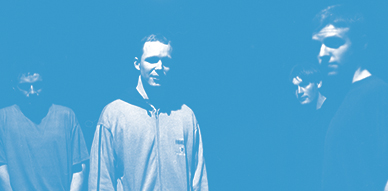
Thanks so much to Darran McCrann for the interview! Some months ago I discovered a couple of songs on Soundcloud. There was no band name, but the credits of the two songwriters, McCrann and Firmager. I found they had been based in Ireland and Australia. Lots of things weren’t clear. But the songs were good. I wanted to know more. Not too long ago Darran got in touch and was kind enough to answer all of my questions with detail. I’m very happy to have learned a bit about their story. Check Tripoli out!
++ Hi Darran! Thanks so much for being up for this interview! How are you? Are you still involved with music?
That’s for showing interest and taking the time. Yes and no, occasionally I still collaborate with Liam Firmager (we’ve worked together on and off since the Tripoli-era). Recently I helped an old bandmate Phil Dean of The Snow Ponies to arrange some tracks from his forthcoming album to be released later in 2026.
++ Let’s go back in time. What are your first music memories? Do you remember what your first instrument was? How did you learn to play it? What sort of music did you listen to at home while growing up?
‘Top of the Pops’ was a major weekly event in our house in Ireland, I remember watching it in the late 1970’s on a portable black and white TV. There’s a picture of me at the age of three miming into a kettle lead, standing on the kitchen bench. I guess I’m still an expert with one to this day. We did have an acoustic guitar in the house, which was red and possessed. I’d knocked it over as a toddler and the terrifying sound would later haunt my nightmares. It’s probably the beginning of all of the trauma. Anyhow I learned to play an acoustic in my teenage years, finger picking was always a preference.
There was always music on in our house and we had one of those giant radiograms. From the age of seven, I would DJ playing the bubblegum pop singles that one of my younger aunts had left before moving overseas. The first time my brain recognised something that resonated, was hearing the melancholic sounds of The Everly Brothers, Del Shannon, and Roy Orbison. Later, obsessed with all of the pop bands of the early 1980’s though too young to understand alternative music, I remember singles like U2’s The Unforgettable Fire. As a teenager I became obsessed with The Smiths, The Cure and all the usual alternative music that fed into the 1990’s.
++ Had you been in other bands before Tripoli?
After moving to Australia, I started writing with guitarist Liam Firmager (later of Tripoli/The Jet Set/The Kissingers) at the age of sixteen in 1991. Liam ran a record shop in Bendigo, a rural town in Victoria, Australia. He’d lived with his family in Ireland and the U.K. and so we had a common music background and references. It was the pre-grunge-era so hair metal was the order of the day with Guns’n’Roses blaring at every traffic light. It seemed so out of touch, music that was more fantasy than reality, so our job was to do the opposite. The early songs influenced by U2, REM with me yodelling over the top with cringe inducing Morrissey-esque flourishes. Andrew McHardy joined us on drums and Ty Pendlebury on bass. We recorded a lot on a four track machine but never gigged. After Liam moved back to Ireland I kept working with Ty and Andrew, joined by a guitarist named Jeremy Dellar. We recorded some new material and played a few shows in the local bars around that time. I think those guys were really into Talking Heads, so that influence is there.
++ What about the other band members? Were they in other bands too?
Liam and I were the principal songwriting partnership. I think Liam preferred to write and wasn’t keen on performing and he’d worked in rehearsal with some others before. After relocating back to Dublin in 1994, after working with a few line ups, Including Chris McDonnell on bass we enlisted Joe Collins and a drummer called Mark Heatherington who got nicknamed ‘Sparky’ due to his reticent manner and air of someone in the grips of an ongoing breakdown. That lineup of the band was short-lived. Most of them had dabbled in other bands but in a limited capacity.
++ Where were you from originally?
I was born in Sligo, Ireland, it’s a town on the North West coast of Ireland. My parents were working class and had a massive extended family. It’s a place where it rains all the time in seventeen variants (heavy, frizzy, saturating, horizontal, etc.) We moved to Australia in 1986, which was for a twelve year old like being moved to Mars, I hated it! The later teenage years were better but I jumped at the chance to return to Ireland. Liam was born in Australia, but had lived in the UK, he’d followed a family member back to Ireland and had found himself a flat in the Northside of Dublin. I think he met Joe and Mark through contacts working at a local restaurant.
++ How was Dublin at the time of Tripoli? Were there any bands that you liked? Were there any good record stores? Or what about the pubs or venues to go check out up and coming bands?
I think we made a catastrophic error by starting in Dublin. By the time we got our act together Britpop had taken off and the local music scene seemed dead in the water. The first gig was at a now closed venue on O’Connell Street. We played at Slattery’s on Capel Street (run by the terrifyingly monikered local impresario, Smiley Bulger) then upstairs at The Attic on the quays and later at Eamonn Dorans in TempleBar (venue for Radiohead’s first Irish show etc.).
Tower Records though a U.S. chain was a staple, and where at the behest of Liam I picked up a copy of Love’s Forever Changes. Working in Temple Bar there were two great record stores, both whose name I can’t recall. Some great artists would pass through Dublin, I recall bumping into the rhythm section from Supergrass on their In It For the Money tour in one and bought a copy of Tim Buckley’s Goodbye and Hello from the other. Pulp had just released Different Class, it was an exciting time.
The local songwriter scene was better though, so I would go out solo to a weekly gathering upstairs at The International Bar, Glenn Hansard (The Frames) and the solo artists Damien Dempsey and Paddy Casey (all still active) would play. There was no amplification, you just had the guitar and your voice. It taught me a lot.
The bigger influences for me at the time were from the UK and the US. I saw Throwing Muses, The Bluetones, Suede etc. all in small to medium sized venues. Though not a big fan, the energy at the first Oasis Dublin gig at a 500 capacity venue was something else, fey was out and dumb and blunt music was back in fashion. Within Ireland however, The Cranberries reigned and that abomination set to music, the song Zombie, was everywhere. With the Britpop-lite of Menswear and pseudo-alternative protest rock from Alanis Morrissette, a bugle from an apocalyptic horseman had sounded, the end was that scene was nigh.
++ What were your favourite bands in your area at the time? Was there any that you think deserved more attention, that should have been bigger?
None really during this era, we were very disconnected. Later when Liam and I returned to Melbourne, Australia and formed The Jet Set (and later The Kissingers) in Melbourne we would rub shoulders with a lot of great underrated bands. At that point we were playing gigs there every week or so and were much more involved with what was going on. There was a buzz around the early 2000’s in that town. Plastic Palace Alice and Phil Dean’s Zeptepi could have received a lot more attention.
++ How was the band put together? How was the recruiting process?
Conscription, but inspired by the methods of Stalin’s apparatchiks. No, it was all very organic, I think Liam met Joe at work and someone told us that Mark had a drum kit. This turned out to be true so he was hired.
++ Was there any lineup changes in the band?
Yes, the original drummer was Gareth O’Hanlon, a lad from the same housing estate as me in Sligo. I remember ringing him to come to rehearsal one day and his excuse was that it was raining, since it rains a lot in Ireland sadly he tapered off. Chris McDonnell on bass was a big lad who played rugby, an absolutely lovely guy but he looked so intimidating that the audience never got around to heckling us. After his time was up Joe came in, his style was more springy and he brought a playful sense of counter melody. It’s what you can hear on the version of Sydney from this era.
++ What instruments did each of you play in the band?
I was the singer, Liam as guitarist (occasional theremin) and backing vocals, Joe on Bass and Mark on Drums.
++ How was the creative process for you? Where did you usually practice?
We rehearsed constantly, initially at a flat in Munster St in Phibsborough, a house divided into flats where Liam and I lived. Later on we moved to a rehearsal studio (now defunct) on Ormond Quay in the city. Typically Liam would come with a chord pattern and we’d kind of trash it out until it had more structure. Then he would go off and perhaps demo the tracks on his 8 track portable studio, and then we’d finish the song in rehearsal. Typically I wrote most of the lyrics and would just improvise over the band in rehearsal or via a demo on cassette, sometimes Liam would give me a line or phrase as an initial idea. Once the melody had formed I would sit down and write some drafts. For the other songs you mentioned Prescriptions and Tonight (Around Your Elevations) these were written and recorded by Liam and I in his flat in Iona Road, Glasnevin.
Around that time I moved into a house with the ex-bassist Chris and the new bassist Joe. We had amps and a drum kit set up in a living room at the back of the house, so we would rehearse constantly. It was a great time, very productive. The neighbours were thrilled.
++ What about influences?
I had been obsessed with Kristen Hersh (both solo and Throwing Muses) and her obtuse Sylvia Plath influenced lyrics. Liam had given me a copy of R.E.M.’s Green in 1991 and nothing was the same, Stipe’s homage in the lyrics I Remember California lead me to the line ‘the palm trees fall into the sea’ from Patti Smith’s Kimberly. David Bowie’s Heroes was in the mix and brought a disjointed paranoia. Scott Walker 3, his masterpiece written in waltz timing, that featured Big Louise and Two Weeks Since You’ve Gone providing high drama and pathos. Finally the lingering influence of Suede’s Dog Man Star was also there, tales of small trapped lives set to Bernard Butler’s post-apocalyptic soundscape.
Liam had an eclectic record collection, everything from Stax to medieval polyphony, and at the time was really into The High Llamas, Burt Bacharach and The Boo Radleys. He also was a massive fan of The La’s, The Stone Roses, The Police, U2, and The Stranglers. He used a Fernandez Strat copy and the amp was a Vox Venue 100. The Vox was a transistor amp but had a very clear ringing tone. The early influence of The Edge had seen him experiment a lot with delay and jangly chorus effects. In that period a distortion pedal was rarely used.
Joe was influenced by Beck, Everything but the Girl, Ron Sexsmith, Tricky and Talk Talk during this period. Though his taste was melodic, he tended away from obviously mainstream music and his mixtape credentials were impeccable. He presented me with a copy of The Colour of Spring about this time, which try as I may I couldn’t get into. It was 10 years later that the penny dropped and it became a favourite.
++ What’s the story behind the band’s name?
Tyranny, Liam came up with it and I said ok. I think he liked the fact that it conjured the image of an exotic location and the dictatorship of Muammar Gaddafi. Two things I had been hoping for.
++ On Soundcloud there are three songs by Tripoli. From what I see they are from different years, different sessions, when and where were they recorded?
Sydney was recorded in the now closed studio called Starc in Rathmines in inner Dublin, it was the most professional session of this era. It was tracked in one day and then subsequently mixed by just Liam and the engineer. They used a 24 track tape machine and recorded mostly live takes with few overdubs. It was more in keeping with our live sound than the other recordings. I remember the session going very well and everyone getting along, it was a good session for the group.
The other two tracks were recorded in Liam’s flat in previous months, he had an 8 track and was on a creative spree at the time. We worked together as a songwriting pair, he would devise and arrange most of the track, playing all the instruments with most of the atmospheric sounds generated by a guitar-synth interface. He was using an old Atari computer, a sequencer and a primitive midi driven synth module. I would take demos from him and return to my flat where I had a writing desk and a typewriter set up where I would crank out the lyrics. We were in different worlds at the time, but it seemed to work.
++ Did you work with a producer for these songs?
No, just with the engineer Alan Whelan for Sydney and Liam produced the other tracks.
++ Were these songs released in any way? Perhaps as demos?
They were sent out to seek record company interest and earned a review in Hot Press, the Irish Rolling Stone. There might have been a blip in the UK’s Melody Maker but I can recall for certain. I think, because that version of the band imploded after the recording of Sydney, the momentum to promote it dissipated.
++ Do you remember which songs were recorded in each session? Could we make a list of them?
Sydney was recorded as a stand alone track at Starc in Dublin in 1996. I think the engineer was Alan Whelan, who now runs a studio called Solitare. It was the only time we worked with him.
Prescriptions and Tonight were recorded over a period of months at Liam’s home studio in 1995. There are about 8-10 tracks recorded at this time that have a similar vibe and sound. Scenes from the Other Side, Another Night, Time, Maelstrom were some of the other tracks
++ Will there be a chance to see the rest of your recordings online?
Well, we re-recorded Syndey and Tonight as The Jet Set for The Theme from Jetset in about 2003. It was done quickly to get the E.P. out there but I preferred originals. It might be time to put the other material up in chronological order as there is no cohesive legacy of the music we made. Up until now I’ve had some material as legacy recordings on my Darn Thorn page at Soundcloud. I think Liam has some Kissingers material on his Happy Valley Sunshine Soundcloud account and on YouTube under the channel Liam Review. There is a bit more material there to be uploaded, since a lot of it was recorded on cassettes that weren’t stored that well, some of the quality has degraded. Over the last few years I’ve been digitising it for posterity. The plan is to add the unreleased demo tracks from the Tripoli-era to Soundcloud as a record of where we were at.
++ Were there any plans or interest from labels to put your songs out?
Some of the initial four track recordings from the Bendigo period of 1991-92 and later songs written after Liam had left were sent to a few labels in the UK. We got a very encouraging reply from London’s Beggars Banquet, basically saying do a better recording and we’ll consider your work. That was probably the impetus for recording Sydney at Starc. As the band unravelled in the period after the Sydney session I’m not sure if it was sent out for review or support. In a later incarnation we were briefly courted by EMI Australia, but it fizzled out.
++ Did you consider self-releasing your music?
We didn’t see it as an option at the time, or at least not in Ireland. It was still the era when, at least for us, a seven inch single meant a serious release. It was before you could make your own CD at home, so that was only possible via commercial production. The truth was that we were stinkingly broke almost all of the time, and probably trying to find some formal support via the ‘demo’. Much later one we would self release but that was as The Jet Set and The Kissingers, but by then were working in a completely different way and within a Melbourne scene that was buzzing with creativity and bands who followed and supported each other.
++ My favourite song of yours is “Sydney”, wondering if you could tell me what inspired this song? What’s the story behind it?
It’s probably the tale of two songs, music that was upbeat and about moving on by Liam, and for me a darker tale.
Though it’s called Sydney, the lyrics at least are about a period when I was staying in a house in St Kilda Beach in Melbourne in 1993-94. It was a bit of a wild time and all my friends were getting into the rave scene, partying non-stop. Heroin had entered the arena and I could see the effect it was having. I don’t think Liam ever understood why I would put the line ‘a weight in sand to drag these shapes’ into the chorus of an upbeat song, but it was about feeling the weight of losing someone to the drug. I remember walking in one night to see people out of it, lying on the bare wooden floor. The Velvet Underground & Nico was playing on a loop and the only light was coming from the orange streetlights outside. I thought they’d overdosed, I had to drag some of them into a recovery position and stayed to make sure they were ok. Nico was singing I’ll Be Your Mirror as I sat with them in the dark, it was a mirror world I wasn’t going to step into. The line ‘harbour dips to recover’ wasn’t about swimming, it was a reference to living in warped reality, a world stretched out of shape. I’d been dragging my heels for a few months but it was the final straw. I had to get out while I could, so I decided to return to Ireland.
It can’t really speak for Liam but his music and lyrics at the time were more wistful, still about escape but somehow more affirming. The key song of his at the time for me was Maelstrom where his lyrics referred to a psychic darkness, the track was claustrophobic swirling atmospheric guitar part, punctuated by a beautiful arpeggiated lead line. By the time we got to Sydney, he wanted something more accessible and outgoing. We had been recording a lot of dark material and it was time to write something in full colour. Underneath his jocularity, he is a sensitive guy, who would always find a positive angle and rally the troops. Joe was going through his own troubles and poor Mark was a bit of lost soul. Like many bands we were a gang of misfit young men, unable to communicate what was going on, but who decide to externalise it all publicly in a confused way via music. Without a guiding hand that train was going off the rails. I think we created a song that despite it all has an affirming feeling. You can get out, somehow, here comes the sun, at least for a while.
++ If you were to choose your favorite Tripoli song, which one would that be and why?
I think Prescriptions for me was a breakthrough song for us creatively. It was not commercially oriented but it kind of encapsulated something that was uniquely ours. While not obvious, later on we would build on what was discovered there. It ends with a coda from another song called Lost whose original lyrics were written by Liam. In Prescriptions the metaphor from the original is inverted and drowned out by a confusion of multi-layered voices.
My true favourite of that era though was a version of Liam’s Lost with my vocal. I was in the grip of a Scott Walker fixation and think I changed the feel of the song so it didn’t work with his intentions. True to its name, the only recording of Lost is actually lost somewhere in my collection. Perhaps one day I’ll find it.
++ What about gigs? Did you play many?
As that band, a handful of times. Liam was no fan of playing live so it was a rare occurrence. In later incarnations we played every week. On reflection, putting the same energy into getting recordings out there would have been more worthwhile.
++ And what were the best gigs that you remember? Any anecdotes you can share?
The early period as Tripoli was more sincere; it was also about learning the ropes and was more about documenting where we were at, regardless of the music’s relative commercial obscurity. A significant memory was the gig at The Attic in 1995 that was recorded for posterity. It mostly involves the audience yelling in-jokes back to us and the sound system struggling to cope.
The best gigs were in the later period as The Kissingers, but I think that was not just about the material but rather the fact that we had matured as a live act. The tone of the band was different, I think Liam wanted to steer me away from the introspective music that we had been making and so there was a great tension there, I wasn’t that person. I’d been through art school so the whole thing for me became a performance, a parody of the self-serious indie star, so wearing terrible sunglasses indoors was mandatory. Underneath the veneer you saw flashes of the old music. We had some great gigs with a lot of energy but it was on different terms.
++ And were there any bad ones?
The first, in some unremembered venue on O’Connell Street was the worst, there was virtually no foldback, and I don’t think anything I was singing was in key. I’m sure the other guys did great, but I wanted to hide under a table. In future permutations of the band we had some hilariously disastrous occurrences at gigs but by that time we had the experience to overcome any internal cringing and make it happen, volatile objects been flung, unsolicited stage invasions involving indecent exposure (by audience members I should add), and falling stage lights that took out the entire electrical system could be endured.
++ When and why did Tripoli stop making music? Was the end of the band when you moved to Australia?
After the Sydney sessions and a few gigs, Mark left the band and Liam got married and was the first to start having kids. We reformed with a new drummer and were considering starting again, but by that stage I’d had enough of Dublin and wanted to return to Australia.
Liam and his family returned later the same year and after a bit of time we started again, originally with the backing of the drummer and bassist Andrew and Ty from the first band in 1991. After a few gigs The Jet Set was established, we added keyboard player Matt Stanton, bassist Lee Herrick, and finally our long term drummer Paul Angas joined. The Kissingers was essentially the same band but complemented in the crossover period with Nicola Barnes on keys and Michael ‘Mog’ Webb on bass. Paul was a great drummer who was professional and willing to help with all of the unglamorous behind-the-scenes heavy lifting, getting the promotional material out there and creating logos and web presence.
Ironically the last gig with this band was at the St Kilda Festival in 2008, where literally a stone’s throw from the stage was the house where the story behind the lyrics to Sydney unfolded. I don’t think the others knew that.
++ Were any of you involved in any other projects afterwards?
Loads really, Liam formed a few bands – The Sugar Free Masons, Happy Valley Sunshine. Since the 1990’s I played my own material as a singer songwriter, so I went back to that, the first band was called Darn Thorn and the End of the World which later morphed into Black Seas. Liam and I had fallen out during that period, but I was working with Paul the drummer, Phil Dean, and Andi Fitzpatrick, all members and friends of the former group. Paul is currently playing with Jen Lush and The Field who are still releasing music. Phil’s project The Snow Ponies is due for a vinyl release in the coming months. Our original bassist Chris McDonnell was in a Dublin band called Doris, who had some success in the early 2000’s. In the last few years, Liam and I dropped the proverbial hatchet and started occasionally writing together. At this point I have no idea how/if that will be released.
++ Was there any interest from the radio? TV?
Not this period, we had no management so we were a bit clueless about promoting ourselves. Later bands with Liam, like The Jet Set and The Kissingers were played on Australian college radio and some of the major alternative stations such as Triple J. Television appearances featured some live performances, most notably a full concert on SBS on Christmas Eve 2006 and our video clip for the song If You Want To was played regularly on RAGE, the influential late night MTV-style programme on the national broadcaster ABC.
++ What about the press? Did they give you any attention?
I think from that period there was only one review from Hot Press, the Irish Rolling Stone. They were reviewing a demo that contained Prescriptions and other similar tracks. The two reviewers didn’t get it at all and said that we were like Pink Floyd fronted by Chris De Burgh. At gigs we would jokingly start a song with a snippet from Lady In Red and we laughed it off, but I was crushed. I guess it helps to develop a thick skin when it comes to the media. Later on in Australia we would be featured and reviewed regularly in the Australian music press.
++ What about fanzines?
I expect there was some fanzine content at some point, but I’m not sure.
++ Looking back in retrospect, what would you say was the biggest highlight for the band?
At the time it was probably recording Sydney, but later it was the support we had in Melbourne. By that stage we’d gained an audience and the full concert feature broadcast nationally during the Kissingers-era on Christmas Eve 2006 was the highlight of that phase. The final TV performance live show recorded was also on Noise TV in 2007 again broadcast nationally on SBS Australia, by that time the band was at its best as a group, no disrespect at all to former members, but at that time we had years of gigging under our belts, and during this period Andi Fitzpatrick had joined as bassist.
++ And aside from music, what other hobbies do you have?
Not so much a hobby but I went to art school in 2000 and since then have been exhibiting within the contemporary art scene, the work is photographic and goes out under the moniker Darn Thorn. Liam has made a number of feature films as a director including the Suzi Quatro documentary Suzi Q (2019) featuring interviews with Alice Cooper, Talking Heads, and Blondie among others.
++ Been to Dublin once and loved it and would love to go back. What do you suggest checking out in your town, like what are the sights one shouldn’t miss? Or the traditional food or drinks that you love that I should try?
Dublin is grand if you stick to the nice areas on the Southside, outside of that things can get sketchy if you don’t know where you’re going. Avoid Temple Bar, unless hanging out with European tourists on mescaline is your thing. I travel through it occasionally, but I haven’t lived there since the 1990’s. Whelans on Wexford Street is a reliable haunt for local music.
The town has changed so much, after we left there was the ‘Celtic Tiger’-era of dodgy economic growth that ended in tears. It’s a different world there now, cafes with all the trappings of international hipsterism, not like the grungy pre-boom days where even the commercial fringes of the underground scene had more of a punk and goth aesthetic. With that in mind the area around Grafton Street and Georges St. Market are an easy tourist go-to for a snack. Obviously there is the Guinness thing, so have some of that from a reliable vendor (i.e. Grogan’s in William St South), but also order some Murphy’s stout, a brew from the rival Corkonians just to annoy the Dubs. Frankly, I’d recommend visiting Cork, fierce craic down there altogether as they say.
++ Anything else you’d like to add?
Nothing to declare but my geraniums.
::::::::::::::::::::::::::::::::::::::::::::::::::::::::::::::::::::::::::::::::::::::::::::::
Listen
Tripoli – Sydney