12
Apr

Thanks so much to Rhys and John for the interview! I wrote about Southville time ago on the blog, but it was thanks to the new and essential retrospective compilation “Across the Airwaves” that was just released by the legendary Harriet Records on CD, I was able to get in touch with the band and talk about their music and more!

++ Hi all! Thanks so much for being up for this interview! How are you? Are you still involved with music?

John: Well thanks. Yes, I still do stuff from time to time. Since Southville there has been Metrotone, Landshipping, Ojn and Tonfedd Oren with Rhys. My work rate is very low though.

Rhys: I record covers and things for my own amusement, but I need a sparring partner to motivate me for anything serious.

++ So is Tonfedd Oren still going? What would you say are similarities and differences between Southville and Tonfedd Oren?

John: We wouldn’t rule out doing some more. Life gets in the way though! Similarities? Not sure.

Rhys: Southville is lo-fi jangly indie guitar pop, while Tonfedd Oren is playful synth-based electronica with cut-up vocals. Both have made good use of short-wave radio noises.

++ Let’s go back in time. What are your first music memories? Do you remember what your first instrument was? How did you learn to play it? What sort of music did you listen to at home while growing up?

John: For me, the house was always full of the Beatles and Bowie.

Rhys: I’d developed a slow-burning obsession with the electric guitar since an early age. Most of the stuff I listened to early on was Welsh-language rock and pop – the Welsh Rare Beat compilations on Finders Keepers will you give you a good idea of that kind of thing. When I was 14, my friend from across the road started playing his mum’s old nylon-string acoustic and he taught me a few chords. We plotted to get electric guitars and form a band, which we eventually did! We were into rock and metal at the time, but later on I discovered the Smiths, The Cure, Jesus and Mary Chain, and read the NME religiously when I went to university.

++ Had you been in other bands before Southville? If so, how did all of these bands sound? Are there any recordings?

John: For me, there were a couple of home-recording projects, notably a track under the name The Locations on a cassette compilation called “Something’s Burning in Paradise Again”. Rhys was a legit pop star though!

Rhys: I wouldn’t go that far! I’d been in a few bands since I was 14 or 15 – not particularly successful, but I’d played live on stage regularly, writing songs (well, just the music part) and made a couple of tv appearances.

++ Where were you from originally?

John: I’m from Staffordshire. Rhys is from Ynys Môn.

Rhys: It’s the little island off the top of Wales.

++ How did you two meet?

Rhys: We were both postgrad students in 1990 and after the department’s Christmas meal there was always an unofficial party in the lab of one of the research groups, everybody would turn up in the afternoon and have a drink or two. I overheard John talk with somebody about recording songs on cassette so I butted in and asked him what kind of stuff he wrote. We had similar tastes so we made big plans but I didn’t expect anything to come of them. John turned up at my flat the next day with a Casio keyboard under his arm! I played him a song I’d written the music for my band which had just fizzled out and that became Looking From A Hilltop.

++ How was Aberystwyth at the time of Southville? Were there any bands that you liked? Were there any good record stores? Or what about the pubs or venues to go check out up and coming bands?

John: We saw loads of bands, both English and Welsh-Language. I remember seeing Y Cyrff and being very impressed…. We saw a lot of pub rock at a place called Rummers too. Andy’s Records was a really good record shop with a knowledgeable owner.

Rhys: John thought Cyrff sounded like Echo and the Bunnymen. Cyrff had been my favourite band for a few years and were a great live act. Mark and Paul from the band went on to form Catatonia. The Welsh language scene was very lively at the time. The Students Union used to get some good bands now and again – I saw The Stone Roses and The House of Love there. The Sea Urchins played there as well but I missed them. Rummers was more pub-jazz though! Andy’s Records is still going strong, and I pop in when I have a chance. There was also a good record fair at the Students Union once a term, and I picked up a lot of good albums there for not much money.

++ I am aware of only a few fantastic Welsh bands of the early 90s but not that many, so I wonder if you have any recommendations for obscure bands that didn’t get a chance to make it?

Rhys: I introduced John to Datblygu, who were hugely influential, and Ffa Coffi Pawb – one of Gruff Rhys’s early bands. There is some great stuff around now as well – Mellt, Los Blancos, Adwaith, Papur Wal, Melin Melyn, Gwenno… You don’t have to understand the words to enjoy a good band.

++ How was the creative process for you? Where did you usually practice?

John: We’d usually come up with a tune and share it on cassette, and the other would go away and think of a way of adding to it.

Rhys: What we did quite a lot was once we’d sorted out the music and lyrics, and what we wanted it to sound like, we’d record all the parts and produce the finished song quite quickly – then over several weeks or months we’d refine the ideas, decide we could do a different guitar part, better vocals, a nice keyboard sound or something. So we’d go back and record a much better version. Quite a few songs exist as a rough version and a better version.

++ What’s the story behind the band’s name?

John: The cassette compilation “Somethings Burning in Paradise Again” was put out by woman called Christina Williams who lived in Southville, Bristol. We thought it was a cool name, like a kind of name of a band who might support Uncle Tupelo or one of the Northwest USA indies we listened to… I actually ended up living in Southville years later, which is kind of an odd thing.

++ Who would you say were influences in the sound of the band?

John: The Smiths, REM, a lot of the Sarah bands. I remember listening to the Rockingbirds and the Go-Betweens a fair bit at the time.

Rhys: The Smiths and early REM were the big influences on how I played guitar and wrote songs, and John introduced me to the Go-Betweens and the Sarah bands. I loved the NME’s C86 compilation a few years earlier but I hadn’t realised that Sarah (and a host of others I’d come to know) was releasing that kind of stuff still.

++ I was surprised to see a compilation of your songs being released this year by Harriet Records. I didn’t know there was a relation with Tim from Harriet. When did it start? Was it for this compilation or does it go further back?

John: We sent him a demo in … what?… 1994? And he said he couldn’t do a single then. Maybe a compilation. 27 Years later he bought a Tonfedd Oren download on Bandcamp. We wrote to him to say thank you and he said “By the way, are you Southville?” and asked us if we wanted to do a CD!

++ I’ll come back to this compilation in a bit. Let’s go in order. Your first release was the “Looking from a Hilltop” 7″ on Pillarbox Red. This is a fine label with great releases but I know little about them. Who were they and how did you end up working with them?

John: Andrew from Pillarbox had heard the Locations track on “Something is Burning in Paradise Again” and said he liked it and did we have anything else? By that time Southville had started so it was very serendipitous.

++ Speaking of the title song, “Looking from a Hilltop”, was the song inspired by any hill perhaps in Aberystwyth, or not really?

John: Kind of – I always think of Constitution Hill in Aberystwyth.

Rhys: The view from there is the background on the inside of the CD booklet.

++ Before this release, had you already released demo tapes? Or were the songs on the 7″ your first recordings?

John: They were our first songs.

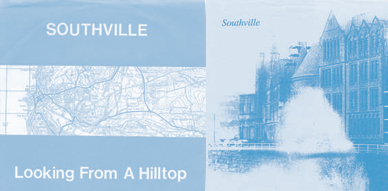
++ On the sleeve there’s a map, is it Aberystwyth? Or another place?

John: Yes its Aberystwyth, with the town name Tippexed out!

Rhys: We were concerned that we’d get into trouble with the Ordnance Survey (who publish maps)! It was all done with photocopiers, razor blades, glue, and Letraset.

++ There’s a song called “16th of April” and I was wondering, is this day an important day for you? Or why this date?

John: I was thinking of the 16th April 1989, just a very odd day when no-one was at their best, against a backdrop of awful national events. I also thought that “16th April” was a cool title.

++ I also was wondering about the sleeve of your next record, the “Inside and Out” 7″. Where was that photo taken?

John: My colleague Richard Bambrey, who is an excellent photographer, took the picture of a wave hitting the shore at Aberystwyth.

++ The “Inside and Out” 7″ has the same song on both sides. Was this on purpose? Why?

John: It was cheaper, and allowed us to sell the song, including postage, for under a pound in the UK. I love the fact there is only one song on it. No need for a b-side.

++ And do tell me about the new version of this song that is on the compilation. It was recorded many years later, in 2013. What made you rediscover and rework your song?

John: We’ve both always been proud of Inside and Out. When digital recording came along it Rhys did a new version of it. I put a new vocal on one day when I came over to do some Tonfedd Oren vocals.

Rhys: The original version was recorded very quickly… I think we did it in a morning after the weekend we spent recording Hilltop and the other songs for the first EP. At the time I don’t think we knew it was going to be coming out on record so it was kind of rushed, just to get the idea down and I made at least one glaring mistake trying to play the bass line I’d just written. Years later I have much nicer guitars and a much better recording setup, and I thought the song had more potential than the one we’d hurriedly recorded on a 4-track with a cheap microphone.

++ So only these two 7″s were released even though you had many more songs. How come? Was there any interest from other labels at the time?

John: No! There was a plan for a split LP on Pillarbox, and a single on Meller Welle. It was so expensive to do vinyl then. We were very keen to get on Sarah Records, and still have some quite inventive rejection letters from them!

Rhys: We though the Meller Welle EP was our best opportunity yet so decided to spend a weekend at a real studio to get at least a couple of songs recorded well. Neil the engineer managed to get a great sound from us, so it was disappointing that it didn’t come out at the time. There was also a cover of a Field Mice song we did for a tribute LP that didn’t happen either.

++ You did appear on tons of cassette compilations in the 90s. One tape label that released you a lot in your compilations was Grapefruit. Again if there’s anything you could tell me about them, that’d be great.

John: It was always good to do cassette compilations. Grapefruit was done by a chap called Simon Minter. We are still in touch – we follow each other on Twitter. He’s an excellent graphic designer and you can see it even then in these photocopied cassette inlays.

++ Your songs appeared on compilations in the US, Italy, Germany… How did it work in those pre-internet days? Did you ever meet the people behind these tapes?

John: No – in fact we weren’t aware of some of them! We send tapes out to people. It took a long time to get responses, and was quite an expensive and time consuming process to buy a cassette, record onto it, write a letter, send it out. I bumped into Karen White, who ran Pillarbox Red with Andrew Austin a few years ago and she described the whole letters-tapes-fanzines scene as “incredibly slow social media”!

Rhys: It was a good way to get some exposure. We had a load of songs recorded by then, so we were happy to “donate” one to a cassette compilation so that more people could get to hear us.

++ I am looking at the new compilation called “Across the Airwaves” and something that caught my attention is that you recorded many songs in Edinburgh. Did you move to Scotland at some point? Or how come you were recording that far from Wales?

John: Rhys had a job at the University of Edinburgh and, by accident, a year or two later I got one too. So there was a year or so when we overlapped there, and of course we met up and recorded songs.

Rhys: Ironically, we became very productive in terms of writing songs when were living far away from each other. John lent me his 4-track for a while and I recorded the music, then we’d met up for a weekend now and again and finish a couple of songs.

++ On the compilation there are 18 tracks. Are these all of your recordings or are there still unreleased songs waiting to be released?

John: There are others but I think these are about the best.

Rhys: I’m a bit of an archivist, and I think we have about 40 recorded tracks, plus a handful of unfinished ones. A lot of songs were recorded twice or even three times though. We’d record it quickly to get the idea down, then we’d think of more ideas and record it again more carefully, with more effort to get the right sound. There are a couple of others which could easily have made it onto the album, but between us and Tim I think we agreed on the best selection.

++ Lastly the CD includes the original Harriet rejection letter! How did you take it at the time and how did you take it now that Harriet is finally releasing all your songs?!

John: We have many, many rejection letters, Harriet was only one. Hearing from Tim was amazing though. Its excellent that these songs are having a second life.

++ I think my favourite song of yours might as well be “Inside and Out”, wondering if you could tell me what inspired this song? What’s the story behind it?

John: It is about a very specific incident, but its many years ago, and… all’s good now and I will say no more.

Rhys: I had some nice sounding jangly chords which I’d been playing for weeks but couldn’t work into a complete song. John cajoled me by suggesting random chords and it quickly came together. We’d also discovered how to program a cool new beat into the drum machine, which worked perfectly with the guitar part.

++ If you were to choose your favorite Southville song, which one would that be and why?

John: “Inside and Out” – I love the fragility and the vague grooviness. I also like “She Says” and the four tracks on the first single. “Sometimes…” as well.

Rhys: I quite like “Underneath The Sky” at the moment because I think it marked a point where my songwriting had progressed, I was arranging more varied guitar parts and programming the drum machine in a more realistic way. The sound and the lyrics just takes me back to carefree summer Saturday afternoons in my flat in Aberystwyth in the early 90s.

++ What about gigs? Did you play many?

None

++ When and why did The Southville stop making music? Were you involved in any other bands afterwards?

John: We moved apart, we had other priorities. I did Metrotone, Landshipping, Ojn… Tonfedd Oren has been lots of fun.

Rhys: I only really played for my own amusement, so I was glad when John sent me some demos of his electronic stuff that became Tonfedd Oren. A totally different way of working for me, but yes, a lot of fun creating the tracks.

++ Has there been any Southville reunions?

John: We have been out for a pint together on occasion if that’s what you mean?

++ Was there any interest from the radio? TV?

John: We got on the radio in France and Belgium. I think that kind of sound made much more sense there than it did in the UK.

Rhys: I remember a small college radio station somewhere in the USA playing us as well, but the radio play was quite sporadic I think. And of course at the time, we couldn’t hear it! The new CD has been picked up by a couple of blogs already so hopefully it will get some radio play.

++ What about the press? Did they give you any attention?

John: None whatsoever!

++ What about fanzines?

John: Yes, quite a few. We were very pleased to have a long piece in a beautiful zine called “Soft White Underbelly”. There were odd bits and pieces in French zines and “Swinging Ruislip”, the Pillarbox in-house fanzine.

Rhys: We made a demo tape to send to prospective labels and it ended up being reviewed by a publication called Sun Zoom Spark, which was much glossier and substantial than the usual photocopied fanzines.

++ Looking back in retrospect, what would you say was the biggest highlight for the band?

John: The first single arriving in the post!

Rhys: Andrew and Karen had sent them to John and he came round to my flat. I went to make coffee and he left them on the table, waiting for me to notice! It took me a couple of minutes because I was expecting the covers to be black and white, not red.

++ Never been to Aberystwyth so I’d like to ask a local about what you would suggest checking out in your town, like what are the sights one shouldn’t miss? Or the traditional food or drinks that you love that I should try?

John: Just walk along the sea front on a sunny evening.

Rhys: I’ve had the opportunity to spend time in Aberystwyth regularly again. It’s kind of completely different to how it was, but still the same, if you see what I mean. There are are a few interesting restaurants there now, hidden away. And of course Andy’s Records is still going strong.

++ Anything else you’d like to add?

The text from the CD booklet, in case you find it useful:

So: Rhys and John, grad students in Aberystwyth, on the coast of Wales, six hours from London, but in a different country. It’s Christmas 1990 and at a party we start talking about music. We agree on the Smiths, Jesus and Mary Chain, and bands who became Catatonia and the Super Furry Animals. Rhys had been in a couple of Welsh-language bands, had made an album, been on the television; John had some home recordings and a pile of rejection letters. Maybe we could try recording something ourselves?

One of John’s solo tracks on a cassette compilation (based in Southville, Bristol) attracted a DIY label in London called Pillarbox Red, run by Karen White and Andrew Austin, one of many small labels producing cheap, short run 7”s made in newly-open Eastern Europe and selling them at gigs and by mail order in the UK, Europe and the US — new, relaxed customs rules in Europe had recently made this cheaper and easier. Fanzines and home-duplicated compilation tapes spread news and music, loosely clustered around a group of bands, writers, fans and labels inspired by the DIY ethic of Sarah Records. John met Karen 20 years later. She succinctly encapsulated the scene as a “kind of extremely slow social media…”

A demo followed, recorded on a hired 4-track, which led to two Pillarbox Red singles, and more compilation cassettes. The songs reflected the time and our situation: set in the kitchens of shared houses; concerning letters that are written or not, received or not; (phone calls were expensive, email a rarity); the yearning to join in with a different, wider world, yet a preoccupation with the psychogeography of the quietly amazing place we lived in (Before you go, think of me, looking from a hilltop to the sea). The singles got on a small, syndicated Belgian radio show. We sent out demos to labels and fanzines. People began to write from abroad — French women, German men… we never did understand why things split like that.

New influences came: the beginnings of Britpop and shoegaze, dance beats. Tapes of US bands via Pillarbox Red. Political and environmental concerns. Together we watched Welsh music TV, Rhys filling the gaps in John’s understanding of the language. We moved out of Aber to respective jobs across the UK, swapped tapes in the post, recorded some demos over a few weekends, overlapped in 1996 by accident in Edinburgh and recorded three tracks for a German single that didn’t happen, in a real studio.

Our lives diverged. Music kept us in touch despite working on our own musical projects. In the early 2010s we worked together again on some tracks as Tonfedd Oren (tonfeddoren.bandcamp.com) which resulted in a single on orange vinyl which still gets regular radioplay, and we revisited “Sometimes…” and “Inside and Out”.

So this was Southville. Thanks Tim at Harriet Records, for this chance to listen again and put it in context. I think I finally know what I was singing about: A feeling of joining a silent tradition without knowing quite what it meant.

::::::::::::::::::::::::::::::::::::::::::::::::::::::::::::::::::::::::::::::::::::::::::::::

Listen
Southville – Inside and Out

07
Apr

Thanks so much to Tony Gauslin for the interview! I wrote about the one-off project Boy Mouse, Girl Mouse years ago on the blog! The band formed by him and Beth (Aberdeen, Jetstream Pony and many more) released one song you can imagine that there was very little info about the band. Happily Tony was up to fill in the blanks and also tell us more about other music projects he has been involved with!

++ Hi Tony! Thanks so much for being up for this interview! How are you? Are you still involved with music?

Hi Roque. Thanks for asking me to do this. I’m doing well – managing to survive in a world that lately seems to get a new wrench thrown into it every few months. A lot of that is thanks to having music to fall back on to distract me from life.

++ Let’s go back in time. What are your first music memories? Do you remember what your first instrument was? How did you learn to play it? What sort of music did you listen to at home while growing up?

First music memories? Probably hearing my dad listening to Zeppelin, Heart, Pink Floyd, and Fleetwood Mac in the late 70s. My first instrument was drums/percussion, which I started in 6th grade. I was a serious band nerd growing up and was in band through all of junior high and high school. The music program was a pretty serious thing where I lived. Marching band/drumline, symphonic band, after-school percussion ensemble, pit band for a couple musicals, etc. The private lessons that I took only focused on drum set for the first year or two, then I switched instructors and instead focused more on orchestral percussion (concert snare, tympani, marimba/xylophone/other mallet percussion).

I got a guitar for my 16th birthday and pretty much have been self-taught on that, bass, and piano/keyboards since then. As for what I listened to growing up, that’s kind of all over the place. The classic rock stuff that my dad listened to, obviously, but I was also exposed to Rush through some kid in the neighborhood when I was like 7. Around that time I also started listening to Top 40 radio and watching music video shows, so I got a healthy dose of early 80s pop and new wave. By high school my favorite bands were the Pixies, the Cure, and Dinosaur Jr, though I also was listening to Young Fresh Fellows, Poster Children, some Dischord stuff, generally whatever was angsty and loud but with some sense of melodicism in there. I fell down the indiepop rabbithole when I went off to college in 92 and started working at the radio station. From then on it was all about Slumberland, Simple Machines, K, TeenBeat, SpinArt, Pop Narcotic, Harriet, Merge, Sarah, etc etc. Mostly US-based stuff, though, since that’s what I had easier access to at the time.

++ Where are you from originally?

My family moved every few years when I was growing up, so we primarily bounced between the DC suburbs and Southern California (where my dad is from). But the formative years were spent in Fairfax, VA.

++ How was LA at the time of Boy Mouse, Girl Mouse? Were there any bands that you liked? Were there any good record stores? Or what about the pubs or venues to go check out up and coming bands?

I was in LA for a few years leading up to 2000, and it was kind of a weird place. Definitely drastically different from the massive DIY thing that DC had going on, though there was certainly an undercurrent of it. I got to witness the final days of No Life Records, which was probably my favorite shop there. Rhino deserves a mention, but that’s mostly because it wasn’t too far from where I lived. Most of the good “bigger” indie bands played the Silverlake Lounge if they even came through town. The Smell was interesting. Saw a few good shows at some hole in the wall down in Long Beach whose name I forget (including the first time I was blown away by the Aislers Set when that first album came out). There were some other shops and venues around, but it’s been over 20 years and their names slip my mind at the moment.

++ What’s the story behind the band’s name?

IIRC, a week or two before the Family Twee project came up Beth had given me a drawing that she made of a pair of mice with a little verse about them. When we decided to record the song she threw that out as a name and it stuck.

++ And how did this project start? Were you and Beth friends already? How did you two meet?

Beth and I were both on the indiepop-list. Shortly after I moved to LA, Beth posted that a band she was involved with was looking for a drummer. I responded and that’s how we initially met. We started dating, then that project fell apart due to various reasons. When the idea for the Family Twee compilation was floated on the indiepop-list we decided to throw a little song together for it.

++ She was of course in Aberdeen, a band many of us are big fans of, did you have the chance to see them live?

I never did see them live. They had already broken up when Beth and I met. I did have a chance to see them once after they reformed, but I ended up not going.

++ Had you been in other bands before Boy Mouse, Girl Mouse? If so, how did all of these bands sound? Are there any recordings?

I was in a bad cover band for a short bit in high school, but that doesn’t count. Then there was the aforementioned project where I met Beth, which was led by a guy who worked at KCRW, the NPR station in Santa Monica. Recordings of that do exist, but I don’t think he ever released them.

A year or so after the BMGM song I got together and played bass with two guys who were in Bunny Summer, which was an early Rachel Blumberg band (they had a 7″ out on SpinArt). We practiced 4 or 5 times and got up to the point of talking about playing an open mic night somewhere, but then I started a new job and it all kind of fell apart. When I moved a few years later I still had the bass that I had borrowed from them. So Jeff and Adam, sorry about that…

++ After this project I know you were in a band called Color and Shapes with Laura Watling, right? Again, I have to ask as both Beth and Laura are two of the most well-known women in indiepop in the US, how did you two meet and what prompted both to start a project?

I met Laura at one of the poplucks (potluck dinner/living room concert) that she put on out in Riverside when I was in the LA area and got to know her there a bit. We both moved up to the San Francisco area around the same time and she asked about playing together. She brought her cassette 8-track over to my apartment and recorded me playing some acoustic guitar once or twice, then took that home and finished them up. I did go to her place in Santa Rosa and recorded some lightly brushed drums for one of the tracks, but I don’t believe those got used.

++  Speaking of Color and Shapes, you were telling me a tape was released? I had no clue. Who put it out? What songs were on it? Are there more unreleased tracks?

Raoul from Popgun put a tape out at some point. I found out about it maybe around 2005/6 or so when a friend messaged me and told me he had bought a copy. I don’t have a copy of it but I think it had two songs on it, which I’m pretty sure are the only two that we recorded (though again, there were drums for one, so there might be an alt mix out there).

++ You are now making music under the name The Quiet Corners, and the songs are great! Was wondering when did you start this project and if there are any news coming up for this project?

Sometime in 2015 I ordered a cheap bass online to mess around with. When it showed up I dug out my cassette 4-track to see if it still worked. Within a few minutes I ended up coming up with the chords that became Goodbye Wherever. I quickly threw a bass line on that and recorded a (poorly played) drum track on my frankensteined electronic drum kit. I had previously dubbed the little practice area in the corner of my living room as “the quiet corner” since I could bang away on the v-drums with headphones on pretty much whenever I wanted (it was a ground floor apartment with thick walls and a garage on the other side of the wall). The name stuck even though it took another 5 years for me to get some other stuff recorded and released.

As for the future, I’m constantly messing around and coming up with little musical phrases or chord progressions that I then flesh out a bit and promptly forget. All of the recordings I’ve made so far are the times when I’ve actually bothered plugging everything together and hitting the record button. I have a few ideas that have been bouncing around my head for too long that I need to record, so there will be more stuff posted someday. I also need to sit down and record some Erik Satie piano pieces that I learned while teaching myself piano over the past few years. I’d like to get both of those done by the end of the summer, but we’ll see.

++ It seems there were many small indiepop bands in California in those late 90s, many that had great music but didn’t make it. I wonder if you have any recommendations for obscure bands that didn’t get a chance to make it?

Unfortunately that’s about the time I began falling away from the indiepop world, so I can’t really help you there.

++ As far as I know Boy Mouse, Girl Mouse was a one-off project, right? Or were more songs recorded?

Correct, just the one song. Nothing else exists.

++ The song that I am aware of, “Make Like We’re Not Sad” was included in a compilation called “Family Twee” that was put together by Skippy of March Records. What made you want to be part of it?

At some point in 1997 someone on the indiepop-list threw out the idea of releasing a compilation of songs contributed by list members. Specifics were hashed out regarding track length, payment, etc (you’d have to check the list archives for specific details on it). IIRC, Skippy took the reins on it, which I’m sure is a decision he quickly regretted. I asked Beth if she wanted to do a song for it, we checked whether we could do a longer song if we pooled resources and that was that (that’s why our track was ~4:30 minutes while everyone else’s had a 2:30 cap).

++ This compilation mostly features people that were involved in the indiepop-list email group. Were you active in the mailing list? How did you like this email forum?

I joined the indiepop-list in 1995, back when the internet was a very different world. Back then there seemed to be only a handful of places to discuss that sort of music online and there was definitely a sense of community from the various popfests and meetups. Even a severe introvert like myself managed to meet a lot of great people over the years (keeping in touch, well that’s another story).

++ I really like the song “Make Like We’re Not Sad”. Care telling me the story behind it? Where was it recorded? Did it take long to put together?

The whole thing was surprisingly quick. I wrote and recorded the instrumental tracks in my bedroom on my PowerMac one weekend after we decided to contribute a song. I gave a tape with a rough mix to Beth, she came up with the lyrics, then came over and recorded them a week or two later. There were some issues regarding horrible monitoring latency when she recorded those due to the jury-rigged setup we used, but she somehow managed (she wouldn’t let me into the room while she recorded the vocals). There were a couple rounds of mixing and the tape was sent off. And that’s the story of the birth and death of BMGM.

++ Who would you say were influences in the sound of your different bands?

That’s a tough one, because I was always a fan of the lofi and DIY aesthetics. Yet I know that really doesn’t come through at all in my recordings. I’d say that’s largely due to recording conditions and equipment – nearly everything I’ve done is via direct input and headphones with no/minimal mics (again, that quiet corners thing). Despite the technical differences, I guess a lot of what sounds I like comes back to the stuff I grew up with all those years ago – Sarah, early Slumberland, the Magnetic Fields, and any of the other stuff I mention in my posts buried in the list archives. Beyond that, I suppose I’m still finding “my sound” which seems to change a little each time I hear something in my head that wants out…

++ After recording this wonderful song, you didn’t think about continuing this project?

Beth and I had a falling out not too long after the song was recorded, so there really wasn’t anything to continue. But I’m certainly open to working with Beth again if she were up to it. But I wouldn’t get your hopes up.

++ One thing that I thought was funny was that a year later after the release of the “Family Twee” CD you were saying you hadn’t received a copy. In the end you did receive one, right?

I did have to email Skippy more than a few times to eventually get some copies.

++ On this CD we see many friends and bands, was wondering which are your favourite tracks on it? And if you were familiar with any of the projects at all?

It’s been years since I’ve even looked at the disc, let alone listened to it (it’s stuck away in a box of CDs in the garage somewhere). I do remember there were a few tunes that I did like, but I couldn’t tell you who or what they were at this point.

++ If you were to choose your favorite song of yours, which one would that be and why?

I kind of like how “We Are Going Nowhere” came out despite the fact that it never really goes anywhere (yes, the title is a little self-referential). And Goodbye Wherever has some of that quick bash-it-out sensibility that I like. But I like to imagine that my favorite song is still to come.

++ What about gigs? Did you play many? With which bands?

One C&S gig where we opened for Aerospace from Sweden. No comment.

++ Having collaborated with both Beth and Laura, I have to ask who else in the indiepopworld has made music with you?!

Nobody, because as far as I know nobody’s ever been interested. If you are, hit me up! Especially if you can provide vocals and/or assistance and feedback on arrangement and composition. tgauslin[at]gmail.com

++ Was there any interest in your music from the radio? TV?

A handful of people from the indiepop-list played the BMGM song on their college radio shows, which I know about because they posted their playlists to the list each week. If there was any interest beyond that, I’m not aware of it. I do recall Beth telling me she played the song for Matt from Sarah and that he liked it, so there’s that.

++ What about the press? Did they give you any attention?

One time the guy from Cloudberry Records asked about an interview for his blog. 😉

++ What about fanzines?

Again, not that I’m aware of.

++ Looking back in retrospect, what would you say was the biggest highlight for you as a musician?

Honestly, at this point I’m touched that people still like and remember the very first song I ever recorded, even if it is mostly remembered because of Beth’s involvement.

++ Aside from music, what other hobbies do you have?

Reading, getting out for bike rides, and getting away from screens to play some mind-numbing hours-long strategic board games. (Though I’m terrible at them I loves me some 18xx. CCMF!)

++ Been to Los Angeles once but I’d like to ask a local about what you would suggest checking out in your town, like what are the sights one shouldn’t miss? Or the traditional food or drinks that you love that I should try?

It’s been decades since I’ve been there, so I can’t really help you. But you’re doing yourself a disservice if you find yourself in California and don’t spend a few hours basking in the sun just staring out at the Pacific.

++ Anything else you’d like to add?

Thanks so much for listening and being interested enough to interview me. I really appreciate it. Take care!

::::::::::::::::::::::::::::::::::::::::::::::::::::::::::::::::::::::::::::::::::::::::::::::

Listen
Boy Mouse, Girl Mouse – Make Like We’re Not Sad

05
Apr

Thanks so much to Dave Todd for the interview!! Many years ago I wrote about thee superb Salisbury band Jane from Occupied Europe, a band that was born from the ashes of another fantastic band, Bubblegum Splash. We tried to do an interview in the past, but only now, after I was revisiting their music that I thought I need to know more about them. Why? Because songs like “Ocean Run Dry” or “Little Valley Town” are true classics in my book. If you’ve never heard them please do yourself a favor. If you already know them, you’ll enjoy this interview!

++ Hi Dave! Thanks so much for being up for this interview! How are you? Are you still involved with music?

Hi Roque, we got there eventually! Thanks for your interest.

I’ve not made any music since JFOE. I did help out at local gigs a few years ago. I’m still a big music fan. I still buy stuff and go to see bands live. And not just old stuff, I still seek out new music, unlike a lot of folk my age.

++ Let’s go back in time. What are your first music memories? Do you remember what your first instrument was? How did you learn to play it? What sort of music did you listen to at home while growing up?

I suppose if we’re going right back, then things like Slade and The Sweet. I didn’t grow up in a house with music, so it will have been seeing bands like Buzzcocks and The Jam on Top Of The Pops that alerted the 12/13-year-old me that there might be something exciting about music.

I played the bass guitar because I wasn’t particularly interested in learning an instrument but wanted to be in a band, and the bass seemed like a fairly quick way in. I learnt in Bubblegum Splash! Before I even knew what the notes were called, Jim and me would write down what I had to play on sheets of paper. Very punk rock!

++ Had you been in other bands before  Jane from Occupied Europe? I know you were in Bubblegum Splash, but maybe others? I also had read something of a band called Ms. Taylor’s Mad? If so, how did all of these bands sound? Are there any recordings?

Bubblegum Splash! was the first band I was in. Me and Jim were old school friends, and we shared a lot of the same musical interests. We wanted to start a band after seeing The Jesus And Mary Chain and Shop Assistants. It looked exciting and something we could do. Even though we couldn’t play – a minor detail! He’d played the bass in a student band in Northampton, learnt a couple of chords on the guitar and I had his bass.

Mrs. Taylor’s Mad was a band Dave Ware had with his brother Andy around the time we had Bubblegum Splash! They were quirky in a Monochrome Set kind of way. I don’t know if there’s any recordings around.

Colin was an old school mate of Jim’s. He wasn’t into the same things as the rest of us, but could play better than any of us. When we decided we needed a proper sit-down drummer, Phil joined. He was in Salisbury to go to the local Art College and socialised with the rest of us.  I don’t think either of them had been in bands before.

++ I interviewed Nikki from Bubblegum Splash many years ago, but would love to hear your thoughts about the band. How did you enjoy Bubblegum Splash? Why did it last so little and only recorded a handful or so of songs? And what similarities and differences you seee between Bubblegum Splash and Jane from Occupied Europe?

Bubblegum Splash! was us learning to play and be in a band. Most people learn to play a bit and then do it in public. We did it the other way around. I think we annoyed a few people but that wasn’t the intention. We were just doing what we wanted to do to the best of our abilities, which were pretty limited! It was fun, and looking back, I suppose I wish we’d played more gigs. As for releases, I think an E.P., a flexi and a couple of songs on a compilation album was about right. Much more would have been pushing it!

Jane From Occupied Europe was us continuing to learn to play and with it becoming more ambitious. 

Ambition was always far greater than ability.

++ What about the other members, had they been in other bands?

Jim had played bass in a student band in Northampton and that was it. We were novices.

++ Where were you from originally?

Salisbury, although I was in Sheffield and Jim was in Northampton,  both studying,, when we decided to start a band. We moved back home when we finished because things were happening musically, sort of.

++ How did you meet?

We knew we wanted a female singer in the band, and we hadn’t found anyone suitable.  Me and Jim were having a drink one night when we saw a girl wearing a Mary Chain t-shirt. Jim plucked up the courage to ask her if she wanted to be in a band and Nikki said yes. I think drink may have played a part on both sides. Little did she know we had a gig in about three weeks’ time!

++ How was Salisbury at the time of Jane from Occupied Europe? Were there any bands that you liked? Were there any good record stores? Or what about the pubs or venues to go check out up and coming bands?

It was quite lively for a fairly small place, much more so than now, although that might be my age. Around at the same time as us were The Mayfields and The Badgeman. We were all friends, shared houses, supported each other. Mad Cow Disease were a little bit older than us and doing pretty well on the industrial metal scene. A bit later came The Nuthins, from our group of friends.

There were a couple of record shops. The Arts Centre was a great venue, plenty of bigger bands would play and we’d get the chance to support. Pubs tended to have a lot of covers bands and musos. Landlords insisting you played for a certain length of time. We weren’t interested in that and even if we’d wanted to, we couldn’t have done it. One pub, long since gone, that was very supportive was the Fisherton Arms. The guy who ran it also had an independent record shop. We also put on our own gigs at the City Hall and other local halls.

++ In the late 80s and early 90s there were many great indiepop bands in the UK, so I wonder if you have any recommendations for obscure bands that didn’t get a chance to make it? Maybe that you shared gigs with them?

I doubt I was listening to anything that folk who read your website would think was obscure. There was so much around to enjoy, it was an exciting time. There still is but I don’t suppose I get that thrill as often.

++ How was the creative process for you? Where did you usually practice?

In Bubblegum Splash! Jim wrote complete songs and showed us what to play and sing. In Jane From Occupied Europe, it probably started like that, but as time went on and we became more competent, Jim (and later Dave too) wrote the basics themselves and we turned them into band songs.

We practiced wherever we could. Church halls, each other’s houses. There weren’t really any dedicated practice places back then.

++ What’s the story behind the band’s name?

It’s the title of Swell Maps’ second LP. Although Jim and me both liked them, they weren’t really an influence. But Bubblegum Splash! did a cover of H.S.Art by Swell Maps, so there’s a tenuous link for you! No, it was more to do with the fact that at the time a lot of bands had short, often one word, names, and we waned to be different. It was a bit of a mouthful though, and a lot of people referred to us as the Janies.

++ Who would you say were influences in the sound of the band?

I suppose the Mary Chain were always there. Then things like Spacemen 3 and Loop, hypnotic stuff.

++ It was you who were behind 7% Records, right? Why did you choose that name? And why did you decide to self-release your records?

No, Dave’s brother Andy became Mr. 7%.

The name came from Jim. Sherlock Holmes took a 7% solution of opium. Later on, Jim was in a band called The Seven Per Cent Solution.

I think we first released our own single because we were impatient.

++ Did you enjoy doing label stuff? Promotion? Dealing with the pressing plant? Did you think about releasing other bands?

I didn’t get too involved in that. After he became the drummer, Phil was pretty good at pushing us on. The rest of us were a bit lazy.

Dave got a grant I think and put together a compilation cassette of local bands called “God’s Great Tape Head Cleaner”. I think we all had lots of spare copies! That was on 7%.

++ And speaking of labels, was there interest from any labels to release Jane from Occupied Europe records?

We had a distribution deal, but I don’t think we had any firm label interest, not that I knew about at the time anyway.

++ Now let’s talk about your songs. On your first 7″, I find it funny that on one side you have an ocean running dry and on the other side a kingdom by the sea. Was this “water” theme on purpose?

I’ll have to speak for Jim here. Salisbury has five rivers, so you can’t go far without seeing water. We once had a song called “Where The Rivers Meet”, so there’s another one. The more literary version is that of running water as a metaphor for life.

++ After that you released “Little Valley Town”. Which town is that? Any anecdotes you can share from recording this 12″?

That would be Salisbury. Having lots of rivers it also has hills and valleys. Although it’s a city, not a town. Poetic licence!

We recorded in a village in Wiltshire called Potterne. It was in a guy’s house; he had converted his garage into a recording room. He usually had pub musicians and MOR acts, so I think we were a bit of an eye opener. He enjoyed having us though, we were so different from his norm.

++ And last but not least, you released an album: “Colorsound”. This is a different sound to your singles. The album is more varied, probably influenced by other music too. There are songs that are more traditional indiepop or shoegaze but I can see some other styles as well. What were you looking to achieve in this album? And which is your favourite song from it, and why?

I think it was just that we were learning as we went along so probably more ideas and influences came into the mix. There wouldn’t have been a conscious decision to change style or become more varied.

I don’t know what we were trying to achieve, just the best we could do, it was the next step.

It’s hard to choose a favourite, but I’m fond of “Synaesthesia”, the last track on the album. Almost instrumental and atmospheric. A good ending.

++ Who was in charge of the artwork of the records? Again, the first two records has similar artwork, and then the album, much different! Did you art direct perhaps?

Friends who were artists did them. The same people did the first two sleeves, and we used another friend’s photos. A different friend,  also a graphic designer, did the LP cover. That’ll be why they’re different. No great explanation.

++ There’s a fantastic song, “Just Like Holden Caulfield”, on a German compilation called “Mit Sonnenshcirmen Fingen Wir Den Blütenzauber”. I suppose you never played in Germany? But how come did you music ended up there?

No, we never played outside of England. This guy wrote to me when I was in Bubblegum Splash! (my address was on the E.P. insert) and asked to do something. Time went on and Bubblegum Splash! ended and Jane From Occupied Europe started. He still wanted to do something, so we recorded that as a one off. It was a bit of a stepping stone from Bubblegum Splash! to Jane From Occupied Europe.

++ And speaking of this song, is “Catcher in the Rye” a favourite book of yours? I’ve noticed you read quite a bit on Goodreads, any recent favourites you’d recommend?

I did like that book when I was younger although it was Jim’s song and title.

I do read quite a bit and have always liked music history books and biographies. Lately I’ve been reading a bit of crime fiction too.

++ Lastly I want to ask about the French compilation called “Heol”. On it there was a song called “Untitled”. I remember a blog of yours were there many “Untitled” songs, demos, of yours. Did they never got names?

When we played live, our set lists always had things written on them like “Slow Song” and “New Fast One” if they didn’t have obvious titles. They’d get names eventually if they lasted long enough.

++ All your back catalog is still on vinyl, are there any plans for a retrospective CD maybe? What about any unreleased recordings? Are there many of those?

To be honest, I don’t think there’d be enough interest. In recent years some songs have been on Cherry Red Records box sets (Bubblegum Splash! too) which has been nice, but I think that’s as far as it will get. I don’t think there’s any unreleased full band songs. Jim and Dave may have done practice recordings on their own.

++ I think my favourite song of yours might as well be “Ocean Run Dry”, wondering if you could tell me what inspired this song? What’s the story behind it?

You’d have to ask Jim for the definitive answer, if he could remember. I think it’s about growing up, looking back at your youth, and looking ahead to the future, not knowing what it holds.

++ If you were to choose your favorite Jane from Occupied Europe song, which one would that be and why?

I’m not sure if we ever bettered “Ocean Run Dry”. It feels complete.

++ What about gigs? Did you play many?

I don’t know the exact number, somewhere between 50 and 100.

++ And what were the best gigs you remember? Any anecdotes you can share?

We tried not to overdo playing in Salisbury but looking down from the Arts Centre stage at a crowded audience was nice.

++ And were there any bad ones?

Plenty! We seemed to struggle when the sound wasn’t quite right. And trying to mix three guitars, and an organ in some songs, wasn’t always easy.

++ When and why did Jane from Occupied Europe making music? Were you involved in any other bands afterwards?

I moved from the area, so I left the band. Just before the album was coming out – great timing! The others carried on for a bit, but I don’t think they had the spark.

++ Has there been any Jane from Occupied Europe reunions?

No. I don’t think it would be logistically possible even if we wanted to, which we wouldn’t. It was hard enough getting things arranged when we were in one place.

++ Was there any interest from the radio? TV?

We had a few plays from John Peel. A home made video for “Little Valley Town”  was shown on late night national television.

++ What about the press? Did they give you any attention?

We did a feature for the NME on new bands. We had some gig reviews (good and awful!).

++ What about fanzines?

We had a bit but I don’t think we really pushed it. I think Bubblegum Splash! probably had more, probably because we fitted the indie pop thing more.

++ Looking back in retrospect, what would you say was the biggest highlight for the band?

I think just doing what we did when we weren’t the most talented, or always the best organised, was an achievement in itself.

++ Aside from music, what other hobbies do you have?

Football is a big one, Salisbury FC. We play in the Southern League, three levels below the Football League. At that level it’s as much about the social aspect as the football itself.  Lots of people you’d struggle to keep in touch with without it. I’ve always been a bit of a statto  and have provided stats and historical articles for the club’s matchday programme for many years and that’s just grown. For the past season I’ve been the programme editor. It’s how clubs at our level keep going, people doing what they can. I go to virtually all the home matches and any away matches I can get to.

++ Never been to Salisbury so I’d like to ask a local about what you would suggest checking out in your town, like what are the sights one shouldn’t miss? Or the traditional food or drinks that you love that I should try?

It’s not the most exciting place, fairly sleepy and with an ageing population. The Cathedral is worth a visit. Not something I appreciated when I was younger, but it’s pretty spectacular. Stonehenge is nearby. I’m interested in stone circles and other neolithic sites. It’s not my favourite site but one of the most well known in the world.

There aren’t the pubs there used to be but still some historic ones and some well noted for their Real Ale like the Wyndham Arms and The Village. The Arts Centre is still there, a lovely venue in an old church. Unfortunately it doesn’t have music like it used to, just occasionally now which is a shame. The only place regularly promoting original live music is a  pub venue called The Winchester Gate. It’s a tiny venue but seems to do quite well.

++ Anything else you’d like to add?

I think we’ve covered everything there is to cover! Thanks for continuing to listen to the music and still being interested.

::::::::::::::::::::::::::::::::::::::::::::::::::::::::::::::::::::::::::::::::::::::::::::::

Listen
Jane From Occupied Europe – Ocean Run Dry

24
Mar

Thanks so much to Reg Allen for the interview! Reg was the drummer of the Ottawa, Canada, band Scarlet Drops who were around in the 80s and early 90s. Most indiepop fans may be aware of them thanks to the two singles that Harriet Records released but they had many more songs. Happily there’s good news. Harriet Records made a comeback last year and released a superb compilation titled “Scarlet Drops 1984-1992” with tons of songs by the Scarlet Drops that I think is essential for everyone! So don’t miss it! And if you want to know a little bit more about the band, please join me in this interview! (Also many thanks for sharing with all of us two still unreleased songs!)

++ Hi Reg! Thanks so much for being up for this interview! How are you? Are you still involved with music?

Still above ground and happy to do this interview. I switched from being a drummer and currently play bass in Ottawa band Good2Go ( good2go.bandcamp.com ). We play regularly in clubs/bars around the greater Ottawa area and have been together for 22 years.

++ Let’s go back in time. What are your first music memories?

My mother used to sing along to the radio to stuff like Dylan’s Blowin In The Wind so I guess it all started with tunes on AM radio in the early 60’s.

++ Do you remember what your first instrument was?

Pots and pans used to drive my Mom nuts. Then it was the piano but I wanted to be a drummer. I like making noise.

++How did you learn to play it?

I took piano lessons which I hated.

++ What sort of music did you listen to at home while growing up?

In the early days it was whatever was on CFRA or CFGO radio usually ’60 and early ’70s’s classic rock

++ Had you been in other bands before the Scarlet Drops? If so, how did all of these bands sound? Are there any recordings?

I played in bands in high school but when punk rock hit I was hooked and some of my friends disowned me saying I had lost my mind. I remember going record shopping with some friends who liked jazz and prog rock and I bought a couple of punk albums ( Ramones and Sex Pistols ) and they laughed at me. The clerk behind the counter said “Wow man good choices” so I felt vindicated. The punk/new wave bands that I was in before Scarlet Drops were The Clones, U-Mens and the Restless Virgins. An unreleased live recording of the U-Mens exists somewhere and I played with Restless Virgins for about 20 months but didn’t release anything while I was in the band.

++ What about the other members, had they been in other bands?

Dan played in Gleaming Speed Heap with me on bass and Glen Russell on drums. As well Dan was in a Vancouver cover band made up of work buddies and Deb has only been in the Scarlet Drops. After the Drops Deb wanted to spend more time with the kids. For a while I was the stay at home Dad so I was with them during the day.

++ Where were you from originally?

I was born in Winnipeg Manitoba, Dan was born in Pinawa, Manitoba and Deb was born in Timmins, Ontario.

++ How did you all meet? I notice you all have the last name Allen… are you related or how was the recruiting process?

Dan is my younger brother and Deb was my wife. I met Deb through friends while I was playing drums in the Restless Virgins.

++ How was Ottawa at the time of the Scarlet Drops? Were there any bands that you liked?

Ottawa had a small but thriving scene. Resin Scraper, Fluid Waffle, Crash 13, Randypeters, Daisy Killers were all cool bands.

++ Were there any good record stores?

Record Runner was where I bought most of my records. Other cool stores were Shake Records and Record On Wheels .

++ Or what about the pubs or venues to go check out up and coming bands?

The Downstairs Club, One Step Beyond, Zaphods ( Rideau St) and Barrymores were the places we used to go and see bands.

++ I am aware of some fantastic Canadian bands of the 80s and early 90s but not that many, so I wonder if you have any recommendations for obscure bands that didn’t get a chance to make it?

Off the top of my head… UIC ( great band), The Nils, DOA, The Subhumans, Purple Toads, Doughboys, L’Etranger, Sons of Freedom, The Gruesomes, Teenage Head were bands that probably should have been a lot bigger in America.

++ How was the creative process for you? Where did you usually practice?

Dan mostly came up with song ideas as he was the guitarist, but Deb and I also wrote a few tunes as well. Some tunes were created from jamming like Renny’s Riot. We practiced twice a week in a garage that we had sealed off so the noise wouldn’t attract Bylaw officers.

++ What’s the story behind the band’s name?

Basically made up quickly before our first show at Bert’s Bar in Algonquin College in the fall of 1983.

++ Who would you say were influences in the sound of the band?

Geeez everybody The Clash, the Ramones, X, Dead Kennedys, Jimi Hendrix, Velvet Underground, Motorhead, the list could go on and on.

++ Last year Harriet Records made a comeback and one of their first releases was a retrospective by the Scarlet Drops. Had you been in touch with Tim all this time, or did this come as a surprise? Did it take a long time to put together this compilation?

It took about 10 months to get it finished. Part of the problem was to locate all the reel to reel and DAT tapes so we could get the best results sound wise. Most of them were in storage in Vancouver. Then everything had to be compiled and mastered. I hadn’t been in contact with Tim very often until we connected via social media and he sent a mp3 of Early In the Morning taken from an old cassette tape. That was the spark that got the project rolling.

++ The compilation has 24 songs. Are these all your recordings? Or are there more unreleased tracks?

There’s about another 15 to 20 tunes that remain. Some of which we released on limited edition cassettes in the ’80’s. Here’s a sample (in the Listen section below)

++ Your first release dates from 1986 on a label called ZOP Records, it was the “Poor Flowers” 7″. Who were ZOP Records? Was it yourselves?

Our first cassette actually came out in early 1984 and our first vinyl EP was in ’86 .Yes it was a label we made up. ZOP is short for Zonophone.

++ On this record there’s Simon Pure playing guitar. What happened to him?

Don’t know what happened to Simon…probably in a pub somewhere getting rowdy.

++ Then you signed to Harriet Records from Boston. How did this happen? And how was your relationship with the label? Did you ever play in Boston?

We never played Boston. Our relationship with Harriet started when we sent a copy of Poor Flowers to Tim’s Incite Fanzine for review and he expressed interest in releasing a single on Harriet. Our relationship with Harriet has always been great. Tim’s a cool guy to work with.

++ The artwork of your singles was created by the artist Jean Smith. It is very distinct and cool. Did you art direct? Or you let her do what she thought best?

Jean Smith (Mecca Normal) is a friend of Tim and he suggested we use her to create the cover art for the singles and we thought that was cool . She’s an awesome Canadian artist.

++ Both Harriet 7″s were recorded at Gadomski Studios. Was this your favourite place to record? Or did you have better experiences at other studios?

Glen Russell who operated Gadomski in his basement was a friend of ours so we liked to record there as it was a relaxed environment plus Glen always knew what he was doing.

++ On the compilation I notice that two tracks were recorded in London, in 1986. Was the band living there? Playing there? What’s the story of the band in England?

We lived in the outer London borough of Bromley (Downham Estate) played a little and recorded a few tunes. London was a culture shock for us coming from small city Ottawa.

++ Speaking of England you had a tape released on Acid Tapes called “Moose Power A-Go-Go”. Was the connection with Acid Tapes from the mid-80s? Or how did you end up working and releasing this tape with them?

We read an article about Acid Tapes and sent them a copy of Moose Power A Go Go. They liked it and released it. Simple as that.

++ Why was this tape album not released as a CD or a vinyl LP?

No money. We were poor and Deb and I had two kids to support so we basically couldn’t afford it. A lot of other local bands were in the same boat. Cassettes were a lot cheaper to mass produce etc.

++ Was there interest from any other labels at the time?

Moose Power A Go Go got a great review in CMJ and we received letters of interest from Epic Records, Capitol Records and a few other labels requesting copies which we sent out but I guess they thought Scarlet Drops had no commercial potential as they responded with rejection letters… which we taped to the wall in the rehearsal garage.

++ You appeared on a bunch of compilations too. On one of them, “The Keeping Secret”, you made a song for “Jimmy Swaggart, the televangelist! Was he famous in Canada?!

Ol’ Jimmy was broadcast on TV in Canada on Sunday mornings. The conman was always asking for money. Sometimes we’d watch his pathetic show after smoking up but we could only bear 10 minutes or so. Ernest Angley was a lot more entertaining in a sleazy kind of way.

++ The other compilations I was curious about were the ones released by What Wave Records. It seems they were promoting Canadian up and coming bands? Who were they? And were you friends or familiar with these bands

What Wave was a fantastic Canadian fanzine and I’m still in contact with Whatwave Dave and listen to his show https://radiowestern.ca/program/radio-what-wave-0. I was familiar with some of the bands Dave would feature in his zine like UIC , Purple Toads, The Nils and The Gruesomes. Scarlet Drops had played on the same bills with all 4 bands when they played in Ottawa.( UIC at Olivers Pub – Carleton University, The Purple Toads – Roosters Coffeehouse – Carleton University, The Nils – Barrymores and The Gruesomes at Zaphods on Rideau St. )

++ I think my favourite song of yours might as well be “Cling”, wondering if you could tell me what inspired this song? What’s the story behind it?

Honestly…Can’t remember…it was 30+ years ago.

++ If you were to choose your favorite the Scarlet Drops song, which one would that be and why?

I don’t really have a favorite SD tune. I tend to like different tunes on different days. Same goes with favorite bands.

++ What about gigs? Did you play many?

Scarlet Drops played about 60 or 70 shows. Some years were busy and other years we’d be gigging less.

++ And what were the best gigs you remember? Any anecdotes you can share?

Opening for Social Distortion was fun. Mike Ness has a reputation for being an asshole but he was nice to us. Playing at Irene’s Pub was always fun as well. One night when we played there we played so loud the dart boards fell off the wall.

++ And were there any bad ones?

Not that I can remember….but there were a fews shows that were sort of lacklustre ….probably my fault as I wasn’t playing the tunes fast enough.

++ When and why did the Scarlet Drops stop making music? Were you involved in any other bands afterwards?

The Scarlet Drops ended in ’92. Dan was going to Toronto for school and Deb wanted to focus on the kids without the constant hassle of looking for babysitters etc. I continued to play with Dan in Gleaming Speed Heap which was a sporadic sort of band and then in 1999 I formed Good2Go ( good2go.bandcamp.com ) with singer Maureen Hogan.

++ Has there been any the Scarlet Drops reunions?

Nope and there probably never will be.

++ Was there any interest from the radio? TV?

CKCU-FM in Ottawa were great as they played Scarlet Drops on a regular basis as they did with a lot of other local bands. A few of our live shows were filmed by Rogers Cable 22. We also got played by various college stations in the U.S. and Canada.

++ What about the press? Did they give you any attention?

Actually some of the best press we received was from College Music Journal (CMJ) in NYC. As well CKCU had a publication called Trans FM that gave us some great coverage.

++ What about fanzines?

Incite was great and Tim did a few reviews. Also What Wave , Maximum Rock n Roll and Flipside reviewed our cassettes/singles and gave Scarlet Drops positive reviews.

++ Looking back in retrospect, what would you say was the biggest highlight for the band?

Getting the great review in CMJ and having singles released on Harriet Records was pretty exciting.

++ Aside from music, what other hobbies do you have?

I used to walk/hike a lot but not so much anymore as I’m fat, old and lazy.

++ Never been to Ottawa so I’d like to ask a local about what you would suggest checking out in your town, like what are the sights one shouldn’t miss? Or the traditional food or drinks that you love that I should try?

Ottawa is a fantastic place with a metro population of 1.5 million. If you’re into outdoor activities like hiking, boating, skating , rock climbing, camping, getting chased by bears and moose then Ottawa’s a great place to visit. Ottawa also has some great live venues and festivals to check out.

++ Anything else you’d like to add?

Thanks so much for the interview. Please check out the attached SD tunes.

::::::::::::::::::::::::::::::::::::::::::::::::::::::::::::::::::::::::::::::::::::::::::::::

Listen
Scarlet Drops – Cling
Scarlet Drops – Accept These Ways (unreleased)
Scarlet Drops – On a Beautiful Day (unreleased)

25
Feb

Thanks so much to Mark Wilsher for the interview! I wrote about Faith Over Reason months ago and while I was away, leaving the blog on a well-deserved holiday, Mark got in touch. He was very kind to answer my questions and this way, learn a bit more about this great South London band!

++ How did you all meet? How was the recruiting process?

The four of us were all from the South London area, actually more like right on the fringes of the suburbs. I was the last to join after meeting Bill Lloyd and Simon Roots at a party. They had some songs and needed a drummer. I first met Moira Lambert when I turned up to play and she’d already written half a dozen songs or so. I thought they sounded great. Before that I’d only jammed and got drunk with friends from school so it was a significant step up.

Simon and Bill had been at school together, and Bill had briefly dated Moira who also lived just along the road from him in Coulsdon right on the edge of the countryside.

++ During your time there were many great independent pop bands in the UK, so I wonder if you have any recommendations for obscure bands that didn’t get a chance to make it?

I always thought that Shelleyan Orphan should have received more attention. There’s a brilliant box set available from One Little Indian.

++ How was the creative process for you? Where did you usually practice?

We were so young when we started, just 19. We rehearsed in Bill’s bedroom which was in the roof of his parents’ bungalow. We’d put his bed up against the wall and set up anywhere we could. I remember drinking a lot of tea, eating instant noodles and sitting out on the roof smoking with a view over a little valley of houses.

As things went on we soundproofed the garage at Moira’s folks’ house and used that as a practice room. It wasn’t very soundproof so I can only apologise to the neighbours now! Moira was the main songwriter and she would usually turn up with something fairly complete written on an acoustic guitar, which we would work out an arrangement for.

++ I don’t know if you know the answer, but I was curious about where in Africa Moira grew up and if that African upbringing brought anything to the band’s music?

I think she grew up for a bit in Istanbul, her Dad was working there. She talked about the flowers painted on the walls, and we had a song named after the famous mosque Hagia Sophia. She talks about this on one of the tracks on our album Easy, but you have to listen hard as it’s buried in the mix.

I think she was actually more influenced by her family’s Scottish roots, singing folks songs at drunken get togethers and so on.

++ What’s the story behind the band’s name?

We just couldn’t think of anything better! It’s a name that – shall we say – reflects who we were at that time in 1989. I think we all grew to dislike the name but we were stuck with it after a few years. People either thought we were a Christian rock band, or else mixed us up with Faith No More.

++ Who would you say were influences in the sound of the band?

We were into all the moody indie stuff that was about in the mid to late 80s. The Cure, Cocteau Twins, Jesus and Mary Chain, U2, The Sugarcubes, that kind of thing. All the American acts that 4AD signed had a big impact too – Pixies, Throwing Muses. Anything on 4AD basically.

We were encouraged to explore British folk music more by our manager Abbo, so we got into Nick Drake, The Pentangle, Fairport Convention, Roy Harper. Moira was quite into Neil Young, Crosby Stills & Nash, Joni Mitchell of course, and she loved to watch CMTV on cable too.

++ Moira was on vocals for Saint Etienne’s “Only Love Can Break Your Heart”, I was wondering what was the band’s connection with Saint Etienne, you mention it was through Pete Wiggs brother?

There was one pub in Croydon where everyone into alternative music went, The Ship. There was a really diverse mix of goths, indie kids, greebos and old rockers who drank there, with a couple of big skinhead lads on the door. That’s where I met Pete’s brother Danny and we were very close for a few years. When his brother and Bob Stanley decided to start a band they had the idea of using different singers for each song, so they asked Moira to record a couple of demos for them. It took about five hours to record from start to finish in a bedroom studio and was never even meant to be released. But it went on to be a massive cult hit – I still hear it on the radio thirty years later, it’s amazing. They gave her some money when it became clear it was doing well. Whenever I hear it now it takes me right back to that bedroom studio.

There was such a huge division between what we used to call “dance” music and indie music. The Rave explosion had been just a couple of years before and a lot of my friends were into banging techno. So we didn’t take advantage of having our singer on this big club hit, in fact we tried to play it down. It’s hard now to understand just how big that cultural divide was, but it seemed important at the time. Things relaxed a bit by the mid-90s and you started to get more guitar based bands in the charts and more musical crossovers generally.

++ Your records came out on Big Cat. Who were behind this label and how did you end up working with them? Did you have a good relationship?

Abbo approached us after a gig at a small venue called the Bull & Gate in North London. He had a management company (with Linda Obadiah) that had success with EMF so there was some money around. His thing was to licence interesting acts from the States, like Will Oldham and Pavement. I remember he was always saying that it was the song that was important, and I guess that’s what he saw in Moira and in us as a band. He managed to get us a publishing deal with Polygram which was amazing, and we used his record label Big Cat for the releases.

Abbo was an ex-punk (the singer from UK Decay) and 10 years older than us, and he showed great faith in us for several years. We got new instruments, amps, a Ford transit van, a tiny weekly salary, and loads of great stories from his rock n roll years. Bill would often do bits of work for the label, delivering things around in his van, helping out in the office – Bill was the most focussed and ambitious out of all of us I think, and it paid off for him.

++ And was there interest from any other labels?

Really early on, within about four months of forming, Island Records had asked us to come in and meet them, and paid for a day in a studio to record some rough demos. But they passed – we were pretty unformed at that point so I don’t blame them. We had a bit of interest from 4AD and Rough Trade but nothing came of it in the end.

++ You worked closely with producer Barry Clempson. How did you enjoy working with him?

Barry had worked with both Shelleyan Orphan and The Sundays, so it should have been a great fit for us. But we were quite dissatisfied with the clinical sound we ended up with on those two EPs. At that time, after all the excesses of 80s chart music, anything that suggested ‘over production’ was ideologically suspect! We were already heading in a more loose direction.

++ In 1991 the band released a collection of demos called “Eyes Wide Smile”. I am curious about this release as it is not common to see a demo compilation while a band is active. What was the reasoning of putting this out?

Because we had a bit of success very quickly, we felt that a decent record deal was just around the corner and we didn’t want to put out a full debut album on Big Cat, which was after all our management’s own label. We also had a whole load of well-recorded demos that we had done at a little studio in Luton. So the idea was to use them to create more of a buzz, it was meant to be quite low-key. It was also nice to capture the incredible innocence and naivety of our sound at that point (although we would have denied that at the time). None of those tracks were recorded with release in mind, it was just us exploring our sound and what we could do in the studio. But I’m glad it’s out there now because that album is a fantastic record of what we sounded like around 1990.

++ The “Easy” album came out in 1994 and you got Stephen Malkmus to produce the record. How did this happen? Was it the label who hired him? Were you big fans of your music? Was it a good experience working with him?

Pavement had released Slanted and Enchanted on Big Cat, and we had also supported them at quite a few gigs around the UK, so we knew them a little bit. They were older than us and a hell of a lot cooler, obviously. Abbo had heard the songs that would go on to form the next two Pavement albums (Crooked Reign & Wowee Zowee) and there was a more lyrical, California rock type sound emerging, so he convinced us that Malkmus would be a good choice. By that point we had a new guitarist Te-bo Steele, and a much rockier sound ourselves. We were trying to fuse lyrical singer-songwriter material with more adventurous music.

It was fun to have him around, but he was more of a mentor than a hands-on producer to be honest. He spent a lot of time playing chess on his Gameboy! He really encouraged us to try and get a live sound down, to allow some mistakes to remain, which we appreciated after our previous experience with Barry Clempson. There’s an unreleased track with him doing backing vocals knocking about somewhere.

He stayed with Bill’s parents in leafy Coulsdon and one memory I have is of him working on a collage from old bits of the Radio Times and some nail polish in their living room, which ended up part of the artwork for Crooked Reign. That’s a very weird juxtaposition of cultures!

++ Something that always make me curious are songs with personal names on them. I wonder if the songs “Song for Jessica”, “Sofya”, “Evangeline”, “Billy Blue” or “Sophia” (is it the same as “Sofya”?) are based on real people?

Sofya was named after the mosque in Istanbul, as I said. Billy Blue was written when she was dating Bill, and Jessica was a song to her imaginary future daughter (she had three sons in the end, ironically). Moira wrote a few songs with her future children in mind, like Lullaby (Mother Love).

++ And do tell me, how come there were no more releases by the band? Was anything planned?

It’s the classic story of tensions between songwriters, between singers and guitarists. After Easy came out we toured Europe with Jeff Buckley for a few weeks and by the end Te-bo had just had enough, so he quit. We looked for another guitarist for a few months but, having spent 1992-3 trying to find someone to replace Simon Roots, I decided that it was time for me to leave as well. So sadly the album never really got promoted, we never toured it properly, and it never really got a chance to be heard.

++ Are there still unreleased songs by the band?

Oh yes, there are quite a few actually. After Simon quit around 1992 we had some material just written and demod. Then there was quite an interesting phase working as a trio until we found Te-bo which led to some alternative-type instrumentation. I may get around to putting them on You Tube one day if anyone’s interested.

++ I think my favourite song of yours might as well be “So Free”, wondering if you could tell me what inspired this song? What’s the story behind it?

Moira was always writing about her relationships. She was at the University of Brighton and had a few boyfriends down there which gave her good material. I guess it’s just that perennial theme of wanting to be with someone, but also enjoying their spirit just as they are.

++ If you were to choose your favorite Faith Over Reason song, which one would that be and why?

It has to be Alone Again. I think that was us at our absolute peak in terms of writing, arranging, performing, recording. I still love that song and it brings back so many memories from 30 years ago.

++ What about gigs? Did you play many?

We toured the UK quite a lot, both headlining smaller venues ourselves, and supporting bigger acts. So we went on the road with Lush and Slowdive on a couple of UK tours. Plus we played a lot around London – everywhere from tiny venues to the Town & Country Club which was one of the largest venues at the time. I remember we supported Spiritualised, the Violent Femmes, Julee Cruise, the House of Love as well. We learnt a lot playing all those gigs, became much better musicians.

++ And what were the best gigs you remember? Any anecdotes you can share?

Well I have to say that supporting Jeff Buckley and his band on their debut European tour was an absolute highlight. There was a huge buzz about him and they put on a spectacular show every night consistently. He was a total pro and a real sweetie. There were record company people at most of the stops on tour, and many well-known musicians were dropping in backstage to say hello. We drank and partied a lot on that tour – which probably contributed to our tattered mental state by the end! Don’t forget we were still only 23 or 24 years old and very innocent. In fact one reason we got the support slot was out innocent reputation. The record company was trying to steer him away from hard drugs, and Moira had been known to get her knitting out at gigs from time to time. I would get up early and go to the art galleries in each city – it wasn’t exactly Spinal Tap.

There was also a brilliant trip to Cologne in Germany for Pop Kom 1994, an MTV festival. Big tour bus, loads of bands, being filmed for MTV – wowza.

++ Were you involved in any other bands afterwards?

I went to art school in 1995 and started getting into the art world, which has been my life for the last twenty-five years. But I did play drums with Broken Dog for a few years which was great because I was a huge fan of theirs, so it was brilliant to get to know them and be involved in their creative process. The legendary BBC radio DJ John Peel was a big supporter of theirs so I got to play on a couple of sessions from Maida Vale studios, and we were asked to record a song for his 60th birthday party. In fact I ran into Steve Malkmus again at that party (Pavement were playing as surprise guests) and we had a brief chat – probably my moment of peak coolness!

++ What about the rest of the band, had they been in other bands afterwards? I read that Moira was recording with Patch from The Sundays, were those songs ever released?

Moira did release a single under the name Ova, but then moved to Canada with her young family soon afterwards. She released a solo album in 2006 (Coming Up Roses) and a few more dance-oriented tracks. But it’s a shame she didn’t get the chance to do more – she has a great voice and writes great songs.

Bill, Te-bo and myself formed a psychedelic rock band called Soup and we gigged a little bit and released a split 7” with Placebo. Playing loud and embracing our inner rock tendencies was cathartic! But as Placebo’s career took off they took Bill with them. He’s been their invisible 4th member since the beginning and has experienced the full rock star life: huge arena gigs, long world tours, MTV, drugs, sex, money and all that stuff. In fact he was the one who spotted their potential and set them up with a management deal in the first place. It’s great to see them being so successful, it’s insane actually.

++ Has there been any Faith Over Reason reunions?

Not musically. But I have met up with Bill a few times when Placebo were out on tour. I met up with Moira in the summer of 2021 for the first time in 20 years and that was pretty cool.

++ Was there any interest from the radio? TV?

Oh sure, we were played a bit on several radio stations, and popped up on some cable channels sometimes. But nothing major. Our biggest supported was probably the Melody Maker who did a few interviews and features.

++ Looking back in retrospect, what would you say was the biggest highlight for the band?

Looking back at my much younger self, it is the camaraderie and sense of adventure that I cherish. Being in a band is like being in a little gang or a family. You go through all this stuff together and share your dreams. That’s a wonderful feeling. There’s nothing like that magical feeling when you are well-rehearsed and are playing together in the groove. I’m so glad I got to experience that and I think about it pretty much every day.

++ Aside from music, what other hobbies do you have?

I’ve been a visual artist, art critic and university lecturer for over 20 years now and that’s really what my life has been about. I’ve been lucky enough to run art galleries, have exhibitions at some prestigious museums, and see my writing published. You can take a look at www.markwilsher.com

I play piano and guitar as well now, but just for middle-aged fun. My teenage son is an excellent saxophonist!

++ Been to London many times but I’d like to ask a local about what you would suggest doing in your great city. I want to know what would you suggest them doing here, like what are the sights one shouldn’t miss? Or the traditional food or drinks that you love that I should try?

I left London in 2006 for Norwich, but I have many fond memories of a tiny bar in central London just off Oxford Street. Bradley’s Spanish Bar in Hanway Street is highly recommended. https://www.bradleysspanishbar.com/

:::::::::::::::::::::::::::::::::::::::::::::::::::::::::::::::::::::::::::::::::::::::::::

Listen
Faith Over Reason – So Free

14
Feb

Thanks so much to Neil Barber for the interview! In the past I wrote about Elephant Noise and also interviewed the band’s drummer Tom Heaney. Lately I got in touch with Neil Barber, who was the main composer of the Edinburgh based band and thought it would be a great opportunity to learn more about Elephant Noise, so here is this great interview!

++ Hi Neil! Thanks so much for being up for this interview! How are you? Are you still involved with music?

You’re welcome Roque.

It amuses me that there is now so much interest in Elephant Noise and similar vintage acts. If only we’d had this sort of support at the time !

I am still involved in music. I teach guitar with a focus on song writing to kids and work with Dave Tough, a fellow writer and producer based in Nashville to create songs for TV and movie placement. London based record companies always liked my writing but not my singing (!) so now to have my material performed and recorded by talented professional musicians is exactly where I want to be. I am not rich yet but still waiting for one of our Christmas songs to make a breakthrough. In Elephant Noise days I thought I was a prophet but my writing is now more crafted and hopefully has wider commercial appeal.

You can hear the songs on my website www.neilbarber.co.uk

++ Let’s go back in time. What are your first music memories? Do you remember what your first instrument was? How did you learn to play it? What sort of music did you listen to at home while growing up?

I was the geeky kid in the playground with the violin case and still play violin a bit on my recordings. I was leader of the school orchestra and played classical music for many years.

The first song I listened to on repeat was Bohemian Rhapsody. I learned the guitar as an older teenager and joined the folk club at University. Folk music has a likeable flavour to it but I eventually felt it said little to me about my own life. I learned a lot about song writing from Dylan and Cohen etc. but acts like Bowie, Roxy Music and The Velvet Underground began to show me that rock music could be art.

++ Had you been in other bands before Elephant Noise? If so, how did all of these bands sound? Are there any recordings?

No Elephant Noise was my first and only serious band. Maybe that is why some of our songs were quite experimental and fresh.

++ What about the other members?

I am still best pals with Crum, our first drummer and Stuart the guitarist.

Crum also writes music for media and has a recording studio.

http://www.steamstudios.co.uk/p/gallery_19.html

Stuart is an academic writer, social work leader and still plays guitar a lot, notably in a very experimental band called Orange Claw Hammer.

https://www.orangeclawhammer.net/

++ Where were you from originally?

I am from Dumfries in the Scottish borders: the original small town boy!

I came to Edinburgh University to study philosophy and that’s when life began for me, although I now have more fondness for the old toon when we visit friends there.

++ How was Edinburgh at the time of Elephant Noise? Were there any bands that you liked? Were there any good record stores? Or what about the pubs or venues to go check out up and coming bands?

I had just returned to Edinburgh after a year living in The States.

Music venues came and went as I recall. The problem with that time was that there was a recession on. Bands were booked because they pulled a crowd. Maybe that was a measure of their quality…maybe not. The London based record industry was certainly cagey about investing in something nascent and fresh when it was less risky to sign bands that sounded like existing success stories.

++ How did you all meet? How was the recruiting process?

Neil (bass player) and I met after we realised we both liked Roxy Music and wanted to avoid the blues. ( I prefer my sevenths major)

He had come up to Edinburgh from Guernsey in The Channel Isles to find a band. He obviously saw something in my writing as he had to teach me a lot about the mechanics of being in a band. He remembered Crum(drummer) from a previous jam/audition and Crum had been at school with Stuart (lead guitar) whom we spotted in the pub and immediately recruited.

Crum left the band after a few years. We were increasingly aiming at mainstream pop success and he wanted something a bit heavier and more indie.

We had two subsequent drummers, several keyboard players and eventually backing vocalists as we became better known.

++ How was the creative process for you? Where did you usually practice?

We were unusually efficient in producing material as I recall, as we all had different specialised areas and huge respect for each other’s unique contributions.

I would write a verse and a chorus on my own at home and bring it in to practice. Bass and drummer would work out a groove and Stuart would add his parts. We’d gig songs and if they weren’t making the grade we’d drop them. Neil (bass) was in charge of production of our recorded material. We seldom disagreed musically and communicated well…maybe the secret of the longevity of our original line-up.

++ Back in the day you only released the Elephant Noise EP in 1991. It came out on RUB Records. Was it your own label? What does RUB mean?

Yes it was our own label. RUB was an acronym for Rich Urban Biker: a teasing description of my university friend who, as one of the many self-employed and well-off computer programmers of the early nineties, discovered that a donation to the arts (us) would allow him to avoid a tax threshold !

Also I thought it sounded a bit rude (as in Stiff Records)

++ Before this release, had the band recorded songs? Perhaps released demo tapes? And speaking of demo tapes, how many did you put out? Were all of your songs released later on “Remember the Big Time” the retrospective compilation Firestation Records released?

“Remember the Big Time” has most of our recordings. I kept the originals in the attic for decades in the hope that such a revival would take place !

++ Tell me about the artwork on the EP sleeve. Where was it taken?

It is a detail of an original painting by Carolyn Burchell, a friend and a mutual friend of Raymond Albeson who took all the great photos we still have. www.axisweb.org/p/carolynburchell

++ The four song on the EP were recorded at Pier House Studios. How did you like working there? Was it your first time at a professional studio?

We had previously made two 3-song demos there. (all on the Remember the Big Time compilation) It was our first studio. Pete Haigh the producer/engineer I think rather enjoyed working with us as we were a bit less grunty than some of his other clients. He referred to us as “a bunch of Guardian readers” and eccentrically gave us rows for rustling crisps wrappers in the studio

++ Many years later Firestation Records released the fantastic compilation “Remember the Big Time”  on CD. Previously they had included you in the compilation album “The Sound of Leamington Spa Vol. 7”. How did the connection with the German label happen?

Not sure. There seems to be a bit of a thing for 80s/90s Britpop in Europe just now…I guess Uve just found some stuff on line.

++ By listening to all of these great songs of yours one does wonder, how come there were no more releases by the band? Was anything planned? And was there interest from any labels to put your music out at any point?

As I said before we did have interest from labels. I had a bit of a flair for hyperbole and managed to knock on a few doors: sometimes quite literally. We did a few gigs with Jools Holland and his Big Band because of the university contacts I had developed, so it was an easy trick to promote that as “touring with Jools Holland” which got us some attention. We did travel down to London to showcase but when you’ve been sleeping on your pal’s floor and are playing to an empty room it’s seldom a convincing performance.

We met a few A & R guys whom we got on with very well, but while they liked the writing and understood what we were trying to do, they couldn’t quite see my face on magazine covers.

Happily now I am a semi-successful bedroom writer which was always my forte.

++ I think my favourite song of yours might as well be “New Town Tom”, wondering if you could tell me what inspired this song? What’s the story behind it?

Eeek…Tom was our second drummer on whom the character in the song was very loosely based.  I know you have interviewed him too and I was relieved to see that after a few raised eyebrows he is comfortable with the song intended as an affectionate portrait. In my youthful arrogance I felt that all autobiographical material was fair game for songs: I hate to think how many people I offended as I threw up my hands declaring, “I can’t help it…it’s art!” The rest of us were all university graduates with time on our hands and degrees to fall back on and were, rightly or wrongly, invested completely in the band ambition. We rehearsed every day. Tom worked very hard to fit in with our schedule but ultimately and understandably was unable to give up his job and risk his security for what was always going to be a shot in the dark. The lyric of the song speaks for itself. “Bring what you hope to find”, is quite a nice line but maybe my vision for someone else’s spiritual emancipation betrays a fair bit of naivety and middleclass privilege. I was young!

++ If you were to choose your favorite Elephant Noises song, which one would that be and why?

I can’t choose sorry. Listening to the songs again now 35 years later, I recognise different song writing techniques for which I now, as a teacher, have labels and insights. There were many songs with precautious chord changes: Indian Summer, Hearsay, and others with unrepentant “art-rock “ambition.  “Lost to the world” wanted to be avant-garde rhythmically and melodically and “She’s an Aeroplane” doesn’t try to hide its Roxy Music aspirations with its landscape of gratuitous chord and tempo changes. I was also fascinated by the idea of the perfect pop song: “This Song is our Friend” is a Marmite track being both many people’s favourite and least favourite track. We always finished gigs with “In my Room”…a floaty Velvet Underground-esque ballad showcasing Stuart’s guitar feedback and our theatrical stage performances.

++ What about gigs? Did you play many? And what were the best gigs you remember? Any anecdotes you can share? And were there any bad ones?

For a while we gigged as much as possible. With travel and PA hire involved we seldom made any financial profit but the desperate hope that the head of the record company would be in the back row kept us plugging away. He never was. It did make us a very capable live act but there was limited value in playing gigs to the bar staff and our partners! Gigs were hard work: setting off to another town for a sound check at 5pm; eating fish suppers on the High St; performing at 10pm; dismantling gear and driving home to unload gear upstairs into the flat. Bed by 4am. Happily we were all in our 20s.  Live highlights for me were playing at a festival in Princes St. gardens, and the Jools Holland support gigs. It’s amazing how a crowd’s expectation can raise a gig into something quite different.

We did a showcase with Swede in London just before they were signed. I maintain there was a mix up in the office.

We did a gig once where I and other singers were getting electric shocks from the mic ! No fun.

Stuart’s determination to put a postmodern stamp on all guitar playing styles led to him falling over and pulling his lead out while “duck-walking” at and early gig.

I was of course never so undignified (ahem)

++ When and why did Elephant Noise stop making music? Were you involved in any other bands afterwards? What about the rest of the band, had they been in other bands afterwards? Has there been any Elephant Noise reunions?

As I said I am still friends with Crum and Stuart. Stuart plays a lot and I am grateful for the guitar parts he has added to some recent recordings of the self-performed songs on my website www.neilbarber.co.uk

Elephant Noise had just got to the end of the road. There was no animosity, just a shared realisation that we had knocked on all the doors. I had just turned 30. Might our fate have been different had there been more money and risk taking in the industry at the time ? Maybe but I have no regrets. There is nothing like being in a band with someone to bond you for life: how can you forget those late night trips home sitting on the bass amp in the back of the van?

Reverting to some of my folkie roots, I play guitar in a ceilidh band. It’s not really my favourite type of music but it’s fun and weddings pay well.

I also do wee gigs playing bass with some of the kids bands I teach and manage.

++ Was there any interest from the radio? TV?

Oh yes. As band manager and general loud-mouth I was absolutely not of the mumbled opinion that “we let the music speak for itself!”

I was interviewed frequently on local and national radio and once enjoyed being on a “juke-box jury” show with Jo Brand! (I bet she’s forgotten me though)

Nowadays with internet self-promotion, things are quite different but at the time you played a delicate game of “sorry we’re not sending out demos just now as we’re talking with (competitor) X” When record companies “passed” on you, that was it forever, so you kept things hidden till the time was right. I got a call from EMI after our first gig asking for a demo. In my arrogance I sent them a tape we’d made off the deck which was of course not great. I never heard from them again.

++ What about the press? Did they give you any attention? What about fanzines?

Oh yes we were a journalist’s dream ‘cos we said stuff. You couldn’t shut me up!

Some of my favourite reviews were “The band betrays a spirit of tarnished naivety and world weariness” (Scotsman) and even the Worhol–esque “The songs are everything they appear and less.” (The List)

++ Looking back in retrospect, what would you say was the biggest highlight for the band?

The Jools Holland gigs and the vinyl release.

++ Aside from music, what other hobbies do you have?

Gardening, swimming.

I also represent the National Secular Society in Scotland and campaign in the press and media against religious privilege through our local group The Edinburgh Secular Society.

++ Anything else you’d like to add?

Thanks for your interest in Elephant Noise Roque….always a nostalgia trip J

Thanks also for sharing my website in the event that any of your readers are interested in my current work as a songwriter, teacher and voice-over artist.

:::::::::::::::::::::::::::::::::::::::::::::::::::::::::::::::::::::::::::::::::::::::::::

Listen
Elephant Noise – New Town Tom

11
Feb

Thanks so much to Vernon Lee and Jason Tan for this interview they conducted and have let me publish on the blog. This interview conducted with Simon Holmes from the legendary Australian band The Hummingbirds was conducted back in 2003 for a Singaporean music discussion group. This email music group is sadly defunct by now and this interview deserved to be resurfaced as The Hummingbirds are one of the best indiepop bands ever. Enjoy!

++ Give us a brief history of how did the four of you, Robyn St Clare, Alannah Russack and Mark Temple come about together prior to releasing your debut single “Alimony” on Phantom Records?

I wrote a song called Alimony. Having played with Mark a few years previously in a band called Bug Eyed Monsters, I gave him a call and we got together. A gentleman called John Boyce initially played bass (who had also been in BEM). Mark met Alannah at the pub (!) and suggested she come down for a jam, which she did, and then stayed. When John left, Rob put her hand up and thus it began…this would all have been circa 1986 or thereabout.

++ The band hailed from Sydney. How was the music scene like in the city and for that matter, in the overall Australian independent scene in the late 80s to early 90s?

I first moved to Sydney in 1983 from Canberra. It seemed at the time as if there were bands playing every night, and there probably were. I was fond of Laughing Clowns, Wet Taxis and The Birthday Party, and would regularly go and see all these bands and more. I must admit however that as much as I enjoyed their music, none of the bands were playing the kind of music I wanted to hear, which would explain why I became involved in my own band. Once The Hummingbirds got started, we seemed to be able to find plenty of places to play and plenty of like-minded bands to play with. Put it this way: it was a scene, with the requisite bands and hangers-on, and if you weren’t playing that night, you’d probably be going to see a mate’s band that was.

++ Are there any Australian indie bands that you particularly like at this moment?

 To be honest with you I never go out anymore, and my awareness of the current local scene is minimal at best, so I’ll have to pass on this question.

++ It’s interesting to note that you are one of the rare few guitar bands that share vocal duties – in this case; you, Robyn and Alannah. How did that arrangement come about?

There was no conscious effort to harmonise: it just seemed right and felt right. I was always at pains to democratise the band as much as possible, so would encourage any and all contributions. If it sounds good, do it!

++ Continuing with the earlier question, one thing that friends of mine who, like me, are big fans of the band, agree unanimously that the vocal harmonies of the Hummingbirds, in particular when the three of you blend together is simply divine. My favourite is on “Madison”. How did you achieve such amazing vocal co-ordination?

Um…practice. It just seemed like our voices sounded good together and we worked at it so as not to tread on each others’ toes, musically speaking. We also felt that the idea of a ‘lead’ singer was not necessarily important in our case.

++ The band had legendary producer Mitch Easter to produce both “lovebuzz” and “VaVaVoom”. Describe his contribution in shaping The Hummingbirds’ sound.

Mitch is a beautiful human being who knows how to pull a good sound and a great performance. I recall that all the arrangements were worked out before we began recording, so his contribution was equipment, inspiration and patience. Being in a rock band himself also helped with the inevitable ‘us against them’ routine that all bands fall in.

++ While The Hummingbirds have a unique musical trademark, which bands would you credit as having some influence on it?

This isn’t a cop-out, but I certainly felt and feel influenced by all music and all sound, be it good or bad. I have no recollection of there being any particular musical acts that we felt an affinity to. I would at the time half-jokingly describe our ultimate band as being a cross between The Carpenters and Throbbing Gristle, which still seems like a reasonable template.

++ We had a best albums of all time poll in our fanzine a while ago. I named “VaVaVoom” as among my all-time favourites while another person polled “lovebuzz”. In hindsight, tell us a bit more in details as to how you perceive each album?

The first album was relatively easy to make, as we had already written all the material previously. In the end, it did involve a trip to America to remix and rejig it, but we were pleased with the result. It seems to be a fairly straightforward proposition and cheery with it. My only regret is that we re-recorded the first two Phantom singles for it at rooArt’s insistence – this of course was a mistake, as you can’t reheat a souffle. I like the record, and at the time thought it was the bee’s knees, but then of course you always do.

The second album is my personal favourite, but I can see how it may have been a little more difficult to digest – it was almost an hour long, generally fairly depressed and replete with plenty of new instrumentation we weren’t known for at the time (horns, etc.) – it was a stretch for us. I must admit that there was a conscious effort on my part to push the envelope, as ‘ fuzzy pop’ really wasn’t doing it for me anymore by that stage.

What both albums have in common is they were made with one guiding principle: what is the best possible alternative to complete silence that one can imagine, and how does one create it?

++ Were you very disappointed that after the high of being named as the Best New Band in 1988 by Rolling Stone magazine at about the time of “lovebuzz”, the band didn’t maintain that critical and commercial momentum in subsequent years?

The majesty of rock: everyone goes up the greasy pole, and then slides back down again. We were flattered by any and all attention paid to us, and never expected any of it, so it was all good, as they say.

++ I really like the last two singles “Gone” and “Tail” on IV Recordings. By that time, why did the band decide to call it a day?

Close listening to either of the last two CD EPs would reveal a severely depressed combo. We had been well and truly through the ringer in our relatively brief time together, and too many mutual disappointments will ruin any relationship. We knew way before we broke up that it was coming – just check out the names of those last two CDs.

++ What are Robyn, Alannah and Mark doing these days?

Bringing up kids, living a life – you know, the usual stuff.

++ I believe you were involved in some musical projects after The Hummingbirds – among them in a band called Fragile. Tell us more about your post-Hummingbirds days.

My post-Hummingbirds days have revolved around working in retail for a living, and pursuing my band Fragile for musical fun. Fragile have released three CDs to date, ‘Airbrushed Perfection’ on Half A Cow and ‘Radical Simplicity’ and ‘Kaizen’ on the Humble Pie label. Having done the pop thing with The Hummingbirds, I am now interested in doing the rock thing with Fragile, and will continue to do so for as long as it interests me.

++ I actually had the opportunity to watch Fragile play at the Annandale recently. The songs of Fragile sound like bluesy alternative rock. What are some of the artistes that you are currently listening to and how have they influenced the sound of Fragile, which is quite a contrast to The Hummingbirds’ sound?

I listen pretty much exclusively to hip-hop and disco these days. As John Entwhistle said about heavy metal, “I like to play it, but I sure as hell don’t like to listen to it.”

++ The Greatest Hits compilation released in 2001 – how did that come about? What are some of the responses to the album that you have heard thus far?

This came about because I got a phone call from BMG saying they were going to put out the CD and would I like to prepare it for them, to which I agreed. The responses I have gotten have been positive, except that people feel that it is too cheap (!)

++ I have to ask this: is there like a treasure chest of many unreleased Hummingbirds songs that are waiting to see the light of day?

Yes, there are plenty of unreleased recordings in the can at various levels of completion – whether they’ll ever be released is another question. We actually did release a large amount of material in the time we were together, and some of the releases are so obscure as to be effectively non-existent. I have in my cupboard reels of multitracks of recordings, which I will one day take another look at. I generally feel that unreleased recordings are unreleased for good reason, and our stuff is probably no exception.

++ Is there any chance of the band ever reforming like that of The Go-Betweens after a long hiatus?

 There is no chance of The Hummingbirds reforming with me in them, I can tell you that much.

::::::::::::::::::::::::::::::::::::::::::::::::::::::::::::::::::::::::::::::::::::::::::::::

Listen
The Hummingbirds – Blush

04
Nov

Thanks so much to Masato Saito for this interview! I really enjoy Pervenche’s first album “Subtle Song”, it is a superb pop albumm! I heard that the band was releasing a second album very soon, an album that has waited for so many years and so I thought it was a great time to talk about this great Japanese indiepop band. Previously Masato had been in bands like Peatmos and Kactus (hopefully we can do interviews with him about them) and also ran the legendary Clover Records!

++ Hi Masato! Thanks so much for being up for this interview! How are you? Are you still involved with music?

Thank you for your interest in us.
2019. I released a cassette tape of “Rocky Mountain Broncos Power” on Galaxy Train.
2021. I released a cassette tape of “The Moment of Nightfall” on Galaxy Train.
“The Moment of Nightfall” is a group formed by members of Pervenche, Red Go-Cart, h-shallows (ex. Smokebees etc).
Current. Pervenche’s 2nd album has been completed. We will release a cassette tape from Galaxy Train this winter. After that, we will release a CD from Clover Records.

++ Let’s go back in time. What are your first music memories? Do you remember what your first instrument was? How did you learn to play it? What sort of music did you listen to at home while growing up?

I remember singing nursery rhymes with my friends when I was a kid. When I was a student, I listened to Japanese hits and the top 20 American songs on the radio. And I liked “THE BEATLES 1962-1966”. In the 80’s I was fascinated by British new wave, electro pop and Japanese YMO. My first instrument was Roland’s cheap analog synthesizer. I started playing the guitar when I was an adult. My guitar playing is just playing chords.

++ Had you been in other bands before Pervenche If so, how did all of these bands sound? Are there any recordings?

When I was young, I used to do home recording on cassette tapes. Collage, and noise!
I joined the band since I was an adult.
I forgot the name of the first band. The band sounded like The Feelies, The Jesus & Mary Chain. The next band is Kactus. I sympathized with the sound like Galaxie 500’s 1st album, Butterglory and Pavement.We released cassette tapes from Clover Records and 7 inches from Sonorama Records and Fuzzy Box Records.

++ I wrote about Peatmos in the blog some time ago. Would love to talk about that band in detail later on, but what would you say were the main differences and similarities between Peatmos and Pervenche?

Peatmos is a Lo-Fi acoustic folk group. Pervenche is a more band sound.
Manami is a Peatmos vocalist and Masako is a Pervenche vocalist. The characteristics of the voice are different.

++ What about the other members?

The sound of Peatmos was made by me and Kotaro of Kactus. The vocal is Manami.
The first members of Pervenche
Vocal: Masako Kato (currently Masako Nagai)
Guitar: Masato Saito
Guitar: Michio Kawada
Base: Shintaro Kiyonari
Drum: Hiroshi Nagai

++ Where were you from originally?

I’m from Hokkaido. Masako and Hiroshi are from Tokyo. Michio is from Shikoku. Shintaro is from Kyushu. We gathered in Tokyo from the northern and southern ends of Japan.

Masako is a friend of Manami. Michio and Shintaro are seniors of Kactus bassist Julia. The two are members of the band Smiley. Hiroshi is a friend of smiley.

++ How was Tokyo at the time of Pervenche? Were there any bands that you liked? Were there any good record stores? Or what about the pubs or venues to go check out up and coming bands?

There were a lot of young fresh bands, but I had nothing to do with them.
My favorite was a band that was pop but had an introverted feel and wasn’t macho. Guitar pop includes Lucy Van Pelt (now Advantage Lucy), Drum Solo (now Sweet Vibration), and Apartment Star. Other than Tokyo, 800 cherries, Red Go-Cart, etc.
Record stores include Some of Us, Warsaw, Vinyl Japan, Rough Trade, Maximum Joy, Apple Crumble, and Lynus Records. The venues are Shinjuku Jam, Koenji UFO Club, Shimokitazawa QUE, Shibuya Nest, etc.

++ During your time there were many great Japanese bands, so I wonder if you have any recommendations for obscure bands that didn’t get a chance to make it?

We hope all the bands will enjoy it.

++ How did you all meet? How was the recruiting process?

The recruitment of members has been published in a music magazine.
The important thing is that we have a common taste in music.
But it’s more important to be able to empathize with your feelings about music.

++ How was the creative process for you? Where did you usually practice?

I write songs in my room using the guitar.
Repeat the same sounds, rhythms, inspirations and simple melodies.
The moment the song is completed. I feel that this song already existed.
Masako imagines the lyrics from the melody of my demo. We make lyrics in English. Why? Only the Buddha knows.
The band practiced at a local rehearsal studio. We don’t use drum sets. Only floor toms and snares. Also, an old and noisy guitar amp in the studio. Oh, I wish it wasn’t a jazz chorus.

++ What’s the story behind the band’s name?

Not masculine. Inspiration from nature, bluish colors, a word.

++ Who would you say were influences in the sound of the band?

The Velvet Underground 、Beat Happning、Young Marble Giants。

++ The band started in 1995 but you didn’t release your album until 2001. I was wondering between these years, did you release anything? Maybe demo tapes?

At that time, I was devoted to Kactus. I was a Kactus drummer. And I was a recording engineer at Kactus. I practiced drums for the first time for Kactus. Every night after work. Before becoming Pervenche. To be precise, Peatmos since 1995 and Pervenche since 1997. Peatmos cassette tape, 7 inches from Sonorama Records, and the compilation “Pop Jingu”. After that, I started recording Pervenche.

The current members are
Vocal: Masako Nagai
Guitar and vocals: Masato Saito
Guitar: Masayuki Takahashi
Percussion and Bass: Hiroshi Nagai

++ You surely appeared on the CD compilation “6661”  that came with Beikoku-Ongaku magazine during that time. This was the most important Japanese magazine for music fans then. How did you end up contributing with them?

I remember that Asako Koide introduced me.

++ Speaking of compilations, you appeared on a compilation that was part of The Lucksmiths Japanese tour. Did you play with them during these tour? Many nights? How was that experience?

They were great. Of course playing! They brought us a happy time. A big gin bottle in the backpack!

++ As I was saying your album came out in 2001. It was called “Subtle Song” and was released by Clover Records. You already had a relationship with Clover, right? How did that start? And how do you like working with this label?

Clover Records was started by myself as a hand-copied cassette tape label. After that, I started to release CDs. Recently I have been inactive.

++ Was there any interest from any other labels?

Not at all.

++ The album was recorded and mixed by Akifumi Ikeda from the band Feed. How was that experience? How was Studio Uen?

Akifumi was an experienced and talented musician. He was patiently involved in our immature performance. UEN is a rehearsal studio near our house. We had our own microphone and recorder.

++ Did you have much experience at recording studios? How do you remember the recording sessions? What was for drinking? Beer? And for food?

We have no experience in professional recording studios. Everything is DIY and home recording. Lots of beer after recording!

++ A song in the album is titled “Snufkin”. Of course, you were Moomin fans? Is that your favourite character?

Yes. Of course I love it. In Japan, TV animation is more famous than the original.

++ You also worked with the great Bart Cummings of The Cat’s Miaow on a song called “Ano Neko”. How was working with him?

I and Masako loved their 7 inches. A simple and accurate ensemble with a necessary and sufficient melody in a short song. And an unobtrusive but wonderful experimental spirit!
When Bart Cummings came to Japan and played live with us, he played the guitar in Akifumi’s room.

++ Another song I want to ask about, is the wonderful cover of The Field Mice’s “September’s Not So Far Away”. Is that your fave Field Mice song? What other covers did you use to do?

Of course, it’s our favorite song!
When Masako went on a trip to England, she visited Sarah Records and stayed in their room. She is a big fan of Sarah Records. She has a complete collection of 7 inches. We contacted them for their consent when recording “September’s Not So Far Away”.
Other covers include “Ride Into The Sun” by The Velvet Underground and “Death of a Disco Dancer” by The Smiths. etc.

++ The artwork is really nice, done by Masako. What was the idea behind this pretty illustrations?

That is Masako’s creation, so it’s my guess.
British sensations, loneliness and healing, empathy for sadness and tenderness, they may be the same as the existence of a cat.

++ Then you would appear on a compilation in Australia, “Songs for Nao”. How did your music ended so far away?

Guy Blackman of Chapter Music stayed at Michio’s house for several months. During that period, he, Pervenche, and Smiley played together. And after returning to Australia, he invited us to his compilation. I’m glad he invited me to a great compilation.

++ And how come there were no more releases by the band at the time? No singles, no EPs?

We recorded our second album but didn’t release it. Some songs were satisfying. However, I didn’t have enough songs to satisfy. The reason is that at that time the band was no longer united.

++ Are there more recordings by the band? Unreleased tracks?

There is no recording by the band, but there is a sound source for home recording with me and Masako. This is a cover of “Not Like I Was Doing Anything” by The Cat ’s Miaow. This was recorded at the invitation of their cover compilation project, but it wasn’t released.

++ I think my favourite song of yours might as well be “Picnic”, wondering if you could tell me what inspired this song? What’s the story behind it?

This is the first song that made me happy. Simple, easy-to-remember, easy code that anyone can play. A crossover of British post-punk, Simon & Garfunkel, and Japanese nursery rhymes. The Lucksmiths also liked this song. The lyrics were created by Manami of Peatmos.

++ If you were to choose your favorite Pervenche song, which one would that be and why?

“Out of the room”. The end of a long journey, the bitterness of life, a little melody. That’s enough.

++ What about gigs? Did you play many?

We planned an event every month. However, the performance did not improve. But that is a fun memory.

++ And what were the best gigs you remember? Any anecdotes you can share?

This is an event planned by the record shop “Some of Us”. Their event was very cool with hardcore fans of post-rock and emo. Our performance wasn’t powerful, but we heard people from the audience saying, “The song is cool.” I’m happy with that.

++ And were there any bad ones?

There is one audience.

++ When and why did Pervenche stop making music? Were you involved in any other bands afterwards?

What each member wants to do is different. My work has become busy. The members returned to their hometown. I like home recording better than bands.

++ What about the rest of the band, had they been in other bands afterwards?

Michio is working solo as Smiley.

++ But now you are recording a new album, right? How did this reunion happen after 20 years of the first album?

2010. I recorded with Masayuki Takahashi. Masayuki was a member of 800 cherries.
We recorded with just two guitars and my song. It was very good, but I didn’t release it. Eight master tracks are sleeping.
October 9, 2016, Sendai. Red Go-Cart and Masako planned “Melody Cat Vol.1”.
There, I was impressed with the performance of Red Go-Cart. Pure and powerful performance! And a good song. Switched on! Pervenche will restart. We welcomed Masayuki as a guitarist.

++ Tell us a bit about this new album. Do you have a name yet? How many songs? Will the sound change a bit? Who will release it?

“Quite Small Happiness”
Contains 12 songs. Re-recorded 3 songs from 1st album, 7 new songs, cover of Bob Dylan and Peter Ivers. It’s darker than the 1st, but it’s getting warmer. We are planning to release a cassette tape from Galaxy Train and a CD from Clover Records. We do not contact overseas labels.

++ And so far, for Pervenche, was there any interest from the radio? TV?

Not at all.

++ What about the press? Did they give you any attention?

20 years ago. Beikoku Ongaku.
And the cookie scene! Hidetsugu Ito posted an interview with Pervenche. I am grateful. Several other music magazines have also taken care of me.

For now, I don’t think any media outlet knows us.

++ What about fanzines?

At that time, many zines cared about us. I appreciate it very much.
Unfortunately, there is no current connection with ZIN. Some people may be interested.

++ Looking back in retrospect, what would you say was the biggest highlight for the band?

1998 France tour.
Interacting with European streets, indie music bands, fans, and the general public is a precious memory.

++ Aside from music, what other hobbies do you have?

I grow cactus plants and Air plants. It overflows on the balcony.

++ Never been to Toky so I would ask a native about it, what are your recommendations. I want to know what would you suggest doing there, like what are the sights one shouldn’t miss? Or the traditional food or drinks that you love that I should try?

Take a walk through the Yanaka area where the old town remains, Kanda’s musical instrument district, yakitori at the standing bar, and sake.

++ Anything else you’d like to add?

We will be happy if our music reaches your ears sometime and somewhere. Thank you for giving me this valuable opportunity.

::::::::::::::::::::::::::::::::::::::::::::::::::::::::::::::::::::::::::::::::::::::::::::::

Listen
Pervenche – Picnic

26
Oct

Thanks so much to Keith for the interview! I wrote about The Honeymooners time ago, and happily he got in touch with me to tell me the story of this great Scottish band! I have only heard 3 of their songs and was amazed to know there are more, albeit, still looking for them! Would be great if anyone could help us track those demos. The band was active during the heyday of indiepop and released one 7″. It is good time to discover them of course, and if you already heard them, I think you’ll love this interview. Oh! And the photo up there was taken by Ross Donald.

++ Hi Keith! Thanks so much for being up for this interview! How are you? Are you still involved with music?

Hi Roque – I’m good, thanks, and it’s a pleasure. I’m just doing stuff for myself these days. Over the years since the band went its separate ways I’ve learned to play bass, drums and a bit of keyboards and I’ve been doing home recording since the 90s. I’m just starting to get good now, ha ha.

++ Let’s go back in time. What are your first music memories? Do you remember what your first instrument was? How did you learn to play it? What sort of music did you listen to at home while growing up?

My first musical memories are probably my dad playing the piano at home, and a specific memory of being in an empty church with him when I would have been four while he practised playing the piano for my cousin’s wedding. I remember him playing ‘Wedding Day at Troldhaugen’ by Grieg, which is a bit of a banger in its own modest way, and probably the first piece of music I was conscious of liking. The first single I bought, aged about 9, was Crazy Horses by the Osmonds, and the first LP was Aladdin Sane. First gig was Queen at the Glasgow Apollo in 1977.

I got a nylon-strung acoustic guitar on my 15th birthday. I learned to play from a book, then from listening to records and periodically buying/borrowing books of chords or sheet music. I’ve still got the sheet music for Another Music in a Different Kitchen.

++ Had you been in other bands before The Honeymooners? If so, how did all of these bands sound? Are there any recordings?

My first band was called Sound Diagrams. We were a Postcard-influenced guitar band and played Skids, Joy Division and Buzzcocks covers. We played two gigs in 1981, both birthday parties, and recorded one demo/cassette EP the same year. I don’t have any copies of this, or indeed any of the Honeymooners’ demos.

++ What about the other members?

I think you wrote about End Result in your blog piece – the same line-up eventually became a poppier guitar band called Yeah! Yeah! I joined them as second guitarist in 1982 and when Joe, the singer/guitarist, left in 1984 we regrouped as the Honeymooners with Jean singing.

++ Where were you from originally?

I was born in London and grew up in Stockton-on-Tees, moving to Helensburgh, a town to the west of Glasgow, when I was twelve. I think David lived in Manchester at some point before he lived in Airdrie and Stewart and Jean were from Airdrie and Coatbridge respectively.

++ How was Glasgow at the time of The Honeymooners? Were there any bands that you liked? Were there any good record stores? Or what about the pubs or venues to go check out up and coming bands?

The most exciting time for me was probably 1979-1981 when I lived in Helensburgh but could get up to Glasgow on the train to see bands. I saw the Skids, the Undertones, the Specials and the Buzzcocks (supported by Joy Division!) at the Glasgow Apollo, and the Cramps at Strathclyde University Union. In 1981 alone I saw The Fall supported by the Scars at Eglinton Toll Plaza (and one of New Order’s first gigs at the same venue around the same time), the Gang of Four, Pere Ubu and the Delta 5 on the same bill at Tiffany’s, and Orange Juice and the Fire Engines at the Roseland Ballroom. Graham, who was the other singer/guitarist in Sound Diagrams, bought Blue Boy and The Only Fun in Town, and that’s how I first heard them and got into Postcard.

By 1984 the Scars and Fire Engines had split, the Orange Juice line-up had changed, and I remember going to see bands who were tipped for big things but never made it – the Fruits of Passion, His Latest Flame, Sunset Gun. I think 1984 is also the time that the first of those cod-American bands – Love and Money, Hipsway and the like – appeared.

I do remember that things seemed to be picking up indie-wise in 1985 – I was quite enthused by a benefit gig for Youth CND at the Kelvin Hall where Duglas’s pre-BMX Bandits group shared a bill with the Pastels and pre-fame Wet Wet Wet. Then the Splash One club started, and they seemed to be into a lot of the same things we were, and I personally was – both the iconography (Warhol, The Prisoner…) and some of the music (The Loft, Felt, Julian Cope), although we were never a part of that scene other than going most weeks, and I don’t think they thought much of us as a band.

The best record shops were Listen and Bloggs, which I think were both in Renfield Street/Union Street (and possibly ‘Wee Bloggs’, which was in St Vincent Street). I remember going up to Glasgow for a university open day and slipping away to visit the record shops. Listen sold badges in its basement and I bought Buzzcocks and Josef K badges there.

++ During your time there were many great Scottish bands, so I wonder if you have any recommendations for obscure bands that didn’t get a chance to make it?

One band that I think should have been bigger is a post-punk funk band from Aberdeen way called APB who we all saw a couple of times in the mid-1980s.

I didn’t find many of the local bands that made up the Splash One scene musically interesting, and I’m quite surprised at the careers some of them went on to have. I did like the floppy-fringe, ‘sha-la-la’ version of Primal Scream, and the Mackenzies.

++ How did you all meet? How was the recruiting process?

In 1982 I had moved up to Glasgow and was living in a student residence next to the Botanic Gardens. I put an advert up in McCormack’s music shop (which was where all the local musicians advertised). I think I mentioned Postcard and Josef K. I received two phone calls, one from an individual, and one that turned out to be from a band called Yeah! Yeah! I met Stewart and Joe in the Rock Garden pub in Queen Street and then joined them for a rehearsal the following Sunday in Joe’s house, which was in the countryside outside Airdrie.

I began contributing songs and at some point Joe didn’t want to be in the band any more, I think because the songs I was contributing were taking the band in a poppier direction, and we regrouped with Jean as singer. As the Honeymooners, we carried on with just me playing guitar for a while, which I did on the first two demos, then Gudgie (Gordon Keen) joined us as a temporary guitarist and finally we met Martin, again in response to an advert, I think.

++ How was the creative process for you? Where did you usually practice?

I was unemployed for a year after graduating and had a lot of time to sit and noodle on a guitar. Every so often I’d stumble on a ‘good’ chord sequence and top-line melody, and very often another one would quickly follow that seemed to fit with the first, so that was my verse and chorus sorted. I was borrowing a lot of jazz records from Hillhead Library, and trying to learn to play that kind of fast, fluid jazz guitar with all the treble rolled off, by playing along with records by Django Reinhardt or Charlie Christian. I used to borrow books of tricky chords from the library and whenever I learned an interesting new chord or voicing I usually got a song out of it.

The jazzier songs came out of learning to play a bar chord based on A major 7. I remember writing Pulsebeat, which is almost all barred major sevenths, at my grandad’s house in Edinburgh, where I was staying the summer after I graduated. The part of Another Fit… that I think of (with great cultural insensitivity) as ‘the Spanish-sounding bit’ is based on the Amaj7 shape.

The first Honeymooners practices were at a studio/rehearsal space called the Hellfire Club, and after that we rehearsed at Berkeley Street studios.

++ What’s the story behind the band’s name?

I think we would have been looking for something vaguely kitschy and 1960s-referencing. I think we considered The Avengers, which at the time in the UK only meant the 60s TV series. The Honeymooners came from a book called ‘The Patrick McGoohan Screenography’, and was the title of an episode of ‘Danger Man’. None of us were aware of the US sitcom of the same name, which is practically all you get if you google ‘The Honeymooners’.

++ Who would you say were influences in the sound of the band?

Purely from my point of view, I can hear a lot of our sound, and my guitar style, in Josef K’s cover of ‘Apple Bush’ from the John Peel session. We all liked the Monochrome Set and before we did a bit of a pivot towards jazz, a lot of my guitar work was very twangy and Lester Square influenced. I also assimilated some of the jazzier lead guitar on their second LP, ‘Love Zombies’. Another big influence on my guitar playing at the time was ‘early’ Go-Betweens (i.e. the first three LPs), both the nervy, scratchy guitar of ‘Send Me a Lullaby’, which I think of as being Robert Forster, and that lovely, warm, twisty, melodic guitar (Grant McLennan?) like in the solo on their song Unkind and Unwise. I also attribute the awkward time signatures/extra bars in some of my songs to the Go-Betweens’ use of the same.

I think my interest in a jazzy sound starts around 1982 with Night and Day by Everything but the Girl, The View from her Room by Weekend, and, less obviously, Portrait by Five or Six, which is on Pillows and Prayers.

We all really liked the Laughing Clowns. Stewart sent a fan letter to the drummer, Jeffrey Wegener, and got a reply. I also loved the first few Blow Monkeys singles (Atomic Lullaby, Wildflower, The Man from Russia) and their first LP, which has the brass and fretless bass of the Laughing Clowns, but is much sweeter and poppier.

++ I read that as early as 1984 you were releasing demo tapes. There’s one demo tape from that year including “Fate”, “Wild Woman” and “Fun Machine”. I was wondering if through the years you put out more demo tapes? Can we do a demography?

Demo 1 (1984) Recorded at Park Lane studio, Glasgow

Fate, Wild Woman, Fun Machine

Demo 2 (1985) Recorded at Berkeley Street studio, Glasgow

Apple of your Eye, Pulsebeat, What Pleasure, What She Says…

Demo 3 (1986) Recorded at Berkeley Street studio, Glasgow

Taste of Good Things, Untitled, Change of Heart, Pulsebeat (Live in the studio)

Demo 4 (1987?) Recorded at a studio in Edinburgh

I think we recorded this one twice because there was some kind of major falling out with the engineers and the owner ended up giving us another day in the studio. I can’t remember any titles, although I think we might have got round to recording a song with the working title ‘A Wee Gem’. There was also a very good song of Martin’s.

++ You only released one record, the wonderful “Another Fit of Laughter” 7″ in 1987. I was wondering how easy it was to pick these songs from your repertoire for the record? Were there any other songs that were possible singles?

Looking back, I think we knew our best songs were Taste of Good Things, What Pleasure, Pulsebeat and ‘A Wee Gem’. What She Says… is a lovely moody ballad with an outro a bit like the arpeggios in ‘I Want Her (She’s so Heavy’).

I think we chose the two songs on the single as they were relatively new and fresh and we had the idea that Taste of Good Things would be the second single, after we’d been snapped up by a ‘proper’ indie label. So we were kind of throwing forward to that with the message in the run-off groove.

++ Where were the songs recorded? You produced them, right? How was that experience?

They were recorded over a weekend at Ca Va in Glasgow, a recording studio in a former church. No-one produced it as such, and I feel that shows! I couldn’t listen to it for a long time as it just sounded tinny. I remember the response from some friends of the band being, “It sounds like a demo”.

The reason for that was that we wanted the recording to be as live as possible, and even went to the trouble of taking a rehearsal recording of the two songs to the studio beforehand and explaining what we were looking for. I think getting a rough, ‘live’ sound with minimal overdubs was a ‘thing’ at the time, maybe a reaction against slick 1980s production values.

I think the record would have benefitted sound-wise from having a producer, a sympathetic ‘grown-up’ who knew our songs and had the authority or the people skills to overrule us on certain choices. There’s enough ‘live’ feel from the bass and drums to have been able to overdub some of the guitars, say a fatter lead guitar, and maybe double some parts. The arrangement of the A side is pretty good, though – the way it quietens down to acoustic guitar/side stick, then builds to the end with the sax and trumpet stabs. I didn’t really have anything to do with those ideas, and don’t know if they were planned out by the others or just done in the heat of the moment.

++ Was it your first experience at a recording studio? Any anecdotes you can share about the recording sessions?

We’d done quite a few demos by that time and Stewart and David had had the End Result songs released on record.  On the first day, we blasted through the songs together and got them down on tape and then at some point the engineer said, OK let’s overdub the guitars now, and we said, “no, that’s them done – we explained to you we wanted to do it this way”. We pretty much fell out with the engineer at that point.

I think by that time we’d got the impression that engineers were just there to say ‘no’, to explain to you why you couldn’t get the sound that you wanted. I remember this particular guy moaning to us that the guitars and Jean’s voice were all bunched up in the same frequency range and there was a big hole in the mid-range. He was right, but he should have spent more time on recording the guitars during the live take. Martin overdubbed that nice acoustic guitar on the A side, but I don’t think any of the electric guitars on the record were overdubbed in the end. The studio/engineer aren’t credited on the sleeve – I think they might even have asked us specifically not to mention them, as it would reflect badly on them, but somehow that doesn’t sound plausible. I think some magic was worked at the mastering stage with compression and the like to give it a bit more oomph.

++ The 7″ came out on Mr. Ridiculous Records. Who were they? Was it yourselves?

It was indeed ourselves. The recording, pressing etc. was self-financed. I think Stewart’s dad contributed as he’s thanked on the sleeve, and we got help with the printing of sleeves/labels from (friend of the band) Martin Muir’s dad (also thanked). Mr Ridiculous is a song by the Laughing Clowns, and a great name for the label, I think, even down to that RID 001 catalogue number. We did 1000 copies, and I think it was distributed by Fast Forward and The Cartel. I remember there being boxes and boxes of singles, maybe in David’s garage.

++ The sleeve had a photo of Jean on the cover. You were telling me it is a photo from a video. Where was it taken? And where are these videos of the band? I’d love to see them!

I think that still came from a video of a gig. I think the video camera belonged to Stewart and Jean, and I think Martin Muir would have filmed us. I don’t have any video material myself, although I’ve got quite a few photos.

David did the sleeve, using a ‘Tipp-Ex’ correction pen on black card. I did the labels using technical pens and Letratone from my job as a draughtsman. Looking at how well the sleeve turned out I should have let David do the labels to match.

++ “Taste of Good Things” was supposed to be the second 7″ single by the band. But it never came out. Was it recorded? Why wasn’t it released?

The short answer is that we split up not long after the first single was released. What little interest we received as a result of the single and the write-up in the NME didn’t translate into anything, and I don’t think we would have been interested in self-financing another single. We did record Taste of Good Things for our third demo the previous year, but I remember hearing it again in the 2000s after not having heard it for 15-20 years, and it just sounded comically fast.

As a result of the piece in NME we were contacted by a guy called, improbably, Paul Rump, but I think he liked us less the more he heard of our stuff! He was interested in Jean as a solo artiste for a while.

As well as the sense of ‘too little, too late’, in hindsight we were all growing apart in quite a natural way, given that we were in our early to mid-twenties and starting to devote our energies elsewhere, getting ‘proper’ day jobs, starting families and the like. I don’t think any of us were very enthused by the way ‘indie’ music was going – C86 and all that.

++ . Are there more recordings by the band? Unreleased tracks?

Just the demos mentioned above and the track on the Leamington Spa CD, which was taken from the third demo, and which I found out about via TweeNet. I’ve no idea how the compilers got in touch with Jean/Martin, and it seems unlikely that they would have the original reel-to-reel master, so I can only imagine it was mastered from a cassette. I went to live in Japan in the late 1990s and again in the 2000s, which involved putting all my stuff in storage twice, and a lot of possessions disappeared in that time, including all my demo cassettes.

++ I think my favourite song of yours might as well be “Untitled”, wondering if you could tell me what inspired this song? What’s the story behind it?

The lyrics are Jean’s. I wrote the tune in the manner I described above by arriving at a set of chords plus top-line melody, then quickly finding another part – in this case, I think it was the introduction/chorus followed by the verse. They both include diminished chords, and seem to go well together. I was trying to remember what inspired the little riff played on the single string in between the chords in the intro/chorus and I realised it’s Up the Hill and down the Slope by the Loft. The overdubbed diminished chords on the last verse sound like me trying to invoke Josef K.

When we recorded it, the engineer put my guitar through an Eventide Harmoniser, and I quite liked the result, but after we got out the studio somebody decided they didn’t like it and the studio was instructed to run off another version with ‘clean’ guitars.

++ If you were to choose your favorite The Honeymooners song, which one would that be and why?

Taste of Good Things. It’s my best top line melody/chords, I like my lead guitar melody and the ‘Pearl and Dean’ ending. I think that song perfectly balances sweetness, which I think verged on cloying on some of our later songs, with astringency.

++ What about gigs? Did you play many?

We played a lot of gigs, mostly in Glasgow and the surrounding towns (Wishaw, Cumbernauld, East Kilbride…), one or two in Inverclyde (Gourock or Greenock), a couple over in Edinburgh, including one at a venue called the Onion Cellar where I think we played with World Domination Enterprises and the (pre-acid house) Shamen, and a ‘mini tour’ where we played Arbroath, Aberdeen and Inverness. We played a couple of times at 46 West George Street, where the Splash One nights were held. I think we might have been allowed to play a Splash One (maybe The June Brides & The Soup Dragons), but only very grudgingly, at the bottom of the bill and not appearing on the flyers.

++ And what were the best gigs you remember? Any anecdotes you can share?

It’s pretty anecdote-free, I’m afraid. I remember playing a gig in Glasgow in 1987 and being pleased that some people in the crowd were familiar with the single. I also enjoyed supporting bands I liked (the first line-up of James, the June Brides, the Monochrome Set). I also liked playing new songs live for the first time. Thinking about it now, I never owned a working guitar amp the whole time I was in the band, so I don’t know how I always had something to plug in to when we played.

++ And were there any bad ones?

Nothing terrible – mostly just the misery of travelling in the back of a van and having to dismantle and load your own gear up at the end of the night when you just wanted to be home in bed. The flyer for the Mayfair gig says ‘Doors Open 10p.m.’ – that’s practically bedtime! We played one Saturday night gig in Edinburgh without having organised a place to stay and had to kill the time until the first bus went back at something like 5 o’clock the next morning – that was miserable. Our Arbroath date was a midweek one in a pub, playing to what clearly wasn’t an ‘indie’ crowd. It’s the only time I’ve ever played to absolutely no applause at all.

++ When and why did The Honeymooners stop making music? Were you involved in any other bands afterwards?

I think it would have been mid-1987, not very long after the single came out. I remember a couple of pretty awful, tense demo recording sessions, my own sense that the new songs weren’t as good as the ones on the first two demos, my own getting fed up with playing to what I felt were fairly indifferent audiences.

++ What about the rest of the band, had they been in other bands afterwards?

We all carried on playing to an extent. I played guitar in a few bands, sometimes with Stewart on drums, but didn’t contribute any songs.

++ Has there been any The Honeymooners reunions?

Not as such – I was still in touch with Stewart and Jean on and off until the mid-90s, but then I went off to Japan, then Germany, and didn’t return to Glasgow.

++ Was there any interest from the radio? TV?

Janice Long played the single on Radio 1, maybe twice.

++ What about the press? Did they give you any attention?

The single got reviewed in most of the weekly music papers (NME, Melody Maker, The Cut (a Scottish music paper), The List (a sort of Scottish ‘Time Out’) and a couple of independent music trade magazines, including one called Underground. The reviews were generally favourable. My favourite one was by Richard Cook in the NME, who called it “an honourable mess, straggly with bits of trumpet and saxophone, with the saving grace of a few ideas that are actually in motion’’. We also got a small write-up at the front of NME by The Legend! (his exclamation mark).

++ What about fanzines?

The first demo got a fairly lukewarm review in a Scottish fanzine called ‘Deadbeat’. Joe gave us a glowing write-up in his fanzine, ‘Know your Product’, and there was a great appreciation in ‘Searching for the Young Soul Rebels’ which I think I only read after we’d split up, and which went a long way to making up for what I felt had been general indifference while we were active.

++ Looking back in retrospect, what would you say was the biggest highlight for the band?

For me at the time it was playing a good new song live for the first time, supporting those bands I mentioned, hearing Another Fit… on Janice Long, and the Richard Cook review in NME. Oh, and the fact that the single was mastered by George ‘Porky’ Peckham. Post-split, it was that ‘Young Soul Rebels’ piece, and then a long time later stumbling on a handful of incredibly perceptive and articulate pieces about the band/the single online, starting with Tim Hopkins on TweeNet, then the appreciations on Backed With and The New Vinyl Villain and most recently your article.

++ Aside from music, what other hobbies do you have?

Drawing, painting and printmaking.

++ Been to Glasgow twice, and really liked it but I would ask a native about it, what are your recommendations. I want to know what would doing here, like what are the sights one shouldn’t miss? Or the traditional food or drinks that you love that I should try?

I haven’t lived there since 1997, but on the odd occasion I’ve been back I’m struck by how much great stuff there was on my doorstep when I lived in the west end – Kelvingrove Art Gallery, the Hunterian Museum, Kelvingrove Park, the Botanics, Byres Road and Ashton Lane. As for food and drink, there were always really good Indian restaurants and Italian cafés.

++ Anything else you’d like to add?

Thanks for writing about the band. I’m really pleased that you find things to like about stuff we did 35 years ago. Looking back from 2021 I think we had a lot of good ideas and we weren’t afraid to plough our own furrow.

A couple of interesting videos that you might not have seen (just for context, we’re not in them):

The Hellfire Club, The Tube, 1982, from a larger feature about the Glasgow music scene

https://youtu.be/wIzMgARjyCo?t=1103

Footage of a Splash One ‘Happening’

https://youtu.be/dJX2LeYalS4

::::::::::::::::::::::::::::::::::::::::::::::::::::::::::::::::::::::::::::::::::::::::::::::

Listen
The Honeymooners – Untitled

21
Oct

Thanks so much to Arne for the interview! I wrote about the Hamburg band The Purelove some time ago. The band released one album, “King Pop”, that was packed with lots of great pop songs. Later on, the band recorded a second album but never saw the light of day. There was very little info about them on the web so it was a great opportunity to learn more about the band, their city, their music, and the band members too! Hope you enjoy this interview!

Also do check some rare photos of the band Arne shared with all! (1, 2, 3, 4)

++ Hi Arne! Thanks so much for being up for this interview! How are you? Are you still involved with music?

Hi. Well, if I have the time I happily share it.
I am fine and still involved with music but in a very different way than with The Purelove back then.

++ Let’s go back in time. What are your first music memories? Do you remember what your first instrument was? How did you learn to play it? What sort of music did you listen to at home while growing up?

My very first memory (music wise) is me sitting on an electric rocking horse in a shopping mall and somebody is advertising AC/DC and handing over a 7‘‘ Vinyl single. And my first instrument was of course a flute, when I was in elementary school. I hardly had what you can call a musical taste before being 14 when I was introduced to the music of The Jam, The Clash and The Who. This was THE turning point in my life. Its impact is still strong today and Paul Weller just like Joe Strummer are my untouched and invulnerable heroes. And Quadrophenia is one of my all time favourite records.

++ Had you been in other bands before The Purelove? If so, how did all of these bands sound? Are there any recordings?

I was in a school band doing some kind of experimental gothic stuff. Mainly instrumental with story telling through some strange effect filters. But that was only for one school gig.

++ What about the other members?

No idea.

++ Where were you from originally?

I was born and raised in Hamburg but live in a very rural area nowadays. With kids, dogs, other animals.

++ How was Hamburg at the time of The Purelove? Were there any bands that you liked? Were there any good record stores? Or what about the pubs or venues to go check out up and coming bands?

We had a wonderful time and didn’t even know how great it actually was. We regularly raided the local record store for new records and bands and the guys who ran that one knew us and advised us when there were new releases. They thought we were brothers as we dressed and styled alike. We knew most Hamburg bands personally back then and of course had our favourite clubs and venues. Most of them are closed now but one is still open. It’s the „kir hamburg“. We played, drank, danced and deejayed there as well back then.

++ During your time there were many great German bands, so I wonder if you have any recommendations for obscure bands that didn’t get a chance to make it?

Absolutely. There are some artists hat are still doing music today. Try „Bernd Begemann“ and „Dirk Darmstaedter of The Jeremy Days“. A lot of bands didn’t make it but I forgot the names.

++ How did you all meet? How was the recruiting process?

Fidel and I met at high school the year before I graduated. We decided to form a band for the graduation party together with three other guys. But we soon split except Fidel and me who stayed the only constant members. We had guest guitar players now and then but they never became proper band members.

++ Why did Jörg Fiedler go under the name Fidel?

Isn’t that obvious? It’s his nickname derived from his family name. Nobody calls him Jörg except when it’s meant as a joke.

++ Also let me ask about your style! I’ve seen photos of you and you were always wearing a white shirt and a suit (no tie though), and very similar haircuts. Was that on purpose? Was the image of The Purelove and important part of the look and feel of the band?

Well, our haircuts were like that before we met. And we always liked the same clothes and music. That glued us together – besides being very close friends.
Of course we dressed like we dressed on purpose. We knew about the impact it had on a certain gender… And we loved playing with this image. We have other pictures in Jeans and leather jackets as well – but always with quiffs and shirts. We were good looking, mad, young, cool, well known in the Hamburg music scene…
By the way – on concerts I sometimes wore a suit combined with jump boots.

++ How was the creative process for you? Where did you usually practice?

We usually met and recorded in Fidels apartment or occasionally in a rehearsal room before concerts. I wrote lyrics all the time. Whenever something came to my mind. Even at night. Wake up, write down, sleep. Fidel wrote songs all the time. And we checked the songs and lyrics to find the matching stuff. We usually worked separately and matched the output later. Or we talked about a topic for a new song and worked separately on the components until they fit.

++ What’s the story behind the band’s name?

Originally we called the band „Pure“ – after a song from „The Lightning Seeds“. Sadly there was a horrible German band called „Pur“ – and one day we were asked if we were connected to them in a way. We immediately changed the name by simply adding „love“.

++ Who would you say were influences in the sound of the band?

The main influence in the sound was New Order although Marsh-Marigold didn’t want us to sound like them. Pat Fish contributed wonderful guitar tracks but they were nearly muted. We wanted to sound like New Order or Human League with guitars.

++ You only released as far as I know one album, “King Pop”, in 1997. I always find a bit strange that a band’s first release is an album. Were there demo tapes released previously?

We didn’t release any demo tapes except sending them to record companies. Marsh-Marigold wanted to do a full album and we had enough songs to do so.

++ The album was released by Marsh-Marigold, maybe the best label to come out from Hamburg. How did you end up working with them? How was the relationship?

I will not say much because I don’t want any bad blood. I guess we were all happy after the recordings and tour were done. We were young, wild, untamed – Parties, drinking. Not at all what Marsh-Marigold was about. That’s why the second record was never released there.

++ The album has an interesting art, in blue tints, we see a woman (naked?) laying down and a crown. Who came up with this idea?

Fidel came up with the idea. He found a picture like that on the internet and we wanted something similar. Yes naked – his former girlfriend.

++ The record was recorded and mixed by Clemens Kinder. In which studio was it recorded? And how was working with him? Any anecdotes you can share?

Clemens had a mobile studio and we recorded in Marsh-Marigold Home’s basement.
He is a very calm and quiet guy with a very nice humor. Not much to say except I found the „Mark Hollis“ record in his rack at home. Great recording…
Clemens also did the recordings for the Butcher’s „Glorious & Idiotic“ (that we organised).

++ The album was released on CD back then. These days everyone seems to be reissuing their records on vinyl. I won’t ask if you have plans for this, but would that be something that you’d like to happen eventually? What do you think of this vinyl revival?

We thought of releasing a 25th anniversary edition as a booklet with demos and the „Bullet Record“ but skipped the plan. I know alot of people loving vinyls. I don’t have the time to turn records. I prefer FLAC and a proper bluetooth boombox or headphones. So I have no feelings whatsoever concerning the vinyl revival.  

++ One amazing thing is that Pat Fish played acoustic guitar in the album. How did he end up contributing in the record? Were you friends already?

We met Pat after a Jazz Butcher concert in Hamburg and became friends. We used to do cover versions of Butcher songs for fun and it became a ritual to give him a tape each time he was in Hamburg. He offered to help us with the guitars if we have a record deal or want to do demos – and he did. He played other guitars as well, but Marsh-M., well…

++ You also covered some of his songs for a tribute album. Were these your favourite Jazz Butcher songs? Or do you have other favourites?

My favourite Fishy songs are „Big Old Wind“ and „Still And All“. But I love „Sister Death“ as well.

++ Sadly we’ve all heard the news of Pat Fish, and I was very sad about it. I wonder for you, that knew him much more, even touring Germany with him. What are some of the best memories that you can share?

Honestly… It hurts very much…Very much! I knew he was about to die and know more than many others maybe. I know his disease. If you buy the booklet due in November (4 CD set) you will find my name in the credits.
– I was guest in Fishy-Home just before the record deal to finish some demos. I woke up one morning and heard Fishy rehearsing and playing „Partytime“. I lay in my bed listening to Pat playing a concert in his home just for me. Cannot be beaten! I know people who would kill for witnessing this moment.
– Easter egg:  If you listen close to „Two faces“ you will hear Pat singing. Just one word… „Beware“.
While we recorded the songs we went to a bar near. Those who had the day off… And we never came home sober. Pat stumbled into the studio (very drunk) and we had the idea that he should sing this particular word. He did and didn’t remember it the next day.
– We organised the concert that later became the „Glorious & Idiotic“ release. It was a mad night with Pat wearing Fidel’s T-Shirt later the night. Have no idea how that happened.

++ I read somewhere that you were working on a second album. That there was even a song called “Bullet for a Rainy Day”. Is that so? What happened to this album? Why was it never released?

There is a song called „Ballet for a rainy day“ by XTC. And this title so incredibly ridiculous that I changed it into „Bullet…“ which is MUCH more powerful. And the lyrics were what I mentioned before… Wake up, write down, sleep. They appeared one night out of nothing.
„…hold fast to the gun with a bullet for a rainy day…“ about murder and suicide.
The album is finished and ready for release. Actually Shinkansen Records (run by former members of The Field Mice) wanted to release it but we simply didn’t manage to play live in London – no one would let us play. So we never met, they didn’t hear us playing live – no contract. That was it.
The Record is called „The Bullet Record“ with 9 rounds (or songs).

++ . Are there more recordings by the band? Unreleased tracks?

Sure – but they will stay unreleased… Some not even digitised.

++ I think my favourite song of yours might as well be “Little Devil”, wondering if you could tell me what inspired this song? What’s the story behind it?

To quote Pat „It’s a classic Rock and Roll theme“ about desires… And the fact that teen girls nowadays look like women but you better don’t touch them if you don’t want to go to jail.

++ If you were to choose your favorite The Purelove song, which one would that be and why?

It will be a surprise because it’s a difficult song. „Grey Day“ always was and always will. I love the lyrics and I love songs that refuse to be easy.
Grey days never end – grey days only start…“ plus one unreleased song „Bottom of the Glass“.

++ What about gigs? Did you play many?

No. I never liked playing live very much and I had the urgent desire to withhold what the audience wanted. We played Pop but we were untamed and fierce live.

++ And what were the best gigs you remember? Any anecdotes you can share?

Halle (Town in Germany)! Perfect weather, perfect amount of alcohol to be funny, not silly. Wonderful girls waiting for us and chatting with us. Perfect sound, cheap drinks. Which again caused trouble with Marsh-M., the non-alcoholic company that called us anti-social… which lead to a running gag that Pat and we did all the time „Anti-social’s what we are from triple Jägis (Jägermeister – a herbal hard booze shot) at the bar…“ Fish took this quote and played it live in one of his songs later.

++ And were there any bad ones?

Oh yes… Berlin… I was close to beat up the guy who was responsible for the sound and actually threw the mic-stand into the audience (…untamed, fierce). We had two guitar-players. One turned off his guitar because of the poor sound. Our background singer sounded like a witch being burned.

++ When and why did The Purelove stop making music? Were you involved in any other bands afterwards?

It was a process. We needed a break and Fidel did some soundscapes, I wrote a little story of my life so far and started a Manchester cover band „Madchester United“ – Oasis, Stone Roses, New Order… We were Good (!) – even better than the original Stone Roses if you ask me. The last gig was pure fun and success and the audience wouldn’t let us leave the stage. We played twice the estimated time and had the next gig set. Then suddenly the band broke up for no reason I understood. That was the moment I quit singing for good. Until today.
I am involved in a few other bands still – but more as a manager or support or doing artwork.
I ran a blog for 10 years „This Is Indie“ but stopped it last year. It was quite successful.

++ What about the rest of the band, had they been in other bands afterwards?

You already investigated quite well – some sound-projects from Fidel.

++ Has there been any The Purelove reunions?

There was a plan to do so this year (25th anniversary of recording the album) but we don’t see the point. So it is buried for good.

++ Was there any interest from the radio? TV?

Yes and no – we do have contacts but especially I am not interested. I don’t like being asked stupid questions by people who know nothing.

++ What about the press? Did they give you any attention?

Oh yes – I still have a lot of newspaper articles. They were very kind, even called us „Concert of the Day“.

++ What about fanzines?

From everywhere – Blogs are the new fanzines now but back then we got a lot of attention, mainly from Europe.

++ Looking back in retrospect, what would you say was the biggest highlight for the band?

There was no particular moment. To see the progress from a schoolband to a band fully received and accepted by the Hamburg music scene with all the contacts that still work today because people know your reliability which opens doors literally around the world. That’s very fascinating. We had a grant time without knowing how privileged we were. Not from a morally point of view. We worked this out all on our own. And we enjoyed this. The mad going girls, free drinks, possibilities. The fact of enjoying this in an incredible way was the overall highlight.

++ Aside from music, what other hobbies do you have?

Hardly any anymore. I love to read. Gardening. Beer. A house in Sweden. Silence and peace.

++ Been to Hamburg thrice, and really liked it but I would ask a native about it, what are your recommendations. I want to know what would you suggest them doing here, like what are the sights one shouldn’t miss? Or the traditional food or drinks that you love that I should try?

Surprisingly a difficult question. Have a tuna steak with green pepper at „Sagres“, take a walk at „Landungsbrücken“, do a harbour tour, have a Mojito at „Aurel“, see a concert in the „Mojo Club“, go dancing and drinking in the „kir“.

++ Anything else you’d like to add?

Listen to Andy Pawlak „One Word of Truth Outweighs the World“.
Listen to The Jazz Butcher „Time“.

:::::::::::::::::::::::::::::::::::::::::::::::::::::::::::::::::::::::::::::::::::::::::::::

Listen
The Purelove – Little Devil